
Table of Contents
Where Melbourne businesses often choose the wrong fence
- A tall fence can still fail if it creates blind spots.
- A strong perimeter can be undermined by weak gates, poor locks, or an unmanaged driveway.
- A privacy fence may hide activity from staff, neighbours, CCTV, or passing patrols.
- A high-security fence can be overbuilt if the real issue is delivery traffic, staff access, or after-hours visibility.
- Vehicle exposure needs site layout and barrier assessment, not only stronger mesh.
Key Takeaways
- Start with risk, not material. The same fence type can be low, medium, or high security depending on height, gates, fixings, visibility, and integration with lighting or CCTV.
- Use chain mesh or tubular fencing for controlled boundaries where visibility and budget matter, but validate standards, gate design, and maintenance requirements.
- Use anti-climb mesh, palisade, or 358 mesh only when the site needs stronger delay, anti-climb resistance, or protection for high-value stock, fleet, equipment, or critical areas.
- Add bollards or Hostile Vehicle Mitigation controls when vehicle impact, ram-raid, public interface, or pedestrian separation risks are part of the problem.
- Check council, planning, WorkSafe, and access-safety constraints before committing to height, frontage, gates, or vehicle barriers.
The practical answer
The right security level is the lowest practical design that controls the real risk without creating a new one. For a small warehouse, that might mean a visible boundary with secure gates, lighting, and maintained locks. For a high-value industrial yard, it may mean anti-climb mesh or palisade with controlled gates, CCTV, and clear separation between people and vehicles. For a public-facing or vehicle-exposed site, it may need bollards or other Hostile Vehicle Mitigation elements as part of the perimeter, not as an afterthought [4], [6], [7].
Commercial security fencing levels in practice
| Security level | Best fit | Typical fencing approach | What to verify |
|---|---|---|---|
| Level 1: Controlled boundary | Offices, small retail back areas, low-risk commercial boundaries | Tubular steel, chain mesh, or other visible boundary fencing with secure gates and lighting | Sightlines, gate locks, weekly lock checks, and clear areas near the fence line |
| Level 2: Delay + visibility | Warehouses, loading zones, storage yards, trade premises | Taller chain mesh, weldmesh, anti-climb enhancements where needed, controlled gate access | AS 1725 chain-link relevance, gate hardware, lighting, CCTV coverage, and climb aids near the fence |
| Level 3: High-security perimeter | High-value stock, fleet yards, utilities, data/support facilities, industrial compounds | Palisade, 358 mesh, anti-climb mesh, anti-tamper fixings, controlled access, monitored detection | Whether the design delays intrusion long enough for detection and response |
| Level 4: Vehicle-resistance / HVM | Public-facing sites, forecourts, high-speed approaches, crowded-place interfaces, high-risk entrances | Bollards, passive barriers, standoff zones, protected pedestrian paths, traffic separation | Vehicle approach paths, barrier placement, pedestrian movement, emergency access, and HVM assessment |
Choose material after you define the security level
Material still matters, but only after the security level is clear. Chain mesh can be a practical commercial fencing option when the site needs visibility, airflow, and boundary control, and Australian fencing suppliers commonly reference AS 1725 for chain-link security fence and gate requirements [3], [14]. Palisade and 358 mesh are stronger candidates when the buyer needs anti-climb and anti-cut resistance, stronger visual deterrence, or a higher-delay perimeter around valuable assets [12], [13]. Solid privacy-style fencing may help screen stock or operations, but it should not be selected blindly because Victorian urban design guidance links fence height, transparency, and visibility to informal surveillance and perceived safety [4].
Match the fence to the site scenario
| Site scenario | Likely security level | Better-fit perimeter logic | Avoid this mistake |
|---|---|---|---|
| Small office or low-risk retail frontage | Level 1 | Keep the boundary visible, strengthen gates and locks, and support the fence with lighting and clear sightlines | Installing a solid fence that blocks natural surveillance |
| Warehouse or back-of-house loading area | Level 2 | Use stronger mesh, secure gates, lighting, CCTV coverage, and clear movement rules for staff, deliveries, and vehicles | Treating the fence separately from gate access and after-hours monitoring |
| Fleet yard, equipment depot, or industrial storage site | Level 2-3 | Increase delay with anti-climb mesh, palisade, controlled gates, and detection coverage around entry points | Buying height alone while leaving gate hardware weak |
| High-value stock, utility, or sensitive commercial compound | Level 3 | Use high-security mesh or palisade with anti-tamper installation, access control, and response planning | Assuming the fence works without detection, response, and maintenance |
| Public-facing site with vehicle exposure | Level 4 | Assess vehicle approach paths, separate pedestrians from vehicles, and consider bollards or passive barriers | Using mesh or palisade to solve a vehicle-impact problem |
| Temporary construction or works site | Temporary Level 2 | Use stable temporary fencing, secure joints and gates, and prevent climbing or access underneath | Using unstable panels, climbable materials, or wind-sensitive screening without support |
A six-step selection flow
- Map the assets and exposures. List what needs protection: people, stock, vehicles, equipment, machinery, utilities, tenant areas, or customer access points.
- Identify the most likely event. Separate opportunistic trespass, burglary, vandalism, tailgating, vehicle conflict, ram-raid exposure, and public-interface risks.
- Decide what the fence must do. A perimeter may need to define the boundary, deter access, delay intrusion, preserve visibility, guide visitors, separate traffic, or support CCTV detection [1], [2], [6].
- Select the lowest level that controls the risk. Do not jump to high-security mesh if the problem is poor lighting or unmanaged gate access.
- Validate constraints before quoting. Check planning/council rules, frontage height, corner visibility, temporary works requirements, gates, emergency access, and vehicle paths [5], [8], [9].
- Build the maintenance plan into the decision. Gates, catches, hinges, end stops, locks, and access hardware should be inspected and repaired as operational controls, not treated as one-off installation details [1], [5].
Check permit and frontage constraints before final design
Melbourne fencing decisions can be affected by the property’s frontage, fence height, corner visibility, zoning, overlays, and local council rules. Victorian consumer guidance says a sufficient dividing fence depends on factors such as land use, privacy, security, and local fence types, and it also advises checking council planning rules before building [8]. Council examples can be more specific: City of Kingston’s guidance, for instance, shows that some side, rear, front, and corner fences may need building or planning checks depending on height and location [9]. That is why security level should be locked before the quote, but the final design should be confirmed against council and site-specific requirements.
When to add bollards or Hostile Vehicle Mitigation
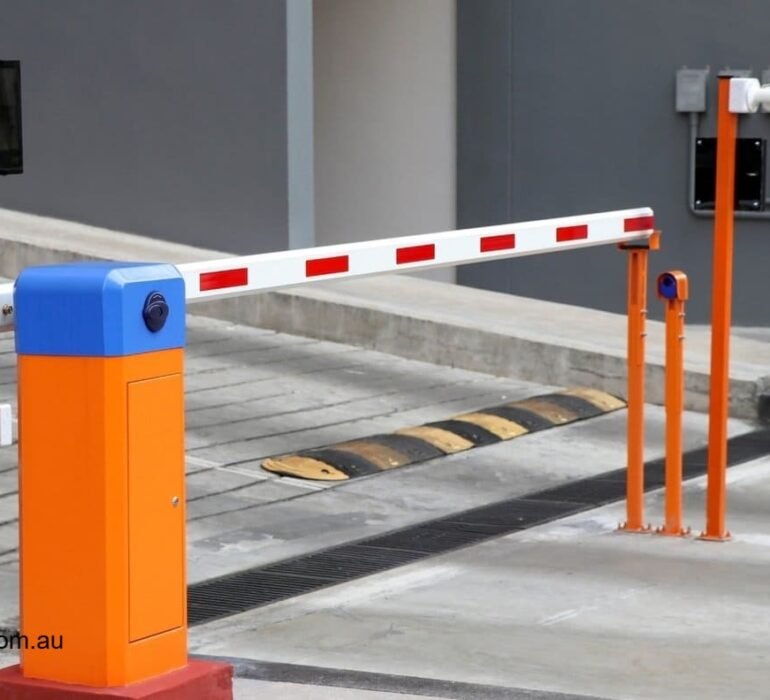
Vehicle exposure is a separate decision layer. If a site has a forecourt, public-facing entrance, high-speed approach, valuable stock near a driveway, or staff working near powered mobile plant, the fence decision should include traffic separation and barrier placement. WorkSafe Victoria guidance on traffic management emphasizes identifying traffic hazards, consulting workers, assessing risks, and using barriers or containment fences to separate people from powered mobile plant where appropriate [6]. The Australian Government’s Hostile Vehicle Guidelines also emphasize separating vehicle and pedestrian spaces, considering passive barriers, and assessing vehicle dynamics before selecting barriers [7].
Use crime data carefully
Local risk should be verified, not assumed. ABS crime victimisation data provides a general backdrop for break-ins and attempted break-ins, but it is not a direct measure of commercial fencing risk [10]. For business-facing context, RACV’s Victorian crime reporting highlights retail crime trends and lists practical small-business security measures such as CCTV, locks, safes, alarms, lighting, and bollards [11]. Use this type of evidence as a prompt to review the site’s actual losses, suburb exposure, access points, and operating hours, not as a shortcut to overbuild the perimeter.
Common mistakes to avoid
- Choosing the strongest-looking fence before mapping the site’s actual risk.
- Blocking visibility with a solid fence when surveillance, CCTV, or passing visibility is part of the security plan.
- Spending on anti-climb mesh while leaving gates, hinges, latches, end stops, or locks weak.
- Ignoring vehicle exposure when the real risk is a driveway, loading bay, forecourt, or public-facing entrance.
- Installing temporary fencing that is unstable, easy to climb, or vulnerable to wind load.
- Treating council checks as an afterthought after height, frontage, or corner visibility decisions have already been made.
What to ask for in a commercial fencing quote
- Site risk summary: assets, access points, operating hours, known incidents, and vehicle exposure.
- Proposed security level: Level 1, 2, 3, or 4, with a reason for that level.
- Fence system: material, height, posts, mesh or panel type, anti-climb features, and visibility impact.
- Gate system: sliding or swing gates, hinges, latches, locks, end stops, automation, manual release, and emergency access.
- Integrated controls: lighting, CCTV, alarms, access control, bollards, signage, and response process.
- Compliance checks: relevant standards, council/planning requirements, WorkSafe considerations, and traffic separation.
- Maintenance plan: inspection frequency, repair responsibilities, and who checks locks, gates, and hardware after installation.
What to Keep in Mind
- Do not buy commercial security fencing by product name alone.
- Define the risk first, then choose the lowest practical security level that controls it.
- Treat gates, lighting, visibility, access control, and vehicle barriers as part of the same perimeter decision.
- Check council and safety constraints before installation, especially for frontage, corners, temporary works, traffic paths, and vehicle exposure.
- Ask every contractor to explain why their proposed fence level is enough, what it does not solve, and what must be maintained after installation.
References
- Victoria Police, “Business premises security,” Victoria Police. Accessed: Apr. 29, 2026. [Online]. Available: https://www.police.vic.gov.au/securing-business-premises
- ADACS Security, “Security Fencing and Access Control. The Ultimate Guide to Perimeter Protection,” ADACS Security. Accessed: Apr. 29, 2026. [Online]. Available: https://adacs.com.au/security-fencing-access-control-perimeter-protection-guide/
- Standards Australia, “AS 1725.1-2010 Chain link fabric fencing, Part 1: Security fences and gates – General requirements,” Standards Catalogue. Accessed: Apr. 29, 2026. [Online]. Available: https://www.standards.org.au/standards-catalogue/standard-details?designation=as-1725-1-2010
- Victorian Department of Transport and Planning, “6.4 Barriers and fences,” Urban Design Guidelines for Victoria. Accessed: Apr. 29, 2026. [Online]. Available: https://www.planning.vic.gov.au/guides-and-resources/guides/urban-design-guidelines-for-victoria/objects-in-the-public-realm/barriers-and-fences
- WorkSafe Victoria, “Construction site security fencing,” WorkSafe Victoria. Accessed: Apr. 29, 2026. [Online]. Available: https://www.worksafe.vic.gov.au/construction-site-security-fencing
- WorkSafe Victoria, “Metal fabrication: Improving safety through traffic management layout and design,” WorkSafe Victoria. Accessed: Apr. 29, 2026. [Online]. Available: https://www.worksafe.vic.gov.au/metal-fabrication-improving-safety-through-traffic-management-layout-and-design
- Australian Government, “Hostile Vehicle Guidelines for Crowded Places,” National Security. Accessed: Apr. 29, 2026. [Online]. Available: https://www.nationalsecurity.gov.au/crowded-places-subsite/Files/hostile-vehicle-guidelines-crowded-places.pdf
- State Government of Victoria, “Fencing in Victoria,” vic.gov.au. Accessed: Apr. 29, 2026. [Online]. Available: https://www.vic.gov.au/fencing-victoria
- City of Kingston, “Fencing permits,” City of Kingston. Accessed: Apr. 29, 2026. [Online]. Available: https://www.kingston.vic.gov.au/property/planning-and-building/do-I-need-a-planning-or-building-permit/fencing/fencing-permits
- Australian Bureau of Statistics, “Crime victimisation, 2024-25 financial year,” Australian Bureau of Statistics. Accessed: Apr. 29, 2026. [Online]. Available: https://www.abs.gov.au/statistics/people/crime-and-justice/crime-victimisation/latest-release
- RACV, “Burglary, car theft and retail crime rises across Victoria,” RACV RoyalAuto. Accessed: Apr. 29, 2026. [Online]. Available: https://www.racv.com.au/royalauto/property/safety-security/crime-rates-in-victoria.html
- JFG Commercial and Industrial Fencing, “Commercial Fencing Melbourne,” JFG Commercial and Industrial Fencing. Accessed: Apr. 29, 2026. [Online]. Available: https://jfgcommercialandindustrialfencing.com.au/commercial-fencing-near-me/commercial-fencing-melbourne/
- RJL Commercial Fencing and Gates (VIC) Pty Ltd, “Commercial Fencing Solutions,” RJL Commercial Group. Accessed: Apr. 29, 2026. [Online]. Available: https://www.rjlcommercialgroup.com/commercial-fencing-solutions
- Lee Group, “Standard Chain Link Fences,” Lee Group. Accessed: Apr. 29, 2026. [Online]. Available: https://leebrosfencing.com.au/commercial-industrial-fencing-products/chain-link-fences/standard-chain-link-fences/