
Table of Contents
Why timber fencing is easy to specify incorrectly
- You choose timber because it looks familiar without defining whether the boundary needs privacy, presentation, temporary separation, access control or genuine high-security performance.
- You compare a basic paling-fence rate with a project that actually requires hardwood feature boards, capped posts, retaining interfaces, difficult access or custom gates.
- You specify the same fence for a public frontage, residential side boundary, construction edge and restricted industrial compound even though each zone has different visibility and security needs.
- You focus on palings or boards but leave posts, in-ground durability, drainage, cut-end treatment, coatings and maintenance undefined.
- You add pedestrian or vehicle gates after the fixed fence has been designed, creating mismatched frames, clearances, privacy gaps or automation requirements.
Key Takeaways
- Timber fencing is a practical shortlist option when boundary definition, privacy, adaptable design and a natural appearance matter more than specialist anti-climb or forced-entry resistance.
- Commercial timber fencing Melbourne projects commonly fit developments, service areas, mixed-use sites and lower-risk boundaries where the fence needs to screen or separate rather than act as the site’s primary security barrier.
- Residential timber fencing Melbourne projects can use paling, picket, board-and-batten or feature-board layouts depending on privacy, streetscape and maintenance priorities.
- Timber service life depends on more than the species name. Exposure, preservative treatment, detailing, moisture management, finishes and scheduled maintenance all affect durability [2] [3].
- For a complete quote, define the fixed fence, gates, slopes, existing-fence removal, access restrictions, finishing and handover requirements together.
What is timber fencing?
Timber fencing normally uses posts fixed into the ground, horizontal rails and vertical or horizontal palings, pickets or boards. Common forms include traditional paling fences, decorative picket fences, open board fences, horizontal feature fences and board-and-batten privacy designs. WoodSolutions notes that the selected style should follow the application and aesthetics, while durability is particularly important for posts because of their exposure to moisture in the ground [2].
The term therefore covers more than one product. A quote for timber boundary fencing should identify the timber type or treatment, post and rail sizes, board or paling arrangement, finished height, gaps, plinths, capping, coatings, gates and treatment of slopes or retaining conditions.
Best fit and not-best-fit table
This table routes timber by site requirement and prevents it from being positioned as the universal answer for every boundary.
| Site or requirement | When timber is a strong fit | When it is not the best fit | Next check |
|---|---|---|---|
| Residential side or rear boundary | The priorities are visual privacy, familiar appearance, adaptable height and straightforward integration with gardens or neighbouring fences. | The owner expects very low maintenance or the exposure and drainage conditions are unsuitable for the proposed timber and detailing. | Confirm the boundary, neighbour process, treatment level, ground clearance, finish and maintenance plan. |
| Residential or mixed-use frontage | Picket, batten or spaced-board styles can define the frontage while retaining some visibility and architectural character. | A tall solid wall would block important driveway, pedestrian or street sightlines. | Review fence height, transparency, gate movement, corner visibility and local planning controls. |
| Commercial development or service boundary | The fence needs to screen bins, plant, back-of-house activity or a lower-risk edge while fitting a landscaped or mixed-material design. | The site needs high-cycle vehicle access, specialist anti-climb performance or minimal ongoing finish maintenance. | Map gates, waste access, fire and service clearances, landscaping, loading paths and future modifications. |
| Construction or subdivision boundary | A purpose-built timber fence forms part of the permanent works or the project requires a robust visual screen that can be staged with the development. | A changing worksite needs a proprietary relocatable temporary-fencing system or a security solution designed specifically to control unauthorised entry. | Separate permanent boundary scope from temporary site-security obligations and construction sequencing. |
| Warehouse or industrial side boundary | The boundary primarily needs screening from neighbours, separation of a lower-risk yard or a softer finish beside offices and landscaping. | The fence protects high-value assets, must maintain CCTV visibility or needs strong anti-climb and tamper-resistant construction. | Use a mixed perimeter where timber screens selected areas and steel or mesh protects higher-risk zones. |
| Acoustic or retaining requirement | Only where the proposed system has a suitable project-specific design for the required function. | A standard timber fence is being assumed to provide certified acoustic performance or retain soil without engineering. | Separate the fence, acoustic and retaining scopes and request evidence for each required performance outcome. |
Timber style and use-case matrix
The visual style changes privacy, visibility, maintenance access and project cost. The actual dimensions and construction still need to be documented by the contractor.
| Style | Typical boundary outcome | Strong use cases | Specification check |
|---|---|---|---|
| Timber paling | Practical visual screening using vertical palings fixed to rails and posts. | Residential side and rear boundaries, development lots and lower-risk commercial screening. | Paling overlap or gaps, treatment, rails, plinth, capping, ground clearance and slope treatment. |
| Timber picket | Lower or partially open frontage with visible spacing and a traditional or decorative presentation. | Homes, heritage-style frontages, childcare or community settings where visibility is intentionally retained and project requirements permit. | Height, picket spacing, top profile, gate match, finish and public-facing safety. |
| Board and batten | Solid or near-solid architectural screen with battens covering board joints. | Feature residential boundaries, mixed-use developments, hospitality areas and selected commercial screens. | Board movement, ventilation, fixings, coating system, rear-face appearance and moisture shedding. |
| Horizontal or spaced boards | Contemporary linear appearance with privacy and airflow controlled by board spacing. | Frontages, courtyards, office landscaping and feature sections within a mixed perimeter. | Board span, movement, gaps, climbable horizontal elements, framing and gate continuity. |
| Hardwood feature fence | Premium natural appearance where grain, colour and architectural finish are central to the brief. | Residential frontages, apartments, offices and mixed-use developments. | Species suitability, sourcing, movement, tannin or finish considerations, fixings and maintenance expectations. |
Commercial and industrial boundary uses
Timber works best in commercial and industrial projects when the brief is explicit about what the fence is expected to do. It can screen service yards, define landscaped edges, separate development stages, enclose lower-risk operational areas or provide a natural-material frontage beside offices and customer areas.
It should not be described as the main high-security solution for every industrial boundary. Where the site needs clear surveillance, strong anti-climb performance, tamper-resistant fixings or protection of high-value assets, steel palisade, weldmesh or another security-specific system may be more appropriate. A mixed perimeter can use timber where visual screening is useful and security fencing where risk is higher.
When comparing a timber fencing contractor in Melbourne, scope the project by site zone rather than only by total metres. Vehicle access, pedestrian entries, loading routes, waste collection, landscaping, temporary works and future site changes can materially affect the fence and gate package.
Residential boundaries and neighbour coordination
Timber paling remains a familiar option for residential side and rear boundaries, while picket and feature-board styles can suit front fences and visible courtyards. In Victoria, a dividing fence is generally treated as joint property, and what counts as a sufficient dividing fence depends on matters such as existing fences, land use, reasonable privacy and security concerns, and common fence types in the area [4].
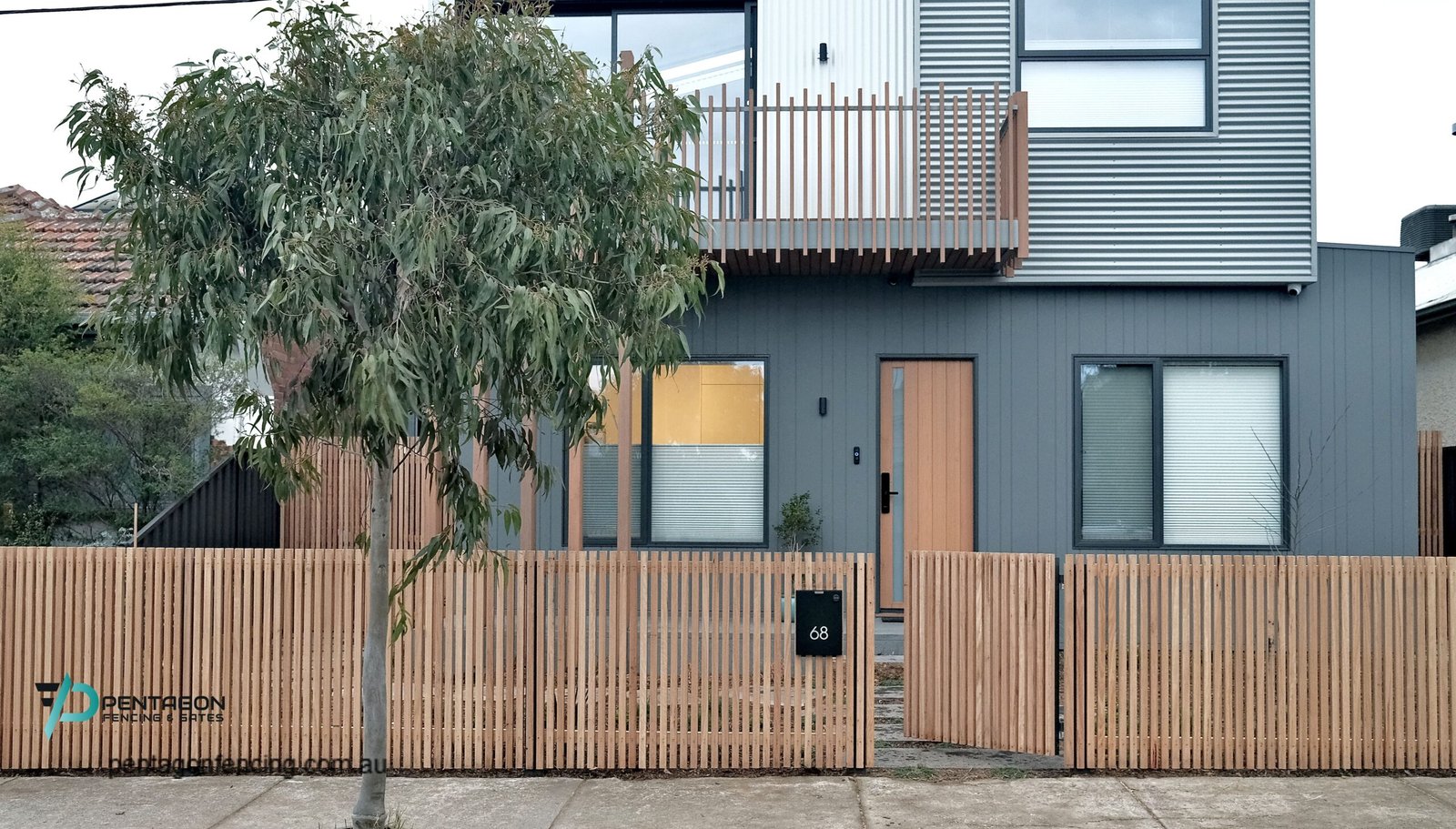
Before replacing or building a shared boundary, confirm the fence line, proposed construction, quote, contribution and access arrangements with the adjoining owner. The Victorian Fencing Notice process records the proposed line, works, contractor, cost estimate and contributions when a formal notice is required [5].
This article provides project-planning guidance rather than legal advice. Owners should check the current Victorian guidance and obtain advice where a boundary or cost-sharing dispute cannot be resolved.
Fence height, planning and building checks
Permit requirements vary with the council area, property controls, fence location, material and height. City of Kingston guidance, for example, distinguishes side and rear timber or steel fences below 2 metres from taller fences, front fences and corner-site fences, and also advises owners to check title restrictions and planning controls [6]. Other Melbourne councils may apply different planning-scheme or report-and-consent processes.
- Check whether the fence is on a front, side, rear or corner boundary.
- Measure total height from the relevant ground level, including lattice, screens or a fence above a retaining element.
- Review the title, covenants, easements, overlays and any existing planning permit.
- Confirm whether the fence forms part of a pool barrier, public interface, fire path or other regulated system.
- Verify requirements with the relevant council and a registered building professional where needed before fabrication.
Construction site timber fencing: permanent boundary or temporary control?
The phrase construction site timber fencing can refer to a permanent timber boundary installed during development, a visual hoarding-style screen or a temporary security control. These are not interchangeable scopes.
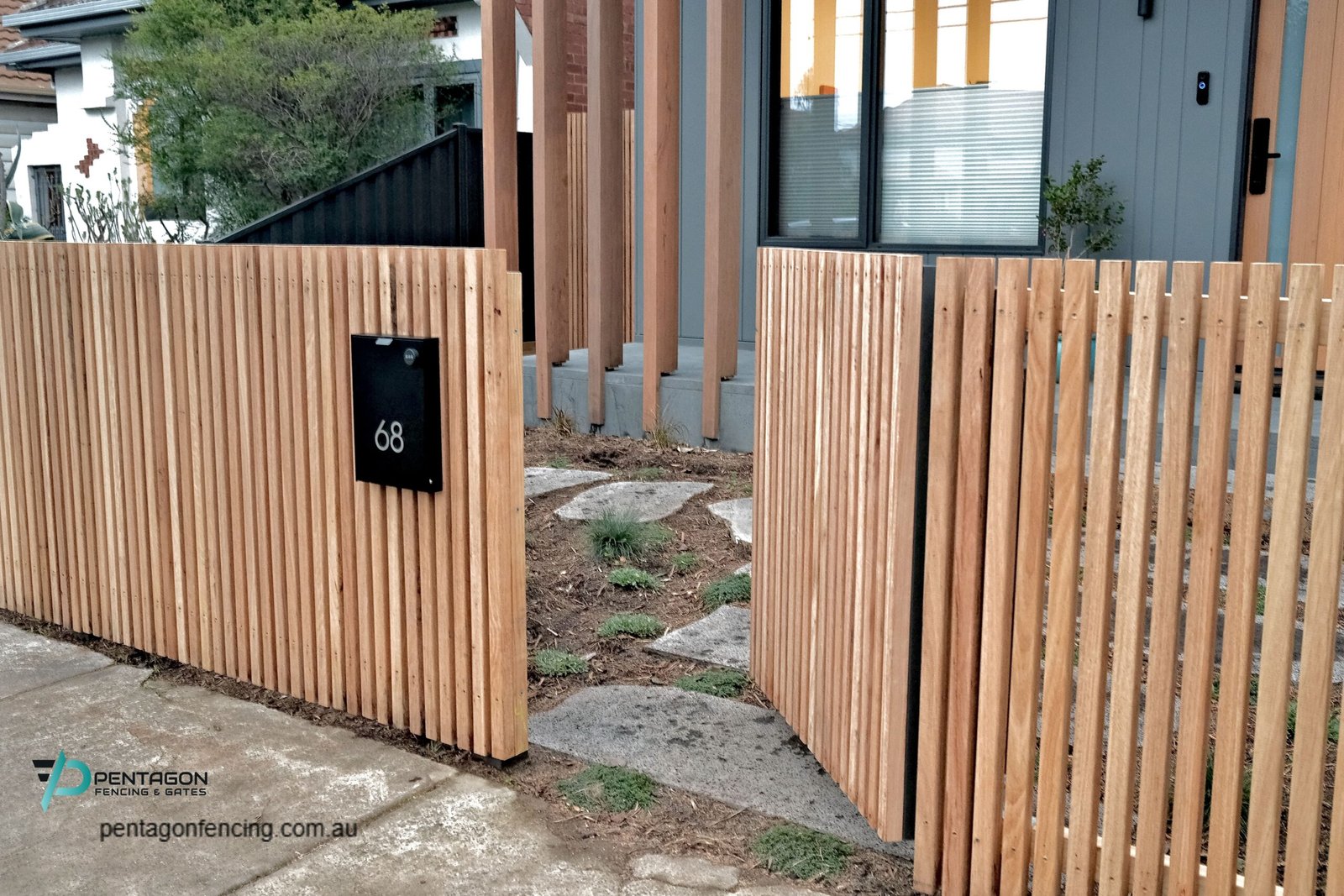
WorkSafe Victoria states that construction-site security fencing used to control unauthorised entry should be well constructed, stable under anticipated loads, difficult to climb, resistant to access underneath and secure at gates and joints [7]. A timber fence proposed for a live construction site must therefore be assessed against the actual safety and security function, not accepted simply because it is solid.
- Clarify whether the fence is temporary, permanent or part of the final development works.
- Identify changing vehicle entries, deliveries, excavations, public paths and after-hours access risks.
- Do not attach signs, screens or coverings without reviewing additional wind loading and support.
- Keep gates, corners, joints and ground gaps from becoming weaker than the main fence line.
- Plan inspection, repair and staged relocation throughout the construction program.
Privacy, street appeal and visibility trade-offs
Solid paling or board-and-batten fencing can improve privacy, while pickets and spaced boards retain more visual connection. The appropriate balance changes between a backyard, apartment courtyard, customer frontage, school edge, driveway and public path.
Planning Victoria recommends low or partially transparent fence types along street frontages or public spaces where informal surveillance is important [8]. For a timber front fence, check whether the proposed height and board spacing preserve safe views between driveways, footpaths, entries and the street.
A site can use more than one timber treatment or combine timber with aluminium, tubular steel, weldmesh or masonry. Mixed materials can preserve privacy at selected zones without making the entire frontage visually closed.
Choosing timber, treatment and detailing
Timber selection should respond to the exposure and component location. WoodSolutions explains that durability is influenced by species properties, exposure conditions, preservative treatment, design detailing and maintenance. Moisture, fungi, termites and ultraviolet exposure are among the hazards that need to be considered [3].
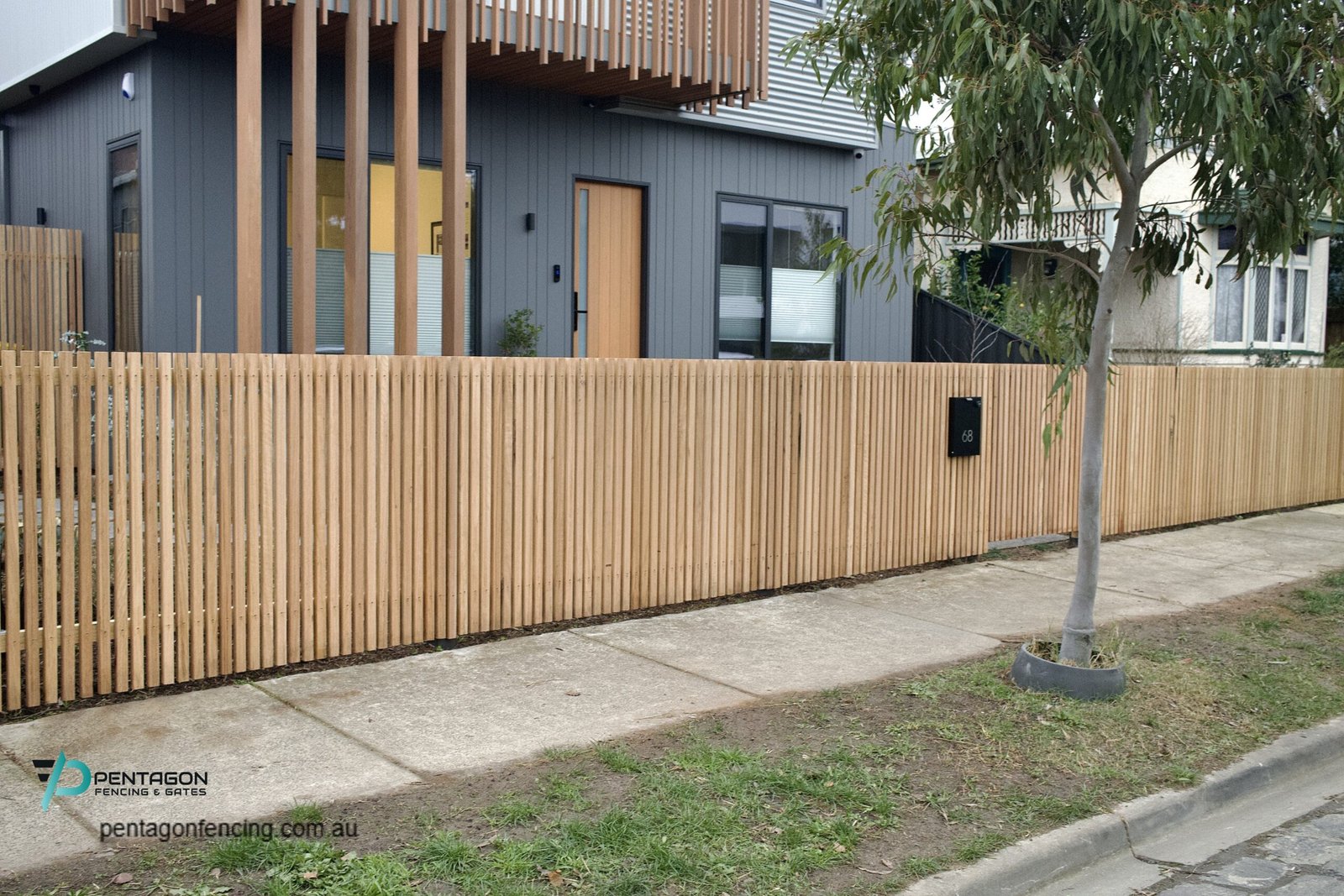
Its fencing guidance distinguishes in-ground components such as posts and plinths from above-ground rails and palings, and notes that preservative treatment and appropriate protection of cuts and joints are important in timber fence construction [2].
- Posts: confirm whether they are naturally durable, preservative treated, embedded or fixed to a designed base, and suitable for the soil and moisture exposure.
- Rails and palings: define treatment or species, dimensions, spans, fixing method and clearance from soil or persistent moisture.
- Cut ends and penetrations: document treatment and sealing requirements after on-site cutting or drilling.
- Drainage and ventilation: avoid detailing that traps water, soil, mulch or debris against the boards and posts.
- Finish: specify whether the timber will weather naturally, be painted, stained or oiled, and who is responsible for the initial and ongoing applications.
Match timber fencing with gates and access
For a timber fencing and gates project in Melbourne, the fixed boundary should be planned with its openings. A matching gate may use timber infill over a structural frame, and the frame, hinge or sliding system must carry the moving load without relying on fence palings as structural components.
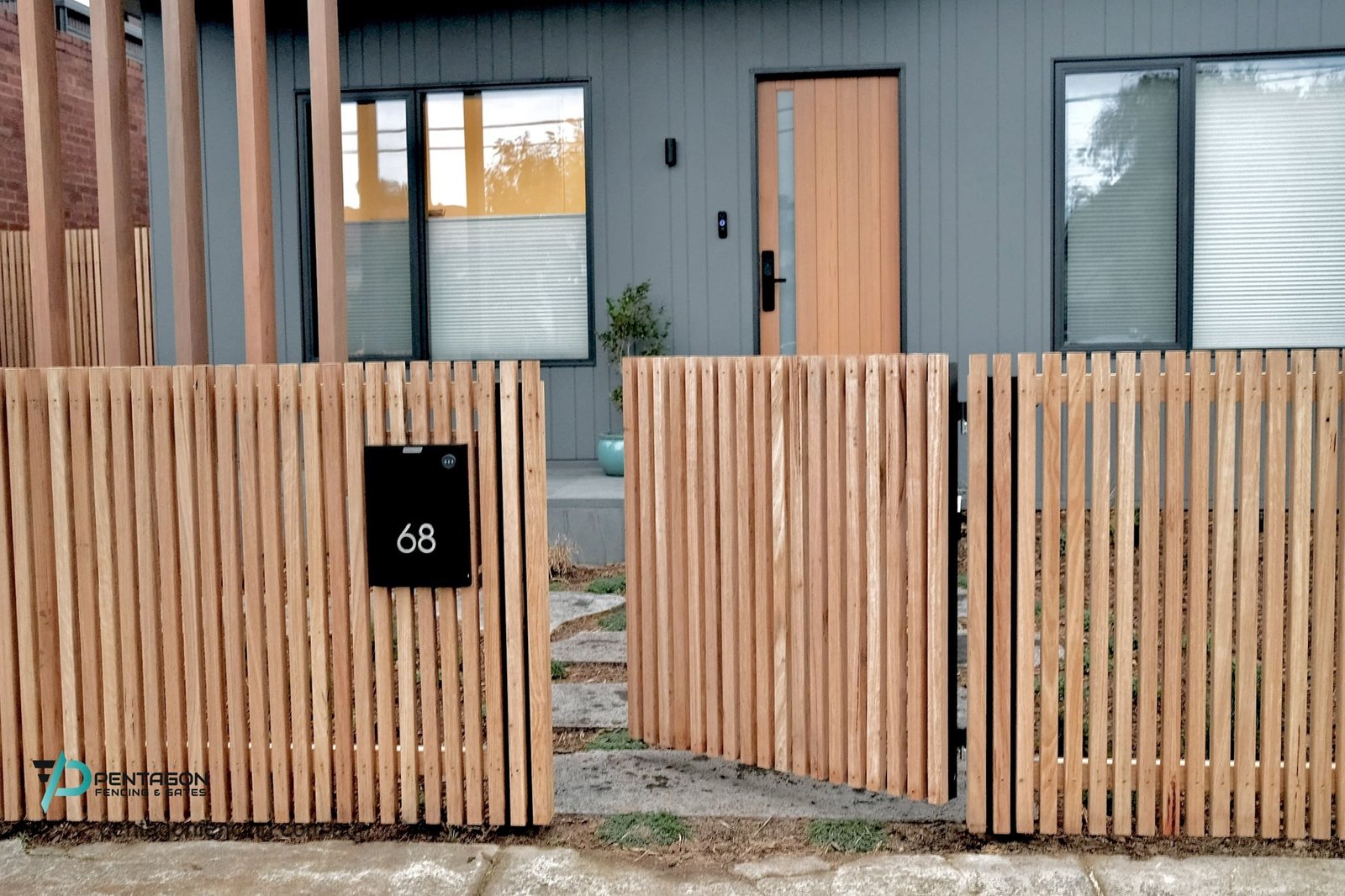
Pentagon offers timber, aluminium, steel and Colorbond side-gate options designed to suit the space, appearance and functional requirements of the property [9]. It also lists timber feature gates within its sliding-gate range and provides automated sliding-gate systems for residential, commercial and industrial projects [10].
- Pedestrian gate: confirm clear opening, latch or lock, self-closing needs, privacy gaps, path levels and post support.
- Swing vehicle gate: assess leaf width, hinge posts, opening arc, slope, wind exposure and clearance from public areas.
- Sliding gate: allow run-off space, a stable support or track detail, guides, stops, motor location and safe pedestrian separation.
- Timber infill: coordinate movement, board spacing, finish and replaceability without compromising the gate frame.
- Access control: define who uses the opening, how often it operates and whether intercom, keypad, remote, vehicle detection or another control is required.
What affects timber fencing cost in Melbourne?
A metre rate is only useful when the same materials, construction and site conditions are being compared. The following factors should be visible in the quote rather than hidden inside a single allowance.
| Cost driver | Effect on the quote | Caveat | Evidence to request |
|---|---|---|---|
| Timber type and treatment | Treated softwood, naturally durable hardwood and feature-grade boards have different material and finishing requirements. | Species name alone does not describe treatment, grade, component exposure or expected maintenance. | Product or species schedule, treatment level, component use and finish specification. |
| Fence style and privacy | Lapped palings, board-and-batten work, feature boards, capping and decorative pickets change material quantities and labour. | Two fences with the same height can have very different board coverage, framing and finishing scope. | Elevation, board or paling dimensions, spacing, overlap, caps and both-face finish. |
| Posts, rails and footings | Height, wind exposure, soil, bay length and gates influence post, rail and footing requirements. | A cheaper board rate can hide lighter support members or optimistic ground assumptions. | Post and rail schedule, centres, footing assumptions and gate-post details. |
| Slope, retaining and drainage | Stepping, custom boards, sleepers, retaining interfaces and drainage protection add design and installation work. | A standard fence must not be assumed to retain soil or obstruct drainage safely. | Level survey, maximum gaps, retaining detail and drainage route. |
| Painting, staining or oiling | Surface preparation, initial coating, multiple faces, cut ends and future recoating add labour and material. | A quote for raw timber is not equivalent to a fully finished and maintained appearance. | Coating product, preparation, number of coats, included faces and maintenance guidance. |
| Existing fence removal | Demolition, old concrete, vegetation, disposal, temporary barriers and neighbour access increase scope. | Unknown footings, services or hazardous materials may require separate assessment. | Removal limits, disposal, exclusions, protection and temporary-boundary plan. |
| Gates and automation | Frames, heavy posts, hinges or sliding hardware, motors, safety devices and access controls are separate from fixed-fence metre rates. | Timber infill can affect gate weight, wind exposure and maintenance without replacing the structural frame. | Opening width, frame, infill, operating method, hardware, controls and electrical scope. |
| Access and staging | Narrow access, occupied properties, commercial operating hours, traffic control and staged construction increase labour. | A photo-based quote may change after services, rock, restricted access or boundary issues are confirmed. | Site measure, work hours, access plan, staging and explicit exclusions. |
Six-step timber fence selection flow
- Define the outcome. Separate privacy, frontage appearance, neighbour separation, construction screening, access control and security requirements.
- Zone the site. Treat the public frontage, side boundary, service yard, construction edge, vehicle entry and higher-risk compound as different decisions.
- Select the style. Compare paling, picket, board-and-batten, spaced boards and feature hardwood by privacy, visibility and architectural fit.
- Lock durability inputs. Specify timber or treatment, posts, rails, ground exposure, moisture detailing, finish and maintenance access.
- Design the openings. Coordinate pedestrian, swing and sliding gates, frames, posts, locks, automation and privacy gaps with the fixed fence.
- Compare equivalent quotes. Require the same removal, site conditions, finish, gate package, approvals and handover scope from each contractor.
Timber fencing project checklist
- Boundary: confirm title information, survey needs, fence line, corners, easements and adjoining-owner arrangements.
- Site purpose: record the privacy, presentation, separation and security requirement for each zone.
- Timber system: identify species or treatment, posts, rails, palings or boards, fixings, caps, plinths and finish.
- Levels: document slopes, retaining walls, drainage paths, soil contact, stepping and maximum bottom gaps.
- Frontage safety: check driveway, pedestrian, corner and public-space sightlines before using a tall or solid design.
- Gates: define openings, frames, posts, hardware, locks, movement, automation and access control.
- Construction stage: plan removal, temporary separation, public protection, pets, deliveries and live-site security.
- Approvals: allocate responsibility for council checks, building or planning permits, neighbour notices and project-specific requirements.
- Handover: obtain material and coating information, keys or credentials, gate instructions, maintenance intervals and repair guidance.
Maintenance and inspection
A timber fence should be inspected as an outdoor assembly rather than treated as a finish-only feature. WoodSolutions recommends appropriate finishes, timber treatments and regular maintenance, and advises keeping fences free of debris that can trap moisture or encourage termite activity [2].
- Keep soil, mulch, vegetation and stored materials from holding moisture against palings, rails and posts.
- Check for loose fixings, split boards, movement, leaning posts, damaged caps and persistent wet areas.
- Inspect cut edges, gate frames and high-contact areas where coatings or timber can be damaged.
- Clean and renew paint, stain or oil according to the selected product and exposure rather than waiting for widespread deterioration.
- Repair local damage early and investigate the moisture, impact or movement that caused it.
Common mistakes to avoid
- Positioning timber as a universal security fence. Route higher-risk perimeters to purpose-designed steel or mesh systems.
- Specifying only the visible boards. Posts, rails, treatments, footings, drainage and fixings determine whether the fence remains serviceable.
- Ignoring the difference between permanent and temporary site fencing. A construction site needs controls matched to changing hazards and unauthorised-entry risk.
- Closing every frontage for privacy. Preserve required views at streets, paths, corners, driveways and monitored entries.
- Comparing unequal metre rates. Timber grade, overlap, finish, removal, slope, gates and access can make two quotes fundamentally different.
- Leaving maintenance undefined. Agree who applies the first finish, which surfaces are included and how future inspection and recoating will be handled.
How Pentagon Fencing can help
Pentagon Fencing & Gates installs timber fencing and gate solutions for commercial, industrial, construction and residential projects across Melbourne [1].
- Compare paling, picket and feature timber options against the site’s privacy, presentation, durability and security needs.
- Coordinate the fixed boundary with pedestrian gates, vehicle gates, sliding systems and access-control requirements.
- Prepare a site-specific scope covering materials, levels, removal work, staging, finishing and installation constraints.
FAQ
Is timber fencing suitable for commercial and industrial sites?
Yes, where the main purpose is boundary definition, screening, development staging or architectural presentation. A high-risk perimeter may need weldmesh, palisade or another security-specific system instead of relying on timber alone.
What timber fence style provides the most privacy?
Closely fitted paling, lapped paling and board-and-batten designs generally provide more visual screening than pickets or widely spaced boards. Privacy still depends on gates, slopes, bottom gaps and transitions.
Can timber fencing include matching gates?
Yes. Timber can be used as infill for pedestrian, swing and sliding gates. The structural frame, support posts, hardware, movement and automation should be designed with the fence rather than added later.
Does a timber fence require maintenance?
Yes. Inspection, moisture control, cleaning, repairs and renewal of the selected finish help protect appearance and serviceability. The maintenance plan should match the timber, treatment, coating and site exposure.
Do I need a permit for timber fencing in Melbourne?
Requirements depend on the council, fence location, height, site controls and intended use. Check the current council, title, planning and building requirements before fabrication, particularly for front, corner, tall, pool or non-standard fences.
What to Keep in Mind
- Use timber where privacy, adaptable design and natural presentation fit the site, not as a default high-security solution.
- Specify posts, treatment, drainage, finish and maintenance with the same care as the visible palings or boards.
- Separate residential, commercial, construction and industrial site zones before choosing one style for the entire boundary.
- Plan gates, access control, removal work, levels and approvals before comparing contractor quotes.
- Check Victorian boundary, council and site-safety requirements before installation starts.
References
- Pentagon Fencing, “Commercial and Residential Timber Fencing,” Pentagon Fencing & Gates. Accessed: Jun. 18, 2026. [Online]. Available: https://pentagonfencing.com.au/service/commercial-and-residential-timber-fencing/
- WoodSolutions, “Fencing,” WoodSolutions. Accessed: Jun. 18, 2026. [Online]. Available: https://www.woodsolutions.com.au/applications-products/exterior/fencing
- WoodSolutions, “Durability Guide,” WoodSolutions. Accessed: Jun. 18, 2026. [Online]. Available: https://www.woodsolutions.com.au/timber-wiki/durability-guide
- State Government of Victoria, “Fencing in Victoria,” vic.gov.au. Accessed: Jun. 18, 2026. [Online]. Available: https://www.vic.gov.au/fencing-victoria
- State Government of Victoria, “Fencing Notice,” vic.gov.au. Accessed: Jun. 18, 2026. [Online]. Available: https://www.vic.gov.au/fencing-notice
- City of Kingston, “Fencing Permits,” City of Kingston. Accessed: Jun. 18, 2026. [Online]. Available: https://www.kingston.vic.gov.au/property/planning-and-building/do-I-need-a-planning-or-building-permit/fencing/fencing-permits
- WorkSafe Victoria, “Construction Site Security Fencing,” WorkSafe Victoria. Accessed: Jun. 18, 2026. [Online]. Available: https://www.worksafe.vic.gov.au/construction-site-security-fencing
- Department of Transport and Planning Victoria, “6.4 Barriers and Fences,” Planning Victoria. Accessed: Jun. 18, 2026. [Online]. Available: https://www.planning.vic.gov.au/guides-and-resources/guides/urban-design-guidelines-for-victoria/objects-in-the-public-realm/barriers-and-fences
- Pentagon Fencing, “Side Gate,” Pentagon Fencing & Gates. Accessed: Jun. 18, 2026. [Online]. Available: https://pentagonfencing.com.au/service/side-gate/
- Pentagon Fencing, “Sliding Gate Automation in Melbourne,” Pentagon Fencing & Gates. Accessed: Jun. 18, 2026. [Online]. Available: https://pentagonfencing.com.au/service/sliding-gates/