
Table of Contents
Why double swing gates are easy to specify incorrectly
- You choose two hinged leaves for a wide opening without checking whether trucks, forklifts, parked vehicles, pedestrians or landscaping will occupy the swing arc.
- You treat a driveway gate, commercial gate and industrial gate as the same product even though the frame, posts, hinges, motors and duty cycle can be very different.
- You compare swing gates only against sliding gates without defining the real issue: available space, operating frequency, access control, visibility, wind exposure and maintenance.
- You automate the gate without first mapping crush zones, hinge-side gaps, manual release, emergency access and safety-device placement.
- You leave the pedestrian access point out of the design, forcing staff, visitors or residents to use the same vehicle gate.
Key Takeaways
- Double swing gates Melbourne projects are strongest where a site has enough inward or outward arc, moderate-to-controlled traffic and a preference for a hinged entry rather than a track or cantilever system.
- Commercial swing gates can suit office entries, low-to-medium traffic business parks, car parks, institutional sites and customer-facing boundaries where appearance and controlled access matter.
- An industrial double swing gate is usually considered when a wider opening is needed than a practical single leaf can provide. National Entrance Systems describes dual-leaf swing gates as common for warehouse entries, logistics yards, factory perimeters and industrial estates where vehicle widths require a larger clear opening [2].
- Automated swing gates Melbourne projects need safety, motor duty, gate weight, wind load, manual release and maintenance planned together. HSE states that powered gate risks should be managed through design, risk assessment, construction, user instructions and routine maintenance [3].
- For high-frequency truck sites where the swing arc or wait time becomes a bottleneck, route the entry to a sliding or cantilever gate review rather than forcing a hinged solution.
What is a double swing gate?
A double swing gate uses two hinged leaves that meet near the centre of the opening. Each leaf swings inward or outward from its own hinge post. The design spreads the opening across two shorter leaves, which can reduce the size and weight each hinge and motor must handle compared with one very wide single leaf.
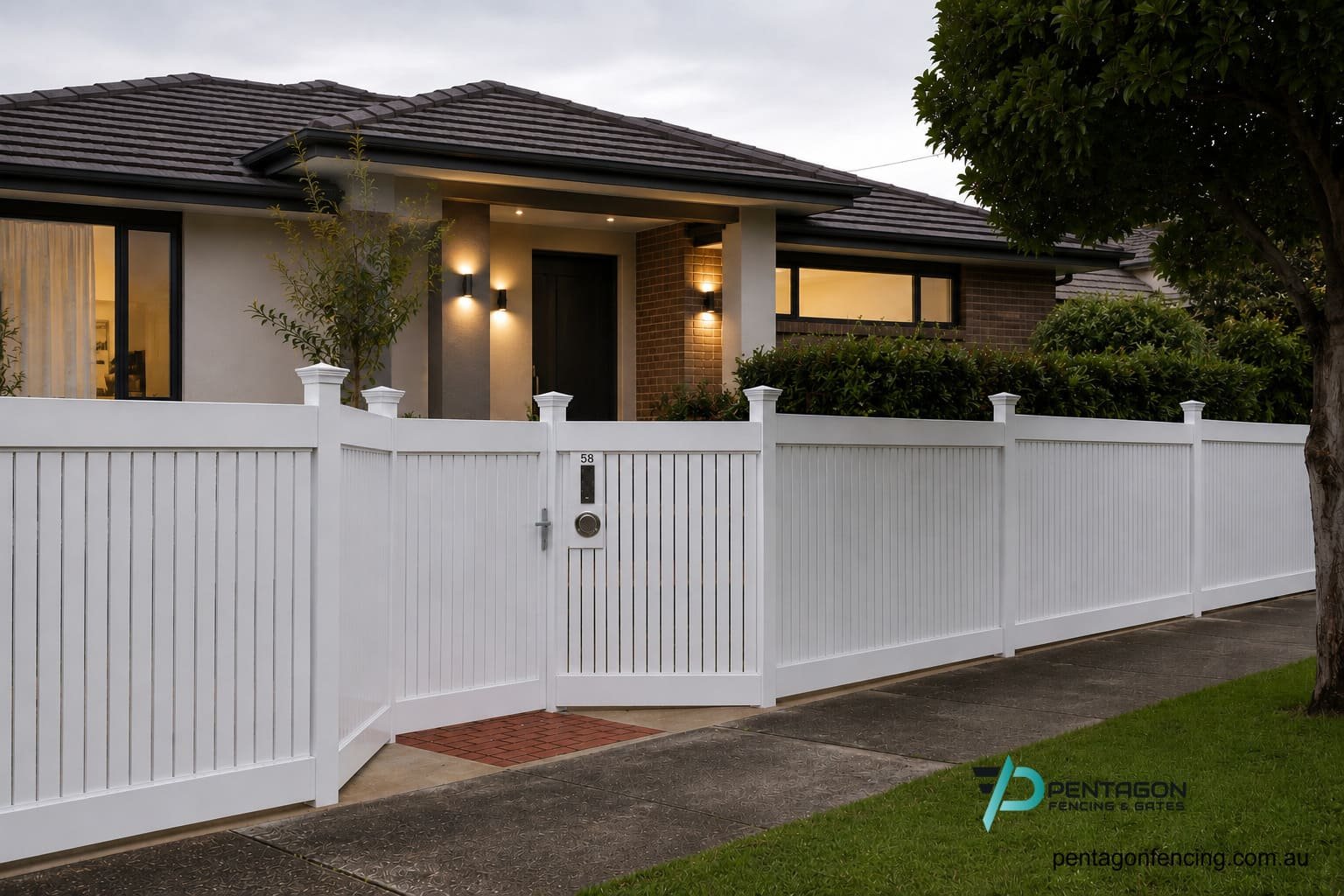
A double-leaf system can be manual or automated. It can use steel, aluminium, timber, COLORBOND® steel, weldmesh, vertical bars, palisade-style infill, slats or other materials depending on the adjacent fence and risk level. Pentagon lists aluminium, steel, timber and COLORBOND® steel swing-gate options for commercial, industrial and residential applications [1].
The quote should define the clear opening, total leaf widths, hinge posts, gate frame, infill, finish, hinge type, drop bolts or centre stop, ground clearance, swing direction, pedestrian access, automation, safety devices and access-control equipment.
When double swing gates make sense
This table maps the gate type to actual site conditions rather than presenting swing gates as the universal answer.
| Site condition | Why double swing can work | When to avoid or review | Next check |
|---|---|---|---|
| Wide driveway or industrial entry | Two leaves can create a wider opening than a single swing leaf while keeping each leaf easier to frame, hinge and automate. | The entry has heavy truck queues, limited stopping distance or no safe clear zone for the gate arc. | Check swept paths, leaf width, hinge post capacity, centre meeting detail and opening time. |
| Commercial frontage or business park | A hinged pair can provide a formal entry appearance, controlled access and material continuity with the front fence. | Visitor vehicles would wait across a footpath or street while the gate opens. | Plan intercom, keypad, stopping area, signage, lighting and pedestrian route. |
| Residential driveway | Double leaves can reduce individual leaf span and suit traditional, architectural or matching-fence designs. | The driveway is steep, short, exposed to strong wind or used for frequent visitor turnover. | Confirm swing direction, driveway grade, parking position, manual release and council/front-fence constraints. |
| School, childcare, healthcare or community site | A swing gate can control vehicle access at selected service or staff entries where pedestrian access is separately planned. | Children, visitors or patients may cross the moving-gate zone, or the open leaves obstruct paths. | Separate pedestrian gates, queuing areas, sightlines, emergency access and supervised access procedures. |
| Low-speed service yard | A manually operated or automated pair can control occasional deliveries without requiring a ground track. | Plant, bins, pallets or parked vehicles are likely to block the swing area. | Mark the swing envelope and keep it clear through site rules and physical layout. |
Single, double and pedestrian gate comparison
The terms sound simple, but each gate type solves a different access problem.
| Gate type | Typical use | Strength | Main risk | Specification check |
|---|---|---|---|---|
| Single swing gate | Narrower driveway, side access, smaller commercial entry or controlled service opening. | Simple hinged movement, one leaf, one hinge side and fewer coordinated moving parts. | A wide single leaf can become heavy, wind-affected and harder to support. | Leaf width, weight, hinge post, opening arc, latch side and automation arm geometry. |
| Double swing gate | Wider industrial, commercial or residential opening where two leaves are more practical than one large leaf. | Shares the opening across two leaves and creates a centred entry presentation. | Needs two clear swing arcs, centre alignment, hold-open control and coordinated automation if powered. | Leaf sequencing, centre stop, drop bolts, hinge-post capacity, wind load and safety devices. |
| Pedestrian swing gate | Staff, visitors, students, residents or maintenance access separated from the vehicle opening. | Reduces the need for people to walk through a moving vehicle gate. | Can become a weak point if latch, closer, hinges, access control and emergency release are not planned. | Clear width, latch, closer, lock, access-control hardware, path levels and after-hours policy. |
| Swing vehicle gate plus separate pedestrian gate | Sites where people and vehicles enter at the same boundary but should not share the same opening. | Improves access control and keeps the main vehicle gate closed more often. | Requires coordinated credentials, lighting, signage, CCTV and emergency access. | User groups, access hours, visitor process, egress path and gate monitoring. |
Industrial and commercial swing-gate use cases
In industrial settings, a double swing gate is most suitable where access is controlled, vehicle movements are predictable and the gate can open without obstructing loading, turning, queuing or pedestrian routes. It can work at factory perimeters, service yards, low-speed depots, controlled equipment compounds and formal entries where sliding run-back is not available or not desired.
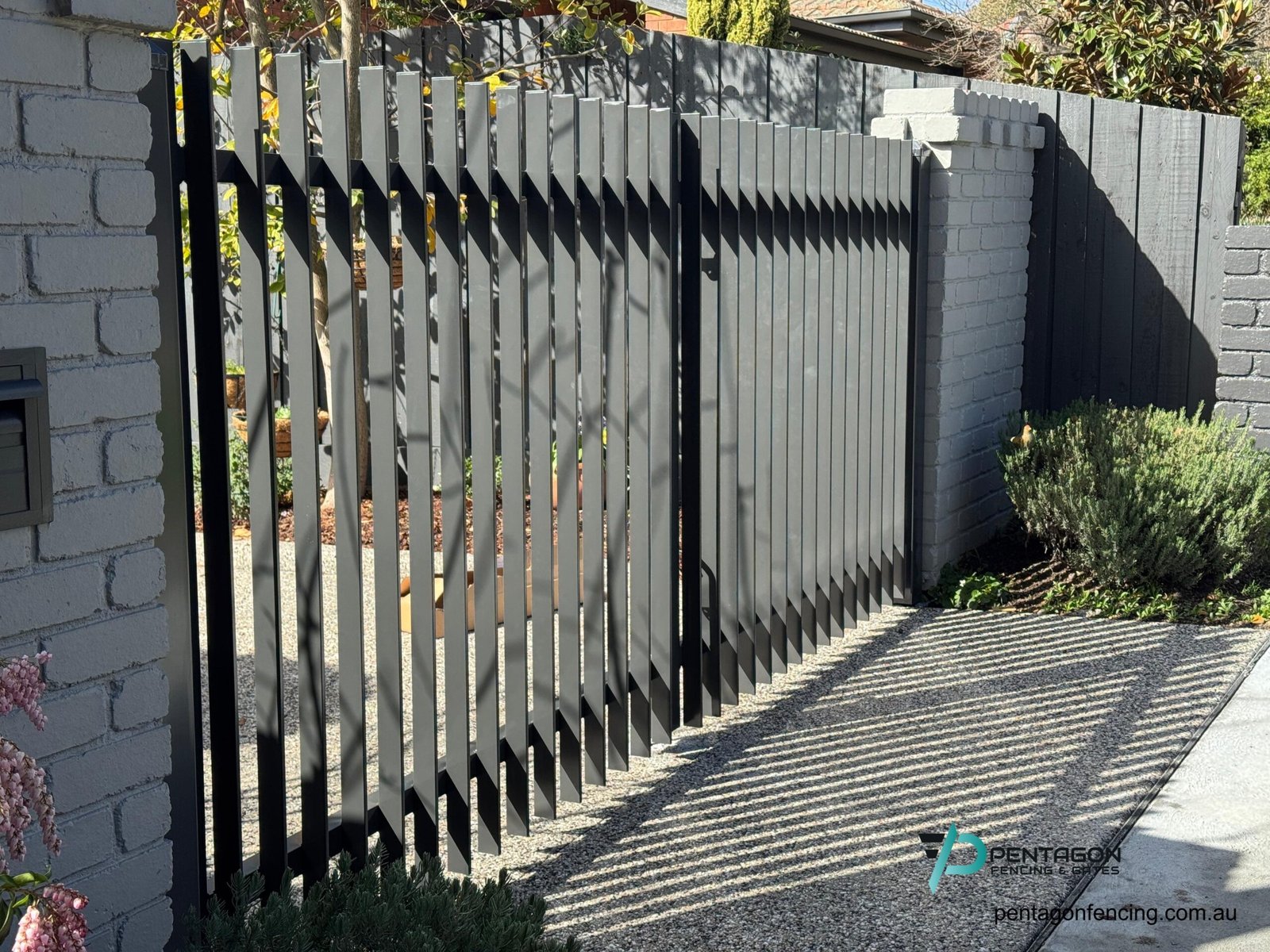
For commercial swing gates, the strongest fit is often a frontage or car-park entry that needs controlled vehicle access and a design that matches the fence, building or landscape. The gate can be manual, remote-controlled, keypad-operated, intercom-integrated or tied into a broader access-control system.
Where a site is genuinely high-traffic, the swing gate should be assessed carefully. Pentagon’s own swing-gate page describes commercial swing gates as needing to perform under constant use, wide openings, large vehicle access and daily wear [1]. If the entry cannot tolerate the opening time, arc clearance or vehicle waiting area, a sliding or cantilever design may be the more practical route.
Residential and mixed-use applications
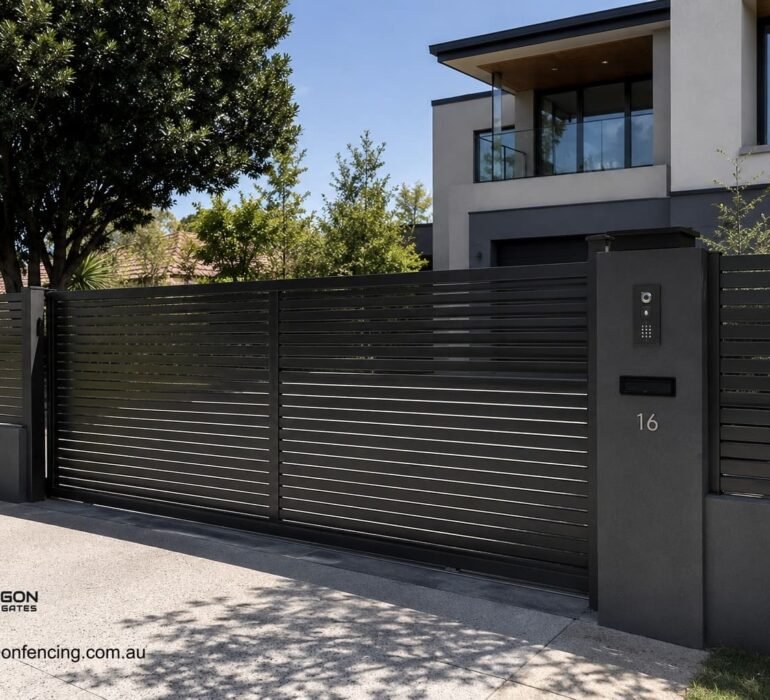
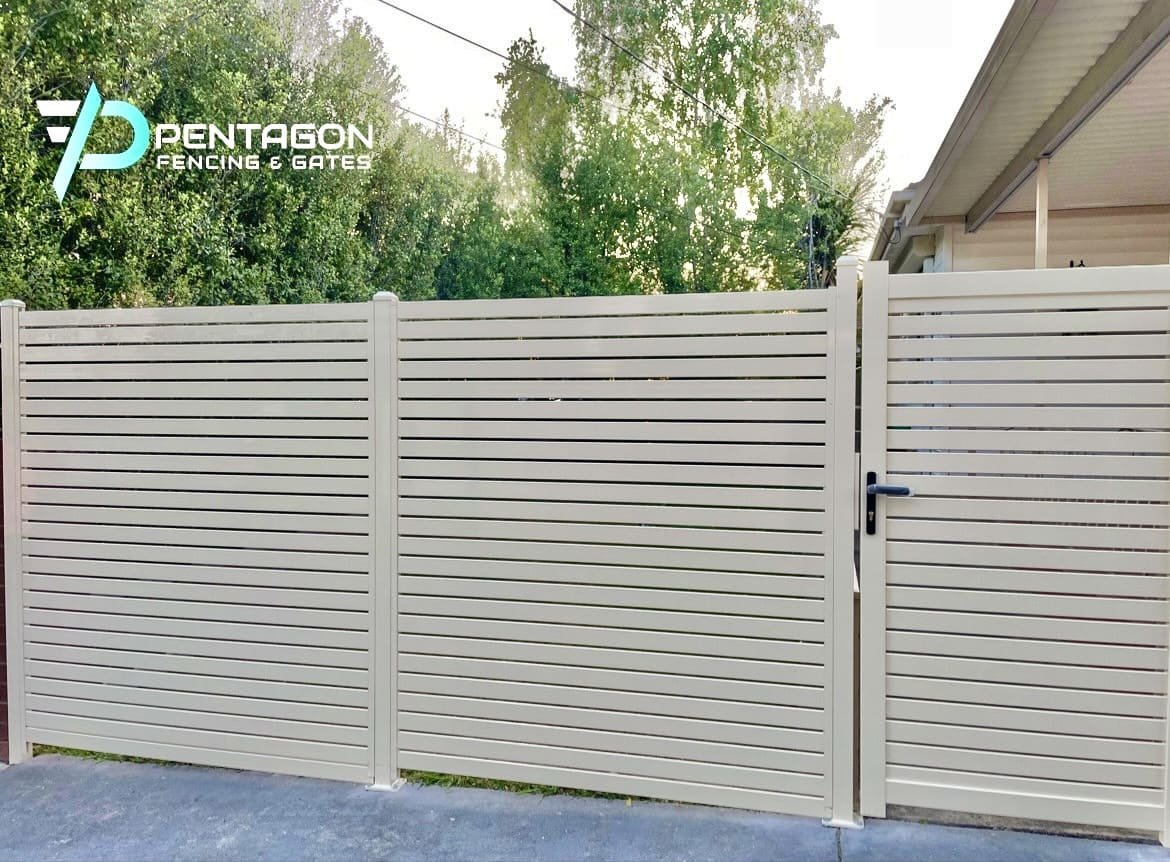
For residential driveways, double swing gates often make sense when the driveway is wide enough, the property has enough inward clearance and the owner wants a traditional or architectural entrance. They can be matched to aluminium slat fencing, steel picket styles, timber fencing, COLORBOND® boundaries or custom front-fence designs.
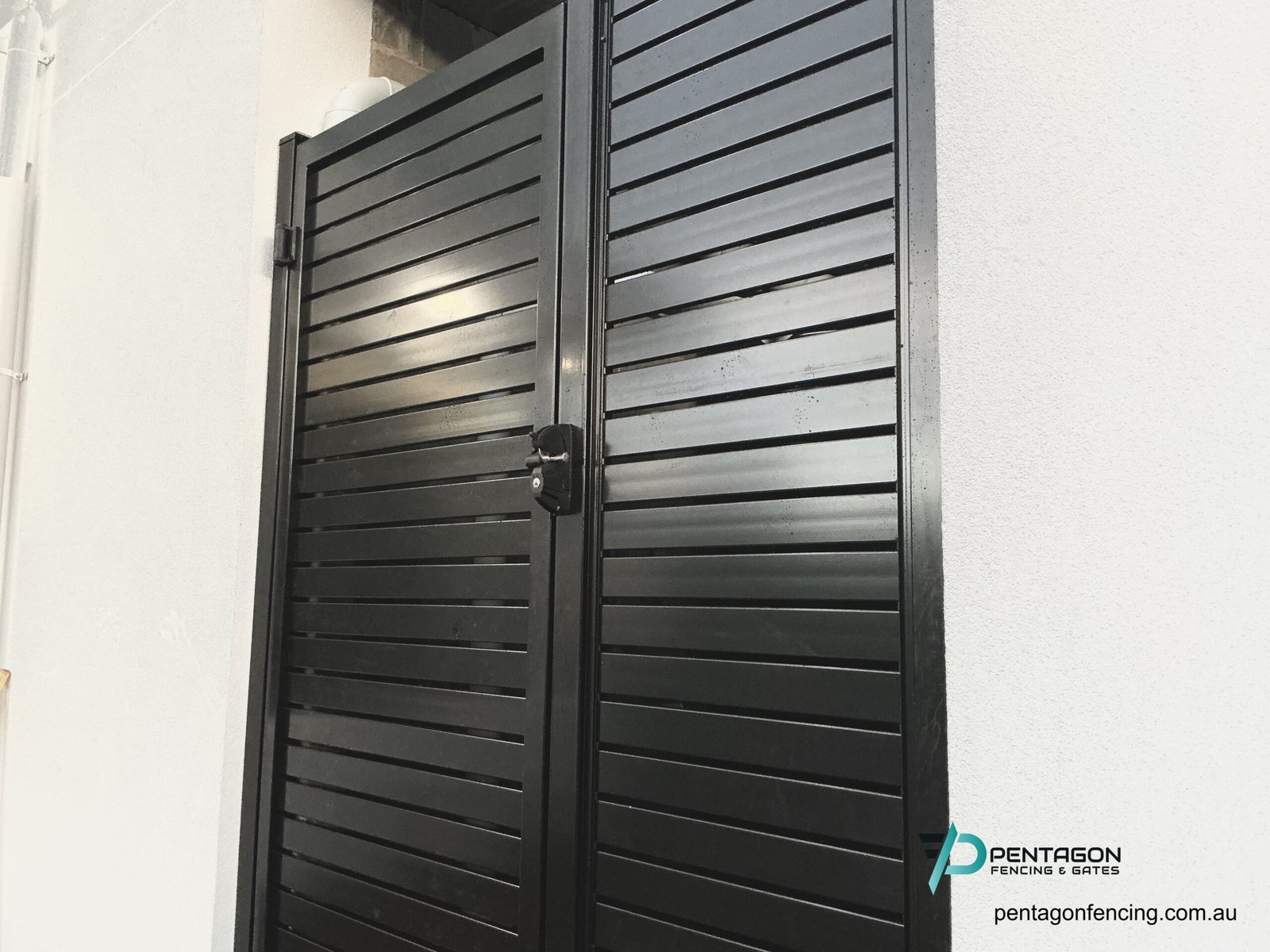
For residential and mixed-use sites, review the boundary and approval context before installation. Victorian Government guidance explains that dividing fences are usually joint property and that owners should check council planning rules before building or replacing boundary fencing [4]. Local council guidance can also affect fence and gate height, front-fence placement, corner visibility and whether gates can swing across public land.
Wyndham City guidance, for example, notes that gates must not swing out over the title boundary or footpath/road reserve [5]. Requirements vary by council, so this should be checked for the actual property before fabrication.
Clearance, slope and swing direction
Swing gates need space. The gate leaf must open through a clear arc without striking vehicles, walls, fences, bins, landscaping, pedestrians or the road reserve. Pentagon notes that swing gates require ample space for proper movement within the property [1].
- Inward swing: usually preferred where the gate must not open across a footpath or road reserve, but it needs internal driveway space.
- Outward swing: may solve internal space issues, but it can create title-boundary, footpath, road-reserve and pedestrian-safety concerns.
- Sloped driveway: may require rising hinges, special automation geometry, increased ground clearance or a different gate type.
- Wind exposure: solid infill can create higher wind load, requiring stronger posts, hinges and motor selection.
- Centre meeting point: double leaves need alignment, stops and locking or drop-bolt details that remain reliable as the gate moves over time.
Automation, duty cycle and access control
Automation should be selected from the gate’s measured requirements, not from a generic motor package. Rotech’s swing-operator guidance identifies gate leaf size and weight, gate panel format, arm type and mounting geometry as key considerations for swing-gate operator selection [6]. Nice Australia explains duty cycle as the number of times an automated gate operator can open and close without overheating, usually expressed as a percentage [7].
For automated swing gates Melbourne projects, clarify who uses the gate, how often it operates, whether access changes by time of day and what happens during power loss. Pentagon lists remote-controlled and sensor-based operation, keypad, swipe-card or access-control integration, photo sensors, auto-stop mechanisms and frequent-cycle operation for commercial and industrial swing gates [1].
- Gate weight and leaf length: include the frame, infill, cladding, hinges and any future changes.
- Motor type: choose an operator matched to leaf geometry, post position, wind exposure and duty requirement.
- Access control: define remote, keypad, intercom, RFID, swipe, mobile access, visitor release or guard operation.
- Manual release: make sure the site can operate or secure the gate during power loss, motor failure or emergency access.
- Safety devices: plan photo beams, pressure edges, force settings, signage, isolation and commissioning tests based on the actual risk assessment.
Safety and risk-control matrix
A powered swing gate is a moving system. Safety must be planned around the installed gate, not added as a generic accessory package.
| Risk area | Why it matters | Control direction | Evidence to request |
|---|---|---|---|
| Crush and trapping zones | Moving leaves can create risks at closing edges, hinge areas, posts, walls and centre meeting points. | HSE lists design elimination, guarding, speed control, force limitation, pressure-sensitive edges and non-contact sensors as possible powered-gate safety measures [3]. | Risk assessment, safety-device layout, commissioning record and user instructions. |
| Falling, leaning or unhinged gate | Industrial gates can be heavy, and failure of posts, hinges or stops can create serious injury risk. | SafeWork NSW states that lack of maintenance was the main cause in notified industrial-gate incidents where gates fell or became unhinged [8]. | Post detail, hinge rating, stopper detail, maintenance schedule and inspection records. |
| Repair-period operation | A gate can become more dangerous when automation, stops or controls are disconnected during repair. | WorkSafe Victoria’s Dandenong fatality case shows why unsafe repair-period conditions and instructions can expose site users to severe risk [9]. | Isolation method, restricted-use signage, temporary securing method and repair handover note. |
| Vehicle and pedestrian conflict | People may walk through the same opening used by vehicles if a separate path is not planned. | Provide a separate pedestrian access gate where practical and coordinate lighting, signage, access credentials and CCTV. | Traffic-management plan, pedestrian route, gate schedule and access-control map. |
| Street and public-realm interface | A front gate can affect sightlines, footpath movement and public safety. | Planning Victoria recommends highly visible barriers and fences and non-injurious top details in the public realm [10]. | Council advice, frontage plan, driveway visibility check and gate-swing direction. |
Materials and infill choices
The gate material should match the fence, the entry purpose and the site’s maintenance expectations. A double swing gate can look architectural, industrial, private or transparent depending on infill.
- Steel: strong option for industrial entries, factories, logistics yards and high-security sites where heavier framing and impact resistance matter.
- Aluminium: useful for residential, commercial and coastal-adjacent sites where low weight, corrosion resistance and contemporary profiles are priorities.
- Timber: suitable for residential and boutique commercial entries where natural appearance is central and maintenance is accepted.
- COLORBOND® steel: useful where solid screening, colour consistency and privacy matter, but wind load and sightlines must be reviewed.
- Weldmesh or bar infill: suitable where visibility through the gate helps surveillance, driver awareness and perimeter monitoring.
Rotech notes that full-body gate panels can create more wind resistance than bar-style gates, and that panel format affects operator choice [6]. This is especially important for wide double swing gates because each leaf acts like a moving panel exposed to wind and motor load.
What affects double swing gate cost?
For a double swing gate industrial scope, cost comparison should be based on equivalent scope, not just the gate opening width. The following items should be visible before approving a quote.
| Cost driver | Effect on the quote | Caveat | Evidence to request |
|---|---|---|---|
| Clear opening and leaf size | Wider openings increase frame size, hinges, posts, hardware, motor load and installation handling. | A wide opening may look simple on plan but fail when truck turning paths or swing arcs are overlaid. | Dimensioned opening, leaf sizes, swing envelope and swept-path check. |
| Posts, hinges and foundations | Heavy leaves, wind exposure and automation forces require suitable hinge posts and footings. | Light posts can make the finished gate sag, bind or become unsafe. | Post size, footing assumptions, hinge type, centre stop and hold-open details. |
| Material and infill | Steel, aluminium, timber, COLORBOND®, mesh and slat infills change weight, fabrication, finish and maintenance. | Solid privacy infill may increase wind load and motor demand. | Frame drawing, material schedule, infill type, coating and wind-exposure assumptions. |
| Automation package | Two leaves typically need coordinated operators, power, controls, sequencing and safety devices. | A residential-duty motor may not suit a commercial or industrial cycle profile. | Motor model, duty rating, leaf limits, control logic, backup power and commissioning record. |
| Access control | Keypads, remotes, intercoms, RFID, swipe access, mobile access, CCTV and vehicle detection add hardware and commissioning. | Poor trigger placement can create queues or unsafe stopping positions. | Access-control schedule, user groups, wiring plan and admin process. |
| Site works and approvals | Concrete, trenching, conduit, electrical work, demolition, traffic control and council checks can materially change the project. | Gate works at front boundaries, corners or public interfaces can require extra review. | Site measure, permit responsibility, service locations, staging plan and exclusions. |
Six-step selection flow
- Map the opening. Measure clear width, driveway depth, slope, swing arc, parking zones, footpaths and vehicle swept paths.
- Choose single, double or pedestrian access. Decide whether one leaf, two leaves, a separate pedestrian gate or a mixed access arrangement is needed.
- Confirm the operating pattern. Record daily cycles, peak use, visitors, deliveries, emergency access and manual operation requirements.
- Specify the structure. Lock the gate frame, infill, posts, hinges, centre stop, hold-open controls, finish and adjacent fence transition.
- Design automation and safety together. Select motors, sensors, controls, manual release and commissioning tests based on a site-specific risk assessment.
- Compare complete quotes. Ensure each proposal includes site works, electrical scope, access control, safety devices, approvals, handover and maintenance.
Double swing gate industrial project checklist
- Gate movement: inward or outward swing, full open position, hold-open method and obstruction clearance.
- Opening: clear width, leaf widths, centre gap, driveway slope, ground clearance and turning path.
- Structure: post size, footing, hinge rating, frame, infill, bracing, centre stop, drop bolt and finish.
- Users: residents, staff, visitors, trucks, forklifts, contractors, emergency services and maintenance teams.
- Automation: motor type, duty cycle, control board, wiring, backup power, manual release and service access.
- Safety: crush zones, hinge-side gaps, photo beams, pressure edges, force settings, signage and isolation process.
- Pedestrian access: decide whether a separate pedestrian gate is needed and how it will be controlled.
- Compliance checks: title boundary, council guidance, front-fence height, corner visibility and public-path interface.
- Handover: keys, credentials, user instructions, commissioning record, maintenance schedule and restricted-use process during faults.
Common mistakes to avoid
- Ignoring the swing arc. A double gate needs two clear movement zones, not only enough width at the boundary.
- Opening over public land. Check title-boundary and council requirements before assuming an outward swing is acceptable.
- Using solid infill without checking wind load. Privacy panels can increase motor demand and post loads.
- Undersizing automation. Gate leaf size, weight, duty cycle and wind exposure need to match the selected operator.
- Forcing people through the vehicle gate. Add a separate pedestrian gate where regular foot traffic exists.
- Excluding safety and maintenance from the quote. Powered gates need commissioning, user instructions and routine checks to remain safe.
How Pentagon Fencing can help
Pentagon Fencing & Gates designs and installs swing gates across Melbourne for residential, commercial and industrial properties, including single-wing and double-wing gates, durable material options, automation, access control and safety features [1].
- Assess whether a double swing gate, single swing gate, pedestrian gate, sliding gate or cantilever gate best fits the site’s space and access pattern.
- Coordinate gate frame, infill, hinge posts, automation, access control, safety devices and adjacent fencing as one project package.
- Prepare a site-specific scope covering swing clearance, vehicle movement, installation staging, handover and maintenance requirements.
FAQ
When does a double swing gate make sense?
It makes sense when a site needs a wider hinged opening and has enough clear arc space for both leaves to open safely. It is strongest for controlled entries, formal frontages, wide residential driveways and selected commercial or industrial access points with manageable traffic pressure.
Is a double swing gate better than a sliding gate?
Not automatically. A double swing gate can suit sites with clear arc space and a hinged-entry preference. A sliding or cantilever gate may be better where traffic is heavy, swing clearance is limited, or vehicles cannot wait safely while leaves open.
Can double swing gates be automated?
Yes. Double swing gates can be automated with operators for each leaf, coordinated sequencing, access-control triggers and safety devices. The motor selection should match gate leaf size, weight, wind exposure and daily cycle demand.
Do commercial swing gates need a separate pedestrian gate?
Often, yes. If staff, visitors, residents or students regularly walk through the entry, a separate pedestrian gate can reduce interaction between people and vehicle gate movement.
What affects double swing gate cost?
Main cost drivers include opening width, leaf size, materials, posts, hinges, footing conditions, automation, access control, safety devices, electrical works, approvals, removal work and installation staging.
What to Keep in Mind
- Choose double swing gates when the site has enough swing arc, suitable traffic flow and a clear reason to use hinged movement.
- Separate industrial, commercial and residential needs before applying one gate design to every entry.
- Plan pedestrian access, automation, safety devices and manual release before fabrication.
- Check title boundary, council guidance, frontage visibility and public-path interfaces before choosing swing direction.
- Compare complete scopes that include posts, hinges, motors, controls, safety, access control, site works and maintenance handover.
References
- Pentagon Fencing, “Swing Gates,” Pentagon Fencing & Gates. Accessed: Jun. 23, 2026. [Online]. Available: https://pentagonfencing.com.au/service/swing-gates/
- National Entrance Systems, “Automatic Swing Gates Australia | Supply & Installation,” National Entrance Systems. Accessed: Jun. 23, 2026. [Online]. Available: https://nationalco.com.au/products/automatic-swing-gates/
- Health and Safety Executive, “Ensuring powered doors and gates are safe,” HSE. Accessed: Jun. 23, 2026. [Online]. Available: https://www.hse.gov.uk/work-equipment-machinery/powered-gates/safety.htm
- State Government of Victoria, “Fencing in Victoria,” vic.gov.au. Accessed: Jun. 23, 2026. [Online]. Available: https://www.vic.gov.au/fencing-victoria
- Wyndham City, “When is a Building Permit Required?,” Wyndham City. Accessed: Jun. 23, 2026. [Online]. Available: https://www.wyndham.vic.gov.au/services/building-planning/do-i-need-approval/when-building-permit-required
- Rotech Automation, “4 Factors to Consider for a Swing Gate Operator,” Rotech Automation. Accessed: Jun. 23, 2026. [Online]. Available: https://rotech.com.au/4-factors-to-consider-for-a-swing-gate-operator/
- Nice Australia, “Duty Cycle Explained,” Nice Australia. Accessed: Jun. 23, 2026. [Online]. Available: https://www.niceaustralia.com.au/duty-cycle-explained/
- SafeWork NSW, “Industrial gate safety,” SafeWork NSW. Accessed: Jun. 23, 2026. [Online]. Available: https://www.safework.nsw.gov.au/advice-and-resources/campaigns/industrial-gate-safety
- WorkSafe Victoria, “Company fined $350,000 after fatal gate crush,” WorkSafe Victoria. Accessed: Jun. 23, 2026. [Online]. Available: https://www.worksafe.vic.gov.au/news/2024-12/company-fined-350000-after-fatal-gate-crush
- Department of Transport and Planning Victoria, “6.4 Barriers and fences,” Planning Victoria. Accessed: Jun. 23, 2026. [Online]. Available: https://www.planning.vic.gov.au/guides-and-resources/guides/urban-design-guidelines-for-victoria/objects-in-the-public-realm/barriers-and-fences