
Table of Contents
Spear top palisade fencing in Melbourne is not the right answer for every site.. It is a stronger fit when the site needs visible deterrence, anti-climb pressure, durable steel construction, and controlled access around higher-risk assets. For commercial and industrial buyers, the practical question is not simply “Should we install palisade fencing?” It is “Does this site need a high-security perimeter, and can the fence, gates, locks, sightlines, and maintenance process support that security level?”
When choosing palisade fencing becomes a difficult call
- You need a stronger perimeter for a warehouse, yard, factory, depot, school boundary, or commercial compound, but you are not sure whether palisade is too much.
- You want a fence that discourages climbing without blocking visibility across the site.
- You are comparing spear top palisade fencing with weldmesh, chain link, tubular steel, or rod top fencing.
- You need the fence to work with gates, locks, lighting, CCTV, vehicle access, and after-hours site operations.
- You want a contractor-led recommendation before committing to height, frontage, permit checks, or gate automation.
Key Takeaways
- Palisade fencing is best treated as a high-security option, not a general boundary fence. Pentagon positions palisade fencing for industrial and commercial sites where anti-climb steel construction and deterrence are important [1].
- Spear top fencing works best when the site needs stronger visual deterrence, but it may not be the best fit for every school, childcare, or public-facing frontage.
- A palisade fence only performs well if the weak points are also controlled: gates, joints, fixings, locks, ground clearance, lighting, CCTV, and nearby climb aids all matter [2] [3].
- For schools and public facilities, fencing should be fit-for-purpose, strong, durable, safe, integrated with pedestrian and vehicle gates, and not unnecessarily unwelcoming [4].
- Before requesting a quote, confirm the perimeter length, height target, frontage or corner constraints, gate types, access-control needs, and any local planning or building permit checks [5].
When palisade fencing is the right fit
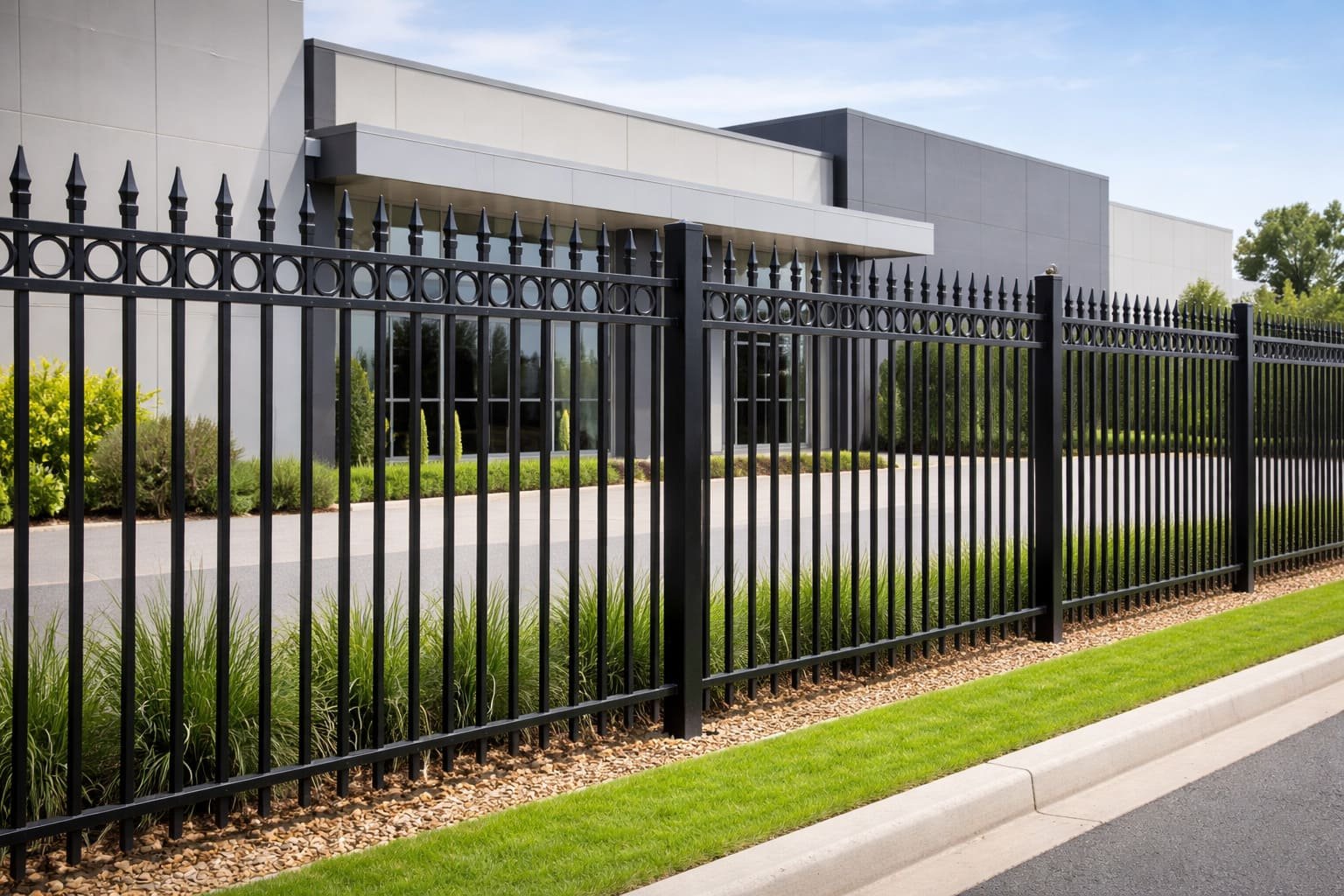
Palisade fencing is most useful when a basic boundary is not enough. Its value comes from a combination of steel construction, vertical pales, visible deterrence, and top profiles that make climbing less attractive. Pentagon describes palisade fencing in Melbourne as a high-security option with anti-climb design and durable steel construction for protecting industrial and commercial sites [1].
Use spear top palisade fencing when the site has one or more of these conditions:
- High-value equipment, fleet, stock, tools, or machinery stored near the perimeter.
- Industrial or commercial land where after-hours access must be discouraged.
- A perimeter that needs visibility for patrols, cameras, or lighting.
- A long boundary where a strong visual deterrent is needed without using a solid wall.
- A gate system that can be matched to the same security level as the fence.
Do not choose palisade only because it looks stronger. A lower-risk office boundary, public-facing frontage, or school area may need a safer or less severe option such as rod top, flat top tubular steel, weldmesh, or a design that balances safety and visibility.
Decision matrix: when to use spear top palisade fencing
| Site scenario | Security pressure | Palisade fit | What to verify before quote |
|---|---|---|---|
| Warehouse, depot, or industrial yard with valuable assets | Unauthorised access, theft risk, after-hours exposure | Strong fit when deterrence and anti-climb pressure matter | Fence height, gate strength, lock quality, lighting, CCTV coverage, clear boundary line |
| Factory or logistics site with vehicle gates | Controlled entry, staff/delivery movement, exposed access points | Strong fit for perimeter, but only if gates match the security level | Sliding or swing gate design, access-control requirements, emergency access, gate maintenance |
| Construction or infrastructure site needing controlled access | Public access risk, exposed hazards, temporary or permanent boundary needs | Fit depends on whether the need is temporary site fencing or permanent security fencing | WorkSafe-style checks: secure joints, stability, climb resistance, ground clearance, wind loads [2] |
| School or public facility with significant security concerns | Boundary control, student/staff safety, public interface | Conditional fit; must be assessed against safety, appearance, access, and site-specific security advice | Whether tall/security fencing is warranted, gate safety, welcoming appearance, pedestrian/vehicle gate integration [4] |
| Retail frontage, office boundary, or low-risk commercial site | Boundary definition, appearance, light security | Often not the first choice unless there is a specific security trigger | Whether tubular, aluminium, or weldmesh provides enough control without over-specifying |
| High-risk perimeter near low roof lines or climbable structures | Unauthorised roof or building access | Stronger fit when a non-scalable perimeter is needed | Nearby climb aids, roof access points, standoff from equipment, maintenance plan |
Scenario 1: warehouses, depots, and industrial yards
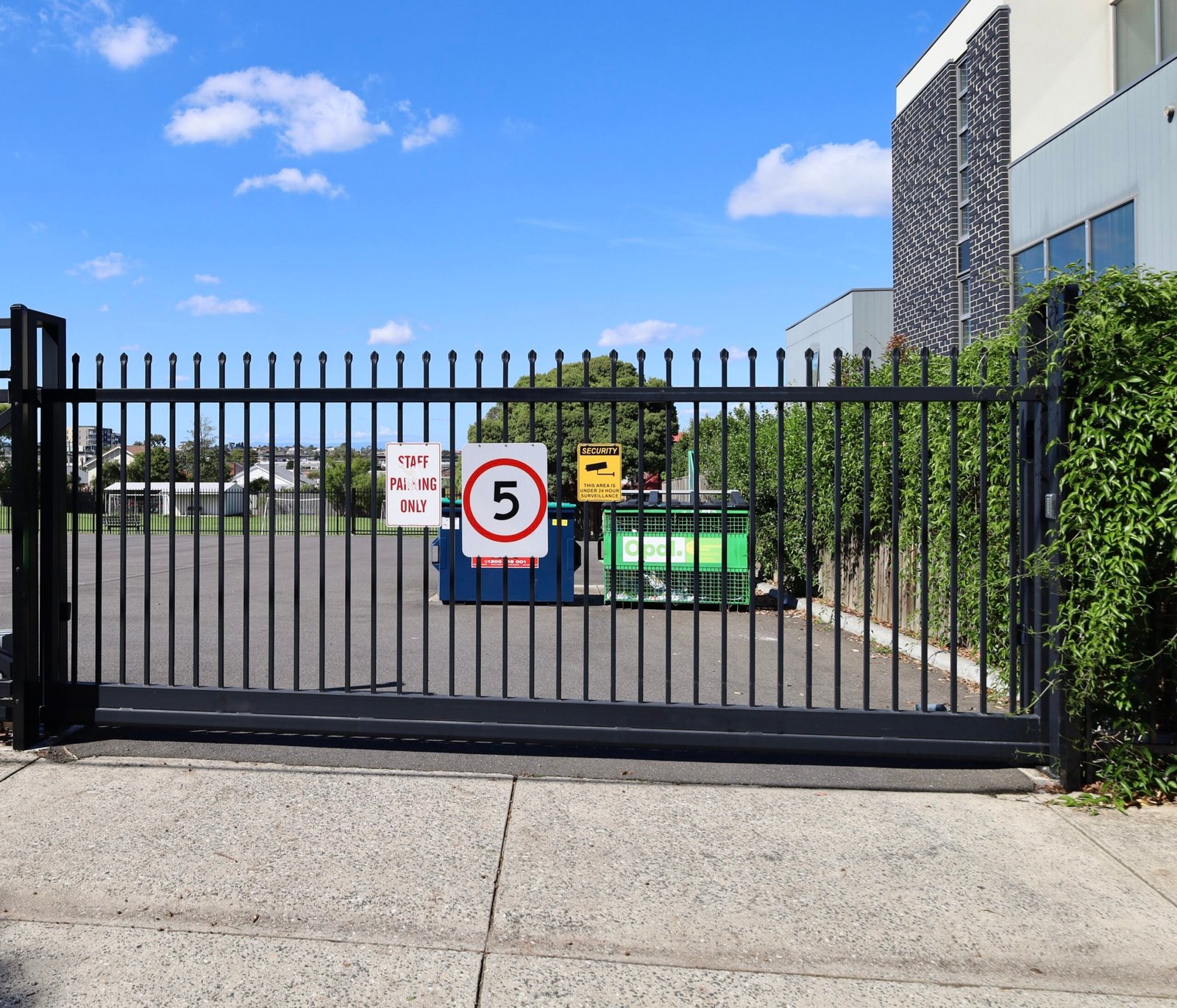
For warehouses and industrial yards, spear top palisade fencing is usually considered when a site needs more than basic boundary control. These sites often have external stock, parked fleet, tools, equipment, fuel storage, loading zones, or after-hours vehicle movements.
The main advantage is that palisade creates a visible high-security perimeter while still allowing visibility through the fence. That matters because security fencing should not be treated as a standalone object. Victoria Police recommends that business premises keep fences and gates well-built, maintained, and secured, use good locks, and keep boundaries clear of potential climbing aids [3].
For these sites, check four things before choosing palisade:
- Where the likely access points are: front gate, side gate, loading bay, rear lane, or shared driveway.
- Whether the gate is weaker than the fence.
- Whether lighting and CCTV still have clear sightlines through the perimeter.
- Whether stock, bins, pallets, trees, or equipment create climb aids near the fence.
Scenario 2: factories and logistics sites with high-traffic gates
A strong fence can fail at the gate. If the site has trucks, staff parking, deliveries, or frequent after-hours access, the palisade decision should include the gate system from the beginning.
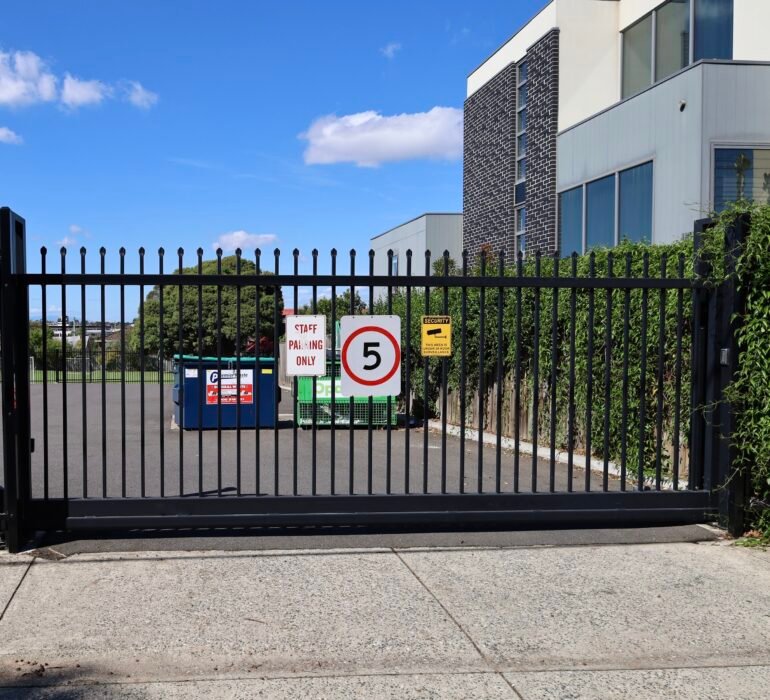
For high-traffic industrial sites, a steel sliding gate or automated access point may be more important than adding a stronger fence panel to a weak entrance. Pentagon states that its sliding gate systems are designed for commercial, industrial, and large-scale projects, including warehouses, logistics hubs, construction sites, and manufacturing facilities [6].
Use palisade around the perimeter when it matches the site risk, but specify the gate separately:
- Vehicle gate width and opening frequency.
- Manual or automated operation.
- Pedestrian access point placement.
- Keypad, intercom, remote, or swipe access needs.
- Emergency access and maintenance requirements.
- Whether the gate frame, infill, locks, and guides match the fence’s security intent.
Scenario 3: construction and infrastructure sites
Palisade is usually more relevant for permanent or semi-permanent security fencing than for short-term temporary fencing. Still, the same security logic applies: the perimeter must reduce unauthorised entry without becoming unstable or creating hazards.
WorkSafe Victoria’s construction site security fencing guidance highlights practical criteria such as well-constructed fencing, securely connected gates and joints, stability under anticipated loads, difficulty to climb, and preventing access from underneath [2].
For construction, infrastructure, or redevelopment sites, use palisade only when the project needs a stronger permanent security layer. For temporary site control, the more immediate question is whether the fencing system is appropriate to site hazards, wind exposure, ground condition, gate access, and public interface.
Scenario 4: schools, public facilities, and community-facing boundaries
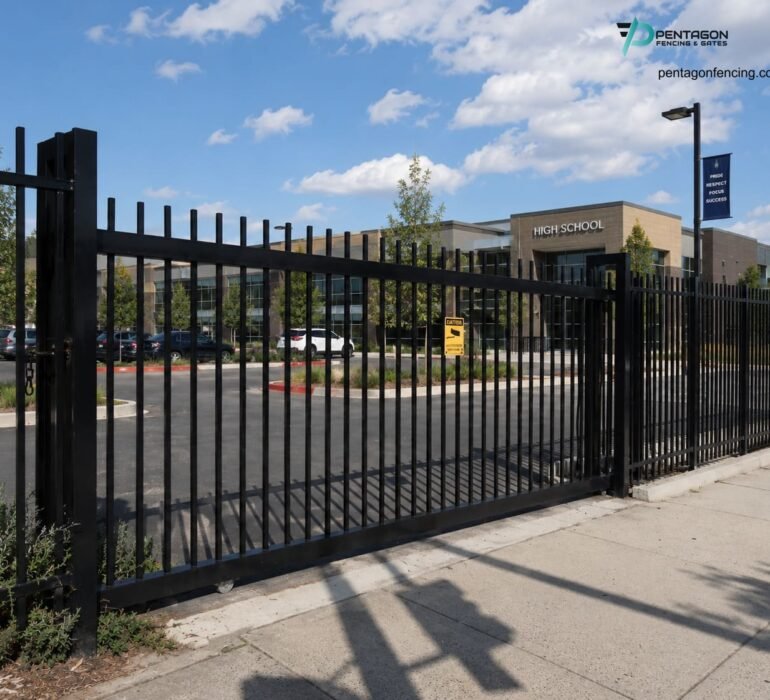
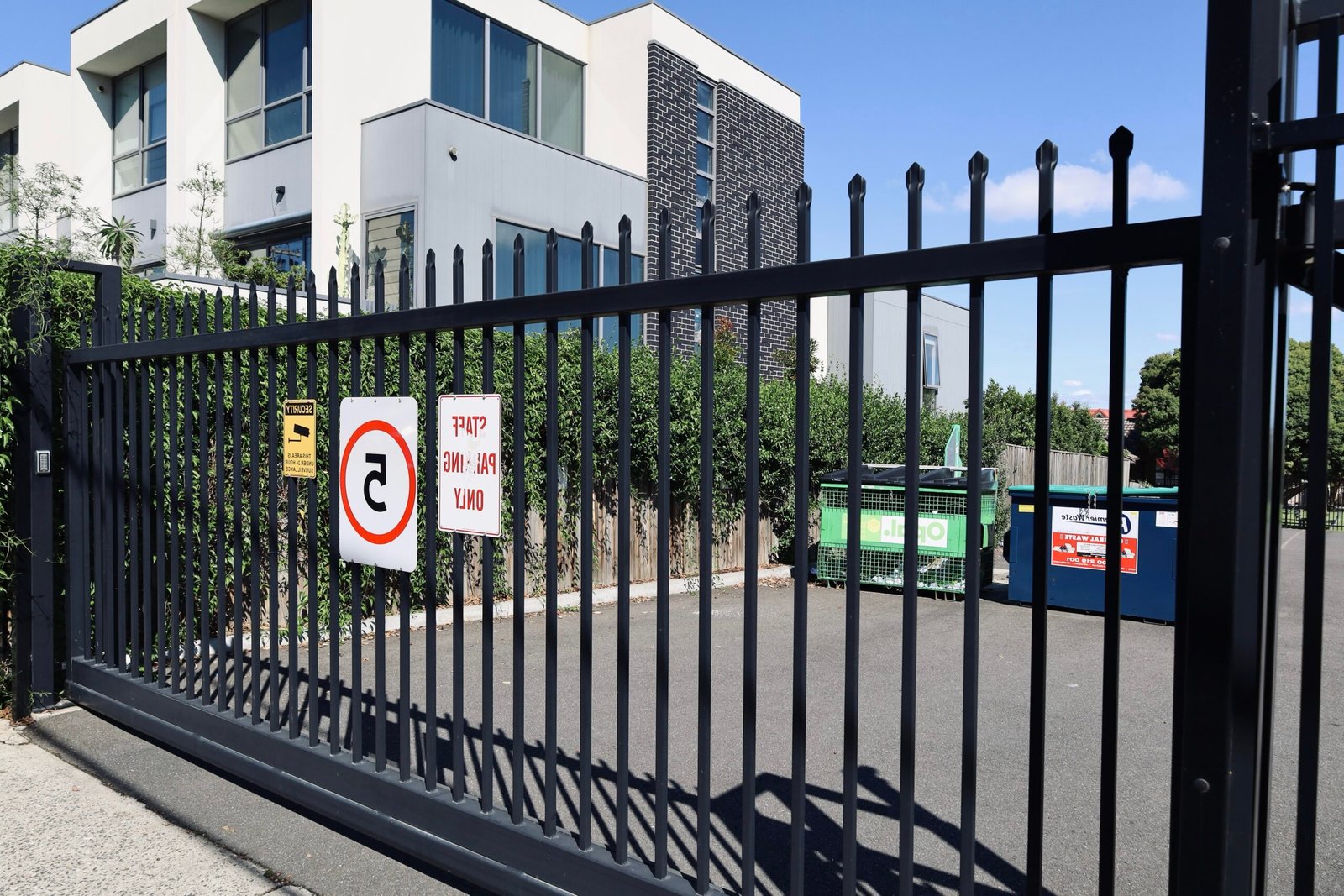
Spear top palisade can be suitable in some school or public facility contexts, but it should not be treated as the default answer. Victorian school building guidance says fencing and associated gates should be fit-for-purpose, strong, durable, safe, discourage climbing, withstand climbing, and integrate with pedestrian and vehicle access gates [4].
The same guidance also notes that fencing should integrate with landscape design and not present as unwelcoming. It identifies palisade fencing as a possible perimeter type in specific school contexts, including where significant security concerns have been identified, but the decision must still consider community use, entrances, safety, and access [4].
For these sites, the decision is usually not “palisade or no palisade.” It is:
- Which boundary needs high security?
- Which frontage needs a more welcoming treatment?
- Where do pedestrians, students, staff, visitors, and vehicles enter?
- Would rod top, weldmesh, or tubular steel provide a safer public-facing solution?
- Does the gate hardware support safe entry, egress, accessibility, and emergency access?
Scenario 5: commercial frontages and mixed-use developments
For commercial frontages, spear top palisade can look too severe if the site only needs a professional boundary. Tubular steel, flat top, rod top, aluminium blade, or weldmesh may provide a better balance of appearance, visibility, and basic security.
Choose palisade for a commercial frontage only when there is a clear reason, such as high-value storage, repeated trespass risk, sensitive back-of-house access, or a need to visually separate public and restricted areas.
If the frontage sits close to a street, corner, shared boundary, or residential interface, also check local planning and building requirements. The City of Kingston, for example, lists different permit/report-and-consent triggers depending on fence location, height, frontage, corner conditions, and material type [5]. Other Melbourne councils may apply different planning overlays or advice pathways, so this should be checked before final design.
Implementation checklist before requesting a palisade fencing quote
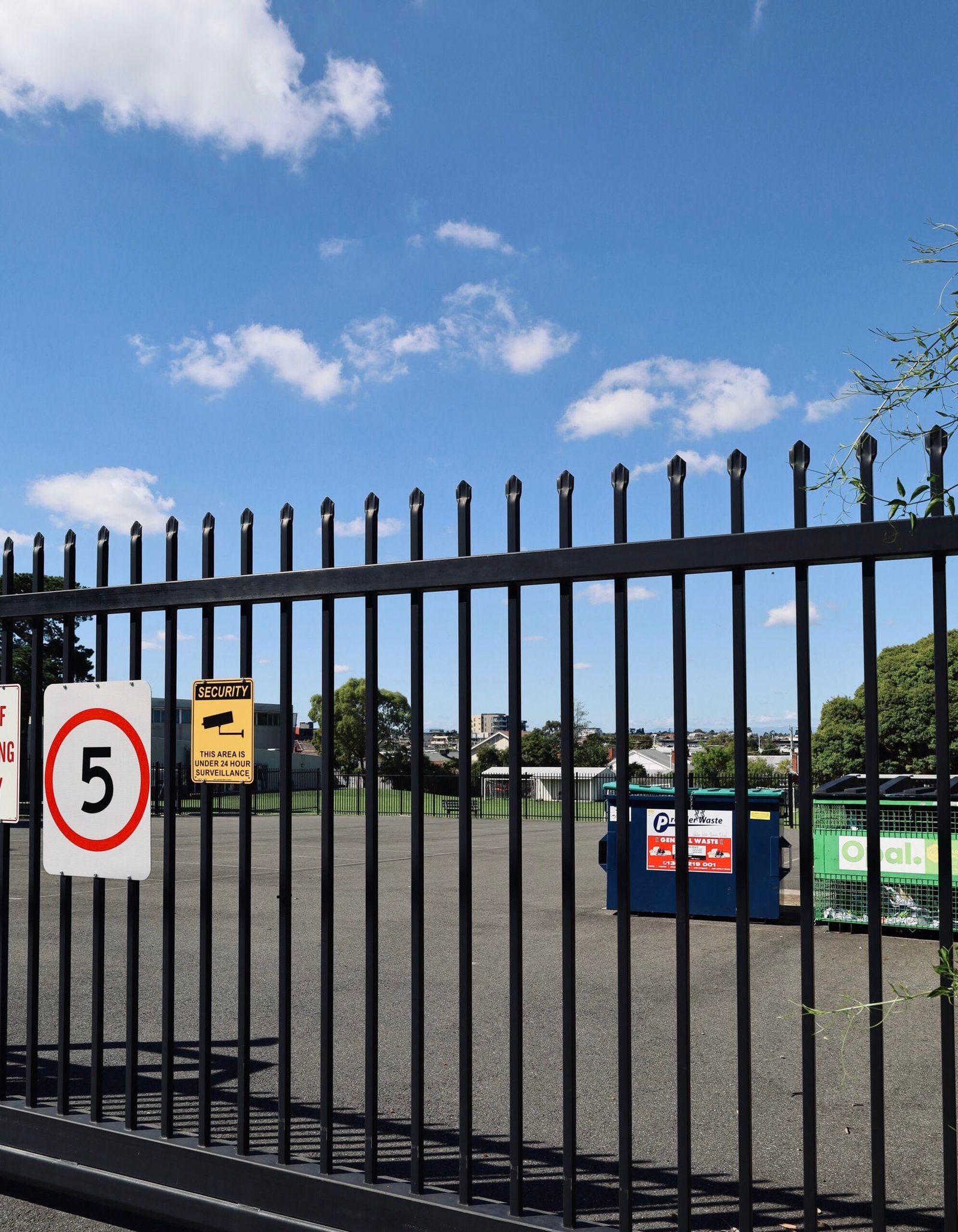
- Define the risk level: asset theft, unauthorised access, vehicle exposure, public interface, or after-hours access.
- Mark the full perimeter: frontage, side boundary, rear lane, shared driveway, loading bay, and blind spots.
- Identify gate requirements: sliding gate, swing gate, pedestrian gate, side security gate, manual or automated access.
- Check weak points: joints, posts, fixings, locks, ground clearance, climb aids, and any low roofline or nearby equipment.
- Confirm visibility needs: lighting, camera sightlines, patrol routes, and natural surveillance.
- Check local constraints: height, frontage, corner site, planning overlay, building permit, or council advice.
- Prepare contractor inputs: site photos, approximate metres, preferred height, gate openings, ground condition, removal needs, and access-control requirements.
How Pentagon Fencing can help
Pentagon Fencing designs, supplies, and installs palisade and steel fencing systems for commercial, industrial, and residential projects across Melbourne, including high-security industrial and commercial applications [1]. For sites where the fence also needs to connect with vehicle access, Pentagon also provides sliding gate systems for commercial, industrial, and large-scale projects [6].
- Match the right steel fencing style to the site risk, not just the visual design.
- Plan the fence and gates together so the entrance does not become the weakest point.
- Prepare a project-specific quote based on perimeter length, height, material, gates, access needs, and site conditions.
FAQ
Is palisade fencing the same as spear top fencing?
Not exactly. Palisade fencing refers to a high-security steel fence style built with vertical pales. Spear top refers to the pointed top profile used on some palisade or tubular steel designs. In practice, many buyers use “spear top security fencing” to describe a palisade-style perimeter with a pointed deterrent top.
Is palisade fencing better than weldmesh?
It depends on the site. Palisade usually provides stronger visual deterrence, while weldmesh can provide security with better visibility and a less aggressive appearance. For public-facing facilities, schools, or sites where visibility and safety presentation matter, weldmesh or rod top may be a better fit. For high-value industrial yards or compounds, palisade may be more appropriate.
Can palisade fencing be used for schools?
Yes, but only when the site context supports it. Victorian school building guidance refers to palisade fencing in specific school contexts, including situations where significant security concerns have been identified, while also requiring fencing and gates to be safe, durable, fit-for-purpose, integrated with access gates, and not unnecessarily unwelcoming [4].
Do I need a permit for palisade fencing in Melbourne?
It depends on the council area, fence height, frontage, corner conditions, planning controls, and site type. For example, City of Kingston’s fencing permit guidance distinguishes side/rear fencing, front fencing, corner blocks, and other cases [5]. For a commercial or industrial project, check with the relevant council or building professional before locking the height and frontage design.
Should the gate use the same palisade style as the fence?
Often, yes, if the goal is a consistent high-security perimeter. But the gate also needs its own design checks: opening width, traffic frequency, lock hardware, automation, emergency access, and maintenance. A strong palisade fence with a weak or poorly maintained gate will not perform as a complete security system.
What to Keep in Mind
- Use palisade when the site genuinely needs high-security deterrence, not just because it looks stronger.
- Check gates, locks, fixings, lighting, CCTV, and climb aids before assuming the fence alone will solve the risk.
- For schools, public facilities, and street-facing sites, balance security with safety, access, and visual impact.
- Confirm height, frontage, corner, and council requirements before finalising the design.
- Ask for a quote based on the full system: fence, gates, access control, installation conditions, and maintenance needs.
References
- Pentagon Fencing, “Palisade Fencing & Steel Fencing Melbourne,” Pentagon Fencing. Accessed: Apr. 30, 2026. [Online]. Available: https://pentagonfencing.com.au/service/palisade-fencing-steel-fencing-melbourne/
- WorkSafe Victoria, “Construction site security fencing,” WorkSafe Victoria. Accessed: Apr. 30, 2026. [Online]. Available: https://www.worksafe.vic.gov.au/construction-site-security-fencing
- Victoria Police, “Business premises security,” Victoria Police. Accessed: Apr. 30, 2026. [Online]. Available: https://www.police.vic.gov.au/securing-business-premises
- School Buildings Victoria, “Building Quality Standards Handbook: Technical specifications,” School Buildings Victoria. Accessed: Apr. 30, 2026. [Online]. Available: https://www.schoolbuildings.vic.gov.au/building-quality-standards-handbook/technical-specifications
- City of Kingston, “Fencing permits,” City of Kingston. Accessed: Apr. 30, 2026. [Online]. Available: https://www.kingston.vic.gov.au/property/planning-and-building/do-I-need-a-planning-or-building-permit/fencing/fencing-permits
- Pentagon Fencing, “Sliding Gates,” Pentagon Fencing. Accessed: Apr. 30, 2026. [Online]. Available: https://pentagonfencing.com.au/service/sliding-gates/