
Table of Contents
Pentagon Fencing & Gates describes aluminium vertical batten fencing as an architectural-style solution that creates depth and visual interest, commonly used for feature fencing, screening and premium commercial or residential designs [1]. The right specification depends on where the battens sit, what they need to screen and whether they form a feature screen, a facade-adjacent element, a front boundary or part of a matching gate system.
Why aluminium batten projects are easy to mis-specify
- You want an architectural feature, but the batten depth, width and spacing have not been translated into measurable quote details.
- You need screening, but you have not defined whether the priority is privacy, airflow, filtered visibility or simply visual separation.
- You call the project a facade, although the proposed battens may actually be a non-load-bearing screen, fence panel or gate rather than building cladding.
- You need the battens to continue across a pedestrian or driveway gate, but the frame, hinges, latch, motor or intercom could interrupt the visual rhythm.
- You want batten fencing on a street boundary, but front-fence height, transparency, corner visibility or council checks have not been reviewed.
- You expect a security boundary, even though an architectural batten layout may prioritise appearance and screening over anti-climb or high-deterrence performance.
Key Takeaways
- Aluminium vertical batten fencing is best treated as a configurable architectural system: batten profile, depth, spacing, height, frame and finish all shape the outcome.
- Aluminium batten screens can support feature, facade and boundary uses, but the spacing should be selected for the required balance of privacy, airflow and visibility.
- A facade screen is not automatically facade cladding, a balustrade or a certified security barrier. Confirm the intended function before design and fabrication.
- For street-facing projects, partially transparent fencing can support informal surveillance and streetscape character, while local height and permit requirements still need site-specific checks [2].
- Aluminium is widely used in construction because it is strong, durable, flexible, lightweight, corrosion resistant and available in different forms and finishes [3].
- Where a project includes gates, access control or automation, the fixed screens and moving gate leaves should be planned as one package rather than separate visual elements.
What is aluminium batten fencing?
Aluminium batten fencing uses repeated aluminium profiles, most often installed vertically, to form a fence panel or screening element. Compared with a flatter slat layout, battens can create more visible depth and shadow because the profiles project from the frame or supporting structure.
The phrase can cover several related applications:
- Feature fencing: a visually prominent fence section used to strengthen the entry or frontage design.
- Aluminium screen fencing: a screen that filters views to parking, bins, plant areas, courtyards or internal site zones.
- Facade-adjacent screening: a non-load-bearing screen positioned in front of, beside or between building elements to add rhythm or conceal selected areas.
- Boundary fencing: a batten-style fence used along a front, side or internal boundary where appearance and controlled visibility matter.
- Matching gates: pedestrian, swing or sliding gates designed with the same batten profile and spacing as the fixed fence.
This article uses “facade” to describe architectural screening associated with a building frontage. It does not treat the fence as structural facade cladding, a balustrade or another regulated building element without separate design and professional review.
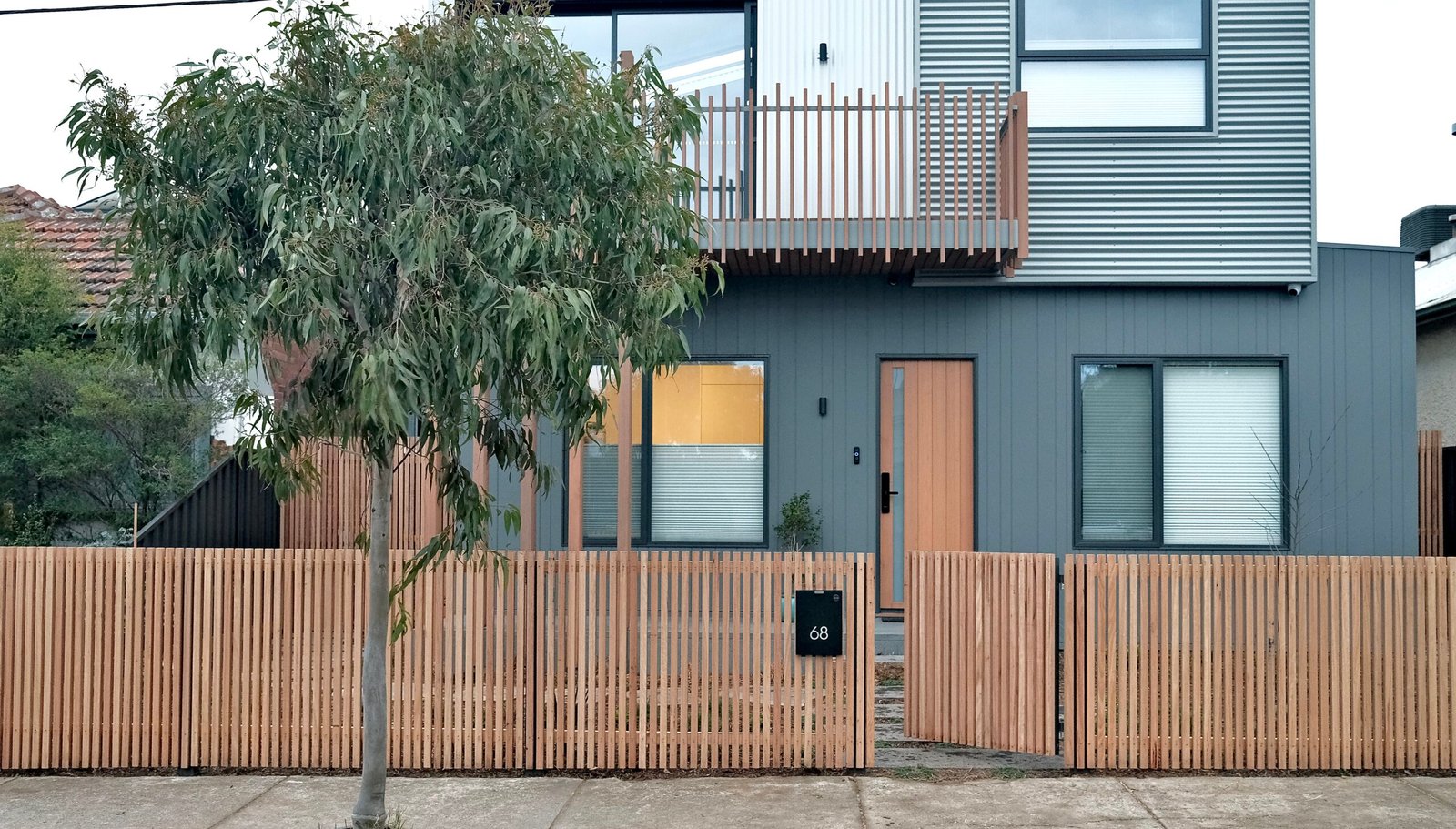
Style variables that change the finished batten screen
Reference images are useful for setting direction, but a contractor still needs measurable details. The table below turns common style preferences into specification questions.
| Style variable | Visual effect | Practical trade-off | Quote-ready detail |
|---|---|---|---|
| Batten width | Wider profiles create a heavier, more solid-looking rhythm; narrower profiles can feel finer and more open. | Changing width also changes material use, visibility and how the screen reads from a distance. | Profile face width, depth and wall specification selected by the fabricator. |
| Batten depth | Deeper battens create stronger shadow lines and more three-dimensional facade interest. | Greater projection may affect frames, returns, gate weight, clearances and how dirt is accessed for cleaning. | Profile depth, projection direction, return details and corner treatment. |
| Gap size | Smaller gaps increase screening; wider gaps produce a more open and transparent frontage. | Privacy, airflow and passive visibility move in different directions as spacing changes. | Clear gap between profiles and the viewpoints from which privacy is required. |
| Height and panel proportion | Tall narrow panels emphasise verticality; shorter panels can act as a lighter frontage feature. | Height may affect posts, footings, wind exposure and planning or building checks. | Finished height, panel width, post centres and ground-level changes. |
| Frame visibility | Concealed or restrained framing keeps attention on the battens; heavier framing creates a more panelised appearance. | The visual preference must still suit structural support, fabrication and gate operation. | Visible rails, posts, frame depth, weld locations and fixing approach. |
| Colour and finish | Dark finishes emphasise shadow and depth; lighter finishes can create a softer or more residential presentation. | Colour should coordinate with the facade, gates, posts and surrounding landscape rather than be selected in isolation. | Colour code, texture, gloss level and whether fence and gate components share one coating batch. |
Privacy, airflow and visibility screening matrix
An aluminium batten screen should be designed from the required sightlines rather than from gap size alone. A screen may look private when viewed straight on but become more transparent from an angle, a driveway or an elevated position.
| Screening goal | Likely batten direction | Main benefit | Trade-off to test on site |
|---|---|---|---|
| Architectural feature with open views | Narrower battens or wider spacing | Creates depth and rhythm without turning the frontage into a solid screen. | Check whether parking, bins, services or private windows remain too exposed. |
| Balanced privacy and airflow | Moderate profile width and controlled gaps | Filters direct views while keeping the screen visually lighter than a fully solid boundary. | Review the screen from footpath, driveway, neighbouring property and internal approach angles. |
| Stronger visual screening | Wider or deeper battens with smaller gaps | Reduces direct visibility to courtyards, plant, bins or selected internal zones. | More material and tighter spacing may create a heavier frontage and reduce airflow. |
| Street-facing transparency | Open spacing appropriate to the site | Supports visibility between the property and street or public space. | Planning Victoria notes that low or partially transparent fences can support informal surveillance; the actual design still needs local review [2]. |
| High-security perimeter | Do not select by appearance alone | A batten look may be retained only if a project-specific security specification supports it. | Compare climb points, spacing, height, gate hardware and alternative steel security systems before proceeding. |
Where aluminium batten fencing fits best
The use-case table below keeps the article focused on architectural screening. It does not assume that the same batten detail should be used for every facade or boundary.
| Application | Why battens can fit | Not the best fit when | Project check |
|---|---|---|---|
| Feature fence at a residential or commercial entry | Depth and repeated vertical lines can strengthen the entry and connect the fence to the building architecture. | The brief needs a traditional picket character or a simpler budget-led boundary panel. | Align battens with facade lines, entry canopy, columns, landscaping and the pedestrian gate. |
| Facade-adjacent screen | Can visually organise a frontage and screen selected views to parking, plant or service areas. | The element is actually structural cladding, a balustrade, a fire-rated assembly or another regulated building component requiring a different design pathway. | Confirm attachment, clearances, access for maintenance and the boundary between fencing and building works. |
| Front boundary fencing | Offers a premium architectural frontage with controllable transparency and street appeal. | The site needs a fully private wall, a heritage picket treatment or a high-security perimeter specification. | Check height, transparency, street context, overlays, driveway visibility and council requirements. |
| Courtyard, bin or equipment screening | Spacing can filter views while retaining some ventilation and access. | The enclosure has technical ventilation, fire, acoustic or equipment-clearance requirements that the fence design alone cannot establish. | Confirm ventilation, door/gate access, maintenance clearance and any consultant requirements. |
| Internal commercial site separation | Can separate entries, outdoor areas or customer-facing zones without using a visually heavy barrier. | Vehicle impact, high-security or industrial hazard control is the primary requirement. | Separate decorative screening needs from bollard, barrier, security or traffic-control needs. |
When aluminium batten fencing is not the best fit
- Maximum privacy is the only priority: a solid or more tightly screened system may achieve the brief with less architectural complexity.
- The site requires high-security deterrence: compare palisade, weldmesh, tubular steel or another security-specific system rather than assuming vertical battens are anti-climb.
- The streetscape requires a heritage treatment: Windsor, Hampton-style or another picket solution may fit the frontage better.
- The element is structural or code-critical: facade cladding, balustrades, pool barriers and fire-rated screens need their own applicable design and approval pathway.
- The project cannot define sightlines: without a privacy and visibility brief, the contractor cannot select spacing confidently.
Matching batten screens with gates and access
Pentagon offers custom aluminium gates in swing, sliding and pedestrian configurations, with optional automation, alongside its aluminium fencing range [1]. Its gate range also separates sliding, swing, side and cantilever gates according to site access needs [4].
- Continue the rhythm intentionally: align the batten width and spacing through the gate where practical, or make the gate contrast deliberate rather than accidental.
- Allow for a stronger frame: a gate leaf may need more framing than a fixed screen, which can change the visual depth.
- Plan hardware before fabrication: hinges, latches, locks, intercoms, keypads and motors can interrupt battens or create unusable clearances.
- Check the moving path: swing arc, sliding run-off, track position and pedestrian approach should be resolved before the screen elevations are finalised.
- Keep service access: automation and access-control components need inspection and maintenance without dismantling the feature screen.
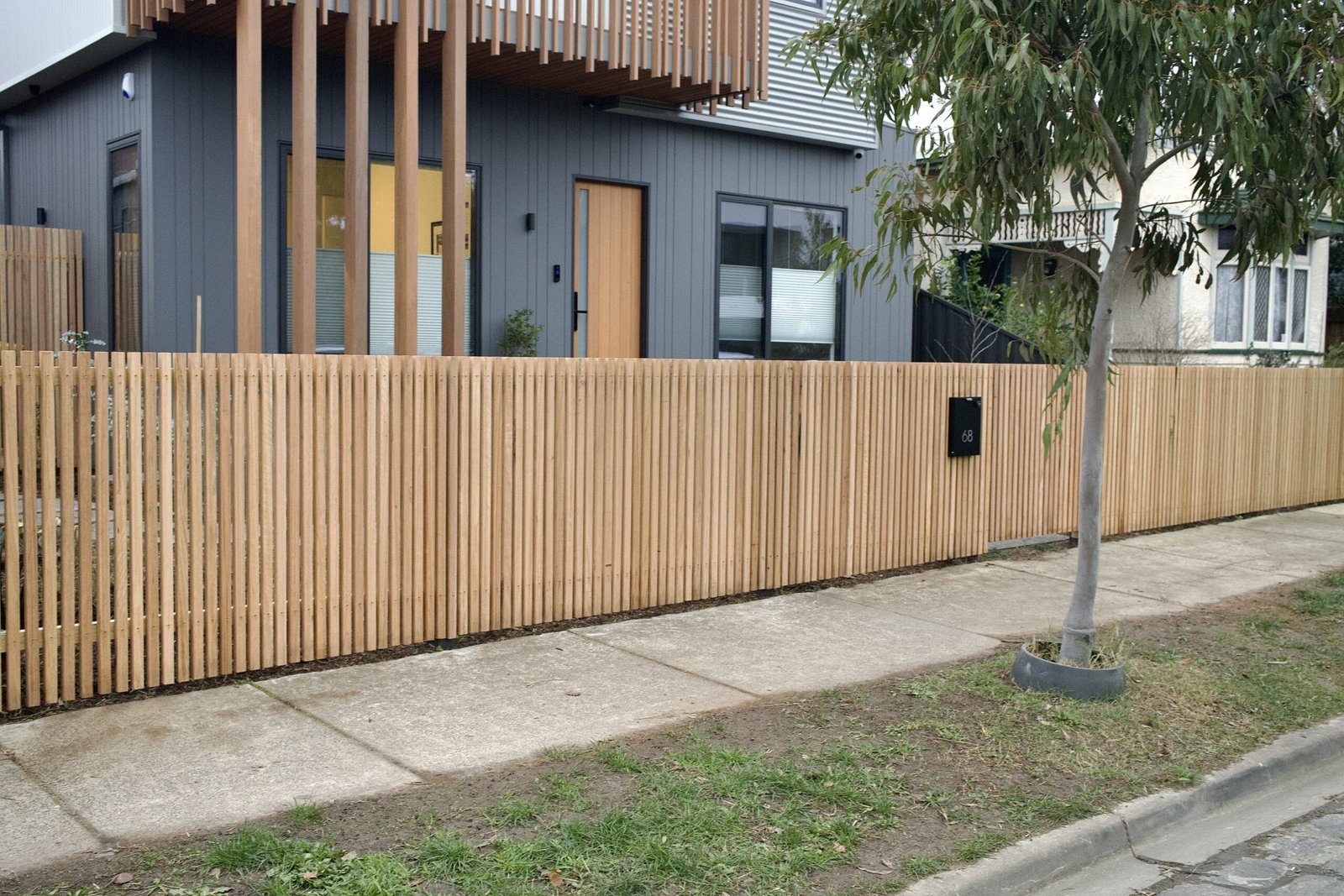
Melbourne front fence and boundary checks
Planning Victoria states that front fences should complement the dwelling and adjoining front fences. Its residential development guidance also provides maximum front-fence height standards for fences within 3 metres of a street, subject to the applicable zone schedule and site context [5].
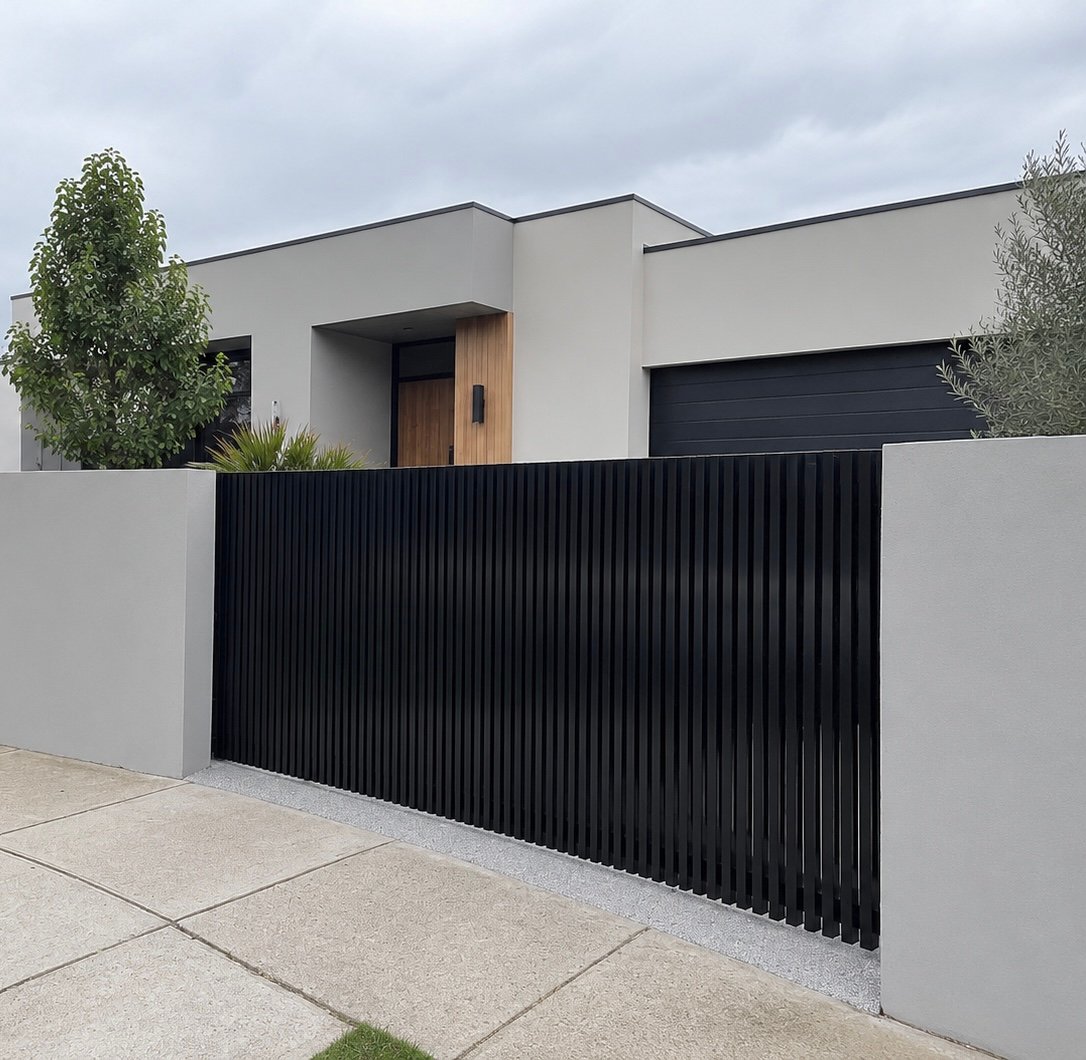
Council requirements can vary. City of Greater Geelong, for example, says a building permit is needed in specified circumstances including a side or rear boundary fence above 2 metres, a front fence above 1.5 metres within 3 metres of the street, and certain higher corner fences [6]. This example should not be applied as a universal Melbourne rule; the relevant council, planning controls and building surveyor should be checked for the project address.
For a shared dividing fence, the Victorian Government recommends discussing the proposed works with the neighbour and provides a formal Fencing Notice process where agreement has not already been reached [7]. A premium aluminium feature fence may also exceed what another party considers a sufficient dividing fence, so scope and contribution should be agreed before fabrication.
Material, finish and maintenance considerations
The Australian Aluminium Council describes aluminium as strong, durable, flexible, lightweight and corrosion resistant, and notes that it can be alloyed, formed in many ways and supplied with different surface finishes [3]. Geoscience Australia also describes aluminium as light yet strong, malleable and highly resistant to rusting because a thin oxide layer forms on the surface [8].
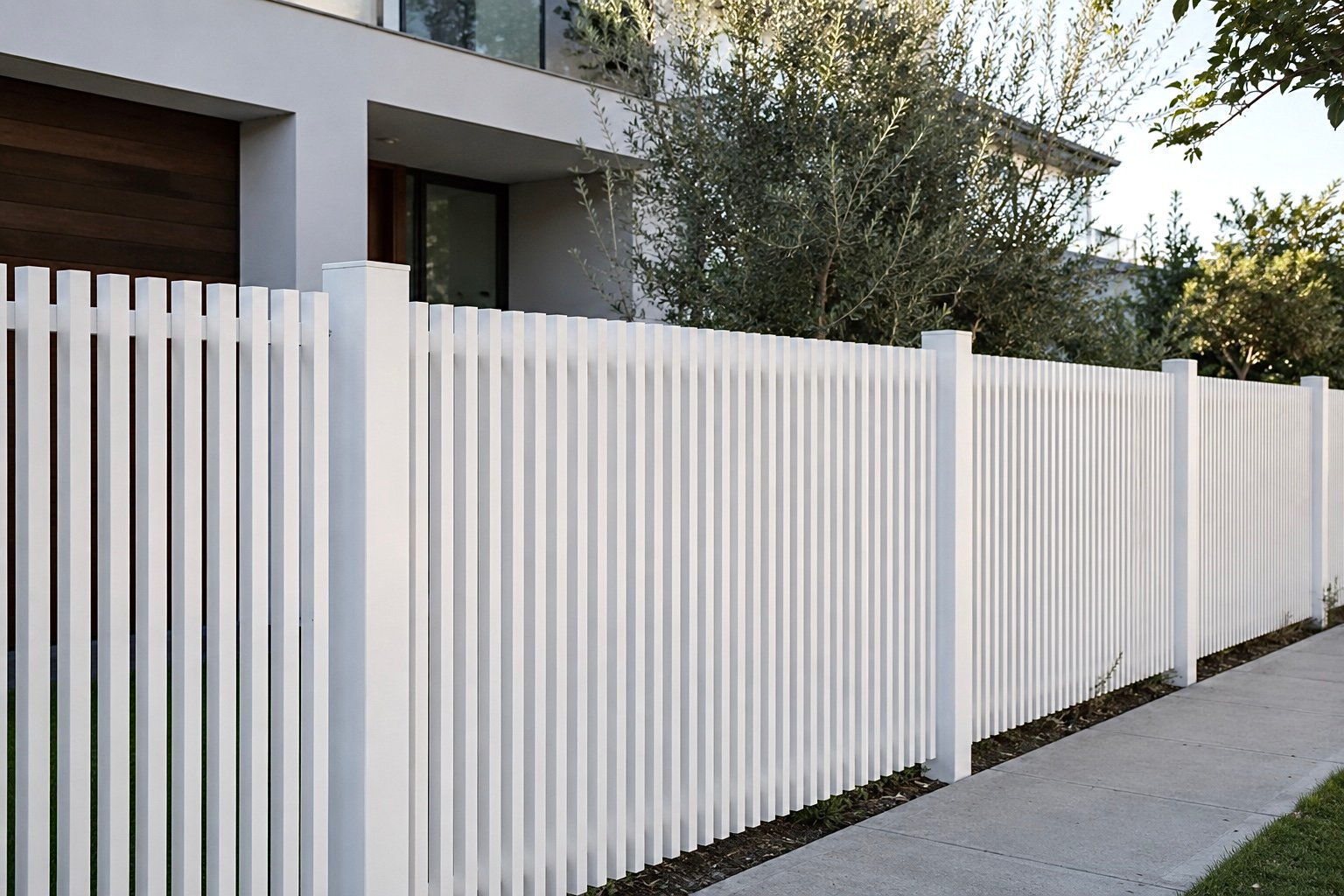
Those properties support architectural fencing, but they do not remove the need for project-specific material selection and maintenance. Ask the contractor to clarify the aluminium profile, coating system, colour, exposed fixings, cleaning access, contact with dissimilar materials and how damaged components can be repaired or replaced.
Quote-readiness checklist for aluminium batten fencing Melbourne
Use this checklist before requesting an aluminium feature fencing or batten-screen quote in Melbourne.
- Application: feature fence, facade-adjacent screen, front boundary, side boundary, courtyard screen or equipment/bin screen.
- Dimensions: approximate length, finished height, panel widths, corners, returns and changes in ground level.
- Batten specification: preferred face width, depth, orientation, clear gap and whether the frame should be visible.
- Screening target: areas that must be hidden, views that should remain open and the relevant viewing angles.
- Gate package: pedestrian, swing, sliding or automated gates, including opening width and hardware requirements.
- Finish: colour, texture, gloss level and any need to coordinate with facade, windows, roofing or landscaping.
- Site constraints: slope, access, existing fence removal, retaining walls, underground services and work near footpaths.
- Approval checks: council area, front or boundary location, overlays, title restrictions and any building or planning advice already obtained.
Decision shortcut
- Choose open batten spacing when the priority is facade rhythm, airflow and a partially transparent frontage.
- Choose closer batten spacing when the screen needs to filter direct views, while checking the effect on airflow and visual weight.
- Use deeper battens when shadow and three-dimensional facade interest are central to the design.
- Use a simpler aluminium style when the project does not need the depth, custom detailing or visual emphasis of battens.
- Use a security-specific system when deterrence, anti-climb performance or high-risk perimeter control is the primary requirement.
Common mistakes to avoid
- Specifying “vertical battens” without dimensions. Width, depth and gap size must be clear enough for contractors to quote the same design.
- Calling every screen a facade. Clarify whether the element is fencing, non-load-bearing screening or part of the building envelope.
- Assessing privacy from one viewpoint. Test the screen from the footpath, road, driveway, neighbouring property and inside the site.
- Designing the gate after the fence. Gate frames and hardware can disrupt the batten rhythm if they are added late.
- Using batten fencing as a default security solution. Architectural screening and high-security perimeter performance are different design problems.
- Ignoring local checks. Height, boundary position, title restrictions, overlays and council rules can change the project pathway.
How Pentagon Fencing can help
Pentagon Fencing & Gates designs, fabricates and installs custom aluminium fencing and matching gates across Melbourne, including aluminium vertical batten fencing for feature fencing, screening and premium commercial or residential applications [1].
- Translate a feature-screen concept into measurable batten profiles, spacing, panels, posts, finish and gate details.
- Compare batten fencing with slat, blade, picket or security-focused systems where the site brief involves different privacy, facade or perimeter priorities.
- Prepare a site-specific quote covering fixed screens, matching gates, access requirements, existing fence removal and installation constraints.
FAQ
What is the difference between aluminium batten fencing and aluminium slat fencing?
Batten fencing generally uses profiles with greater visible depth, creating stronger shadow and a more three-dimensional architectural effect. Slat fencing often reads as a flatter horizontal or vertical screen. The exact distinction depends on the profile and framing specified by the contractor.
Can aluminium batten fencing provide privacy?
Yes, but privacy depends on profile width, depth, gap size, height and viewing angle. A quote should identify which views need screening rather than describing the fence only as “private”.
Can aluminium battens be used as a facade screen?
They can be used as non-load-bearing architectural screens associated with a facade, subject to the attachment, access and project requirements. Do not assume a fencing system is suitable as structural facade cladding, a balustrade, a fire-rated screen or another regulated building element without separate professional review.
Is aluminium batten fencing suitable for a front boundary?
It can suit front boundaries where an architectural appearance and controlled transparency are priorities. The final height, location, sightlines and approval pathway should be checked against the relevant planning scheme, council and building requirements.
Can a sliding or pedestrian gate match aluminium batten fencing?
Yes. The gate can use the same batten profile, spacing and finish, but its frame and hardware may need different structural detailing. Gate type, movement, access control and automation should be resolved before fabrication.
Is aluminium batten fencing a high-security fence?
Not by default. It can define a boundary and control visibility, but high-security suitability depends on height, spacing, climb points, gate hardware, site layout and the required deterrence level. High-risk sites should compare security-specific steel or mesh systems.
What to Keep in Mind
- Define the batten width, depth, spacing and frame rather than quoting from a style name alone.
- Choose spacing from actual privacy, airflow and sightline requirements at the Melbourne site.
- Separate architectural screening from structural facade, balustrade and high-security requirements.
- Plan matching gates, access hardware and automation before the final screen elevation is approved.
- Check front-fence, boundary, neighbour and council requirements before fabrication begins.
References
- Pentagon Fencing, “Aluminium Fencing Melbourne – Commercial & Residential,” Pentagon Fencing. Accessed: Jun. 13, 2026. [Online]. Available: https://pentagonfencing.com.au/service/aluminium-fencing-melbourne/
- Department of Transport and Planning Victoria, “6.4 Barriers and fences,” Planning Victoria. Accessed: Jun. 13, 2026. [Online]. Available: https://www.planning.vic.gov.au/guides-and-resources/guides/urban-design-guidelines-for-victoria/objects-in-the-public-realm/barriers-and-fences
- The Australian Aluminium Council, “What is Aluminium?” The Australian Aluminium Council. Accessed: Jun. 13, 2026. [Online]. Available: https://aluminium.org.au/about-aluminium/what-is-aluminium/
- Pentagon Fencing, “Gates,” Pentagon Fencing. Accessed: Jun. 13, 2026. [Online]. Available: https://pentagonfencing.com.au/service-category/gates/
- Department of Transport and Planning Victoria, “PPN27: Understanding the residential development provisions,” Planning Victoria. Accessed: Jun. 13, 2026. [Online]. Available: https://www.planning.vic.gov.au/guides-and-resources/guides/planning-practice-notes/understanding-the-residential-development-provisions
- City of Greater Geelong, “Fences and retaining walls,” City of Greater Geelong. Accessed: Jun. 13, 2026. [Online]. Available: https://www.geelongcity.vic.gov.au/services/building-planning-and-development/building-and-renovating/fences-and-retaining-walls
- Victorian Government, “Fencing in Victoria,” vic.gov.au. Accessed: Jun. 13, 2026. [Online]. Available: https://www.vic.gov.au/fencing-victoria
- Geoscience Australia, “Aluminium,” Geoscience Australia. Accessed: Jun. 13, 2026. [Online]. Available: https://www.ga.gov.au/education/minerals-energy/australian-mineral-facts/aluminium