
Table of Contents
Where Colorbond fencing is often specified poorly
- You choose full visual privacy for every boundary, even where a street frontage, security patrol route or vehicle entry needs clear sightlines.
- You add a lattice, slat topper or other extension after the base fence has been quoted without reviewing total height, wind exposure, posts, approvals or neighbour agreement.
- You compare only the panel price and overlook demolition, disposal, retaining conditions, sloping ground, heavier posts, gates and restricted site access.
- You treat a solid privacy fence as a high-security anti-climb system even though the site may require weldmesh, palisade, electronic access control or layered perimeter measures.
- You design the fixed boundary first and leave sliding, swing or pedestrian gates until later, creating mismatched heights, colours, clearances or access-control requirements.
Key Takeaways
- Colorbond fencing is a strong option when privacy, clean boundary definition and a consistent finished appearance matter more than open surveillance through the fence.
- Commercial Colorbond fencing Melbourne projects are best suited to service yards, plant areas, storage zones and side or rear boundaries where screening is useful and the risk does not require a specialist high-security fence.
- Residential Colorbond fencing Melbourne projects commonly suit side and rear boundaries, multi-residential developments and locations where both neighbours need a neat, low-maintenance finish.
- A solid fence is not automatically the right choice for a public frontage. Victorian urban-design guidance supports lower or partially transparent boundaries where informal surveillance of streets and public spaces is important [3].
- Extension panels, gates, ground conditions, removal work and site access should be included in one specification before comparing quotes.
What is Colorbond fencing?
Colorbond fencing uses prepainted steel infill sheets held within a post-and-rail system. Unlike a timber paling fence, the finished boundary does not rely on exposed individual palings, and a correctly assembled system can provide continuous visual screening with a coordinated appearance on both sides [1].
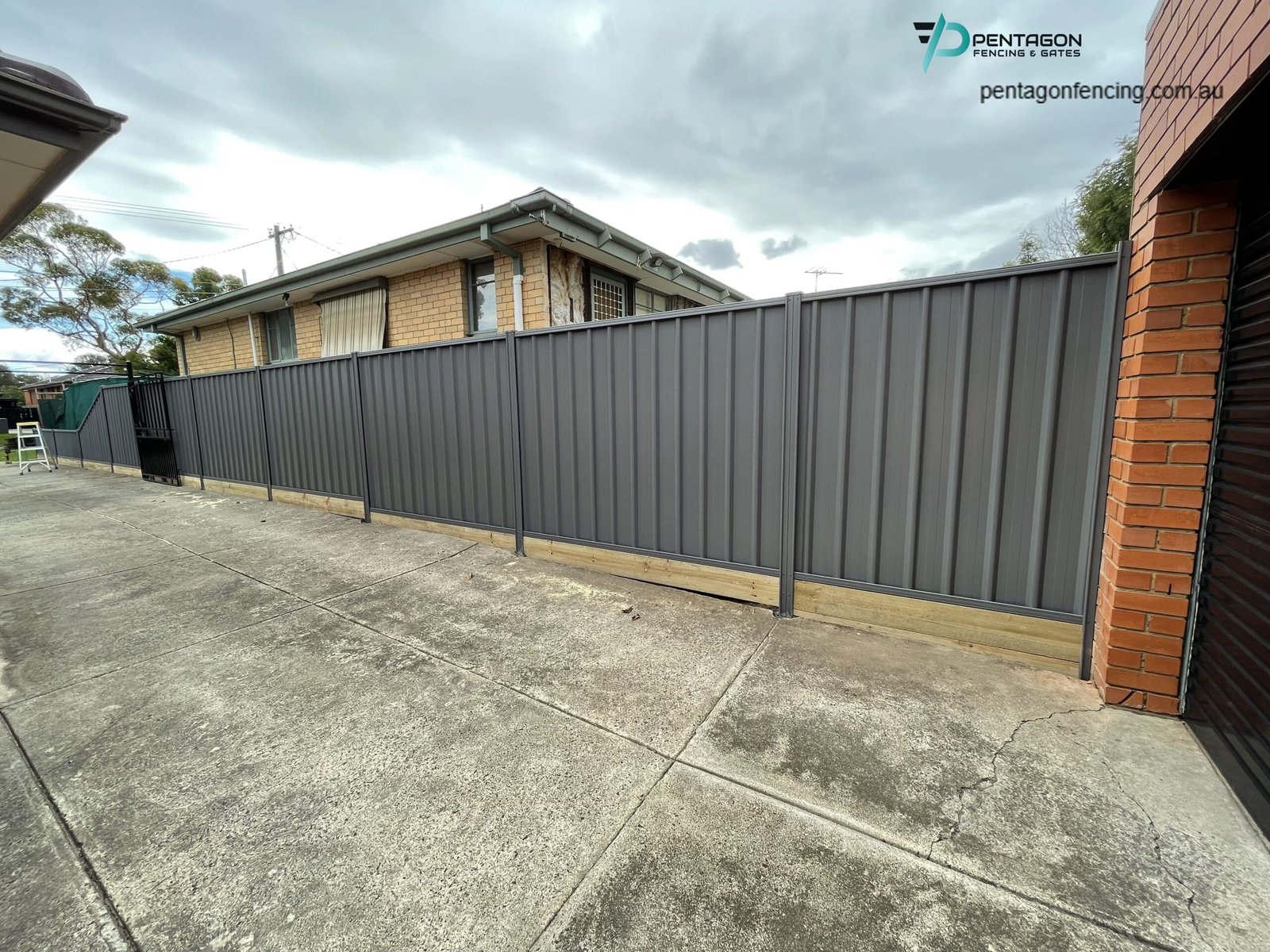
Manufactured systems such as LYSAGHT NEETASCREEN® combine COLORBOND® steel infill sheets with posts, rails and caps as a complete boundary-fence solution [4]. The quote should therefore identify more than a colour name. It should define the panel profile, finished height, bay widths, posts, rails, caps, footing or base detail, treatment of slopes, gate construction and any extension panel.
Where genuine COLORBOND® steel is specified, ask the supplier to identify the product and relevant manufacturer markings rather than assuming every prepainted steel panel is the same product [1].
For buyers comparing privacy fencing Melbourne solutions, the central question is not only whether the panels block views, but whether solid screening is appropriate for each boundary zone.
Where Colorbond fencing fits by site type
This use-case table routes the fence by site need rather than treating privacy as a universal requirement.
| Site scenario | Strong fit when | Watch-out | Next check |
|---|---|---|---|
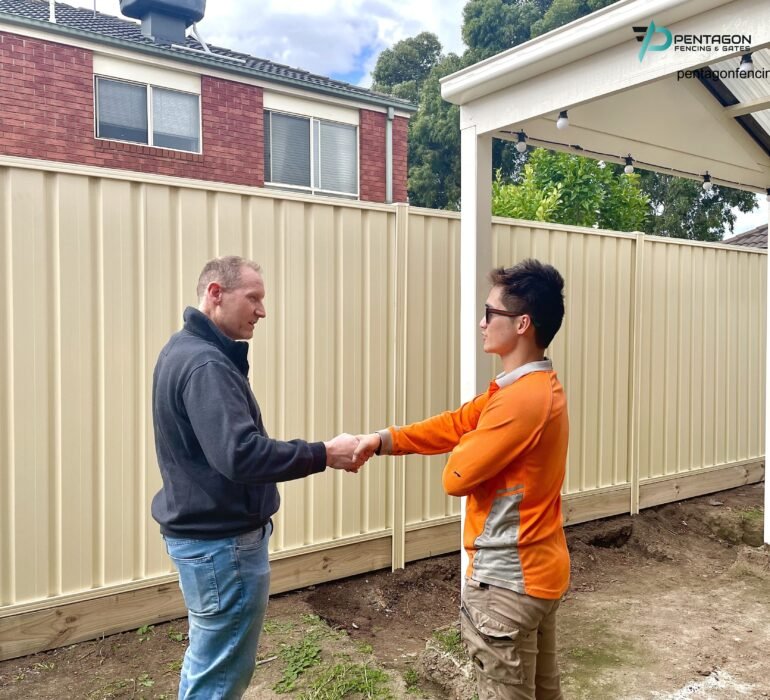
| Residential side or rear boundary | Neighbours want visual privacy, a consistent two-sided finish and less routine upkeep than an exposed timber paling fence. | Height, colour, drainage, existing retaining walls and the process for a dividing fence still need agreement. | Confirm the title boundary, neighbour process, council rules and treatment of level changes. |
| Townhouse or multi-residential development | Repeated private-open-space boundaries need a scalable system, coordinated colours and matching pedestrian gates. | Uniform panels can conflict with landscaping, service access, fire paths or varying finished levels if these are not coordinated early. | Overlay the fence plan with landscaping, drainage, services, gates and construction staging. |
| Commercial service yard, bin area or plant screen | The purpose is to screen equipment, waste, deliveries or back-of-house activity from customers and neighbouring properties. | A completely solid enclosure can affect sightlines, airflow, vehicle movement and passive surveillance. | Check ventilation, access, gate widths, vehicle tracking and any fire or service-clearance requirements. |
| Warehouse or industrial side and rear boundary | The site needs privacy from adjoining land, containment of visual clutter or separation of a lower-risk operational area. | Colorbond should not be assumed to provide the same anti-climb or forced-entry resistance as a purpose-designed security fence. | Separate privacy zones from high-risk asset compounds, vehicle entries and boundaries requiring CCTV sightlines. |
| School, healthcare or community service area | A back-of-house zone needs screening from public view and the boundary can be controlled away from primary pedestrian routes. | Solid fencing around entrances, paths or public edges can reduce visibility and create concealed areas. | Review safeguarding, lighting, emergency access, surveillance and the suitability of transparent fencing in public-facing zones. |
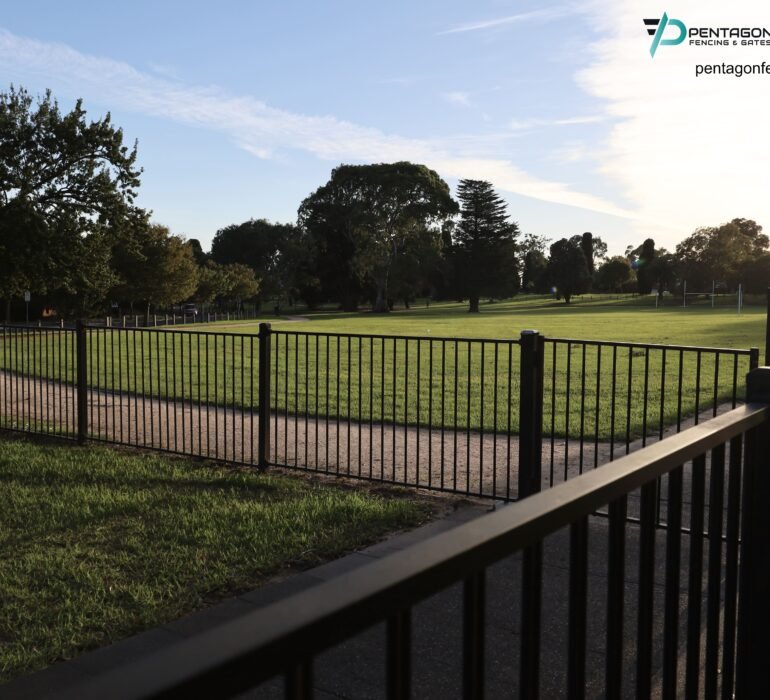
| Street or customer-facing frontage | Privacy is deliberately prioritised and the planning, access and streetscape context supports a solid boundary. | A tall solid fence can reduce informal surveillance and may not suit the desired frontage character [3]. | Compare a lower fence, mixed-material frontage, aluminium slats, tubular steel or weldmesh before locking the design. |
Privacy and boundary-control matrix
The right configuration depends on whether the site needs visual screening, controlled visibility, added height or a coordinated opening.
| Configuration | Privacy level | Best fit | Trade-off or watch-out | Design check |
|---|---|---|---|---|
| Standard solid panel | High visual screening through the panel field. | Side and rear residential boundaries, service yards and lower-risk commercial screening. | Restricts views through the boundary and can create wind exposure or concealed areas depending on the site. | Finished height, post specification, drainage, levels and gate locations. |
| Panel with lattice or slat topper | High at eye level, with partial openness at the top depending on the topper. | Boundaries needing extra visual separation or a decorative transition. | The added element changes total height, wind load, appearance and potentially approvals. COLORBOND® fencing can be personalised with lattice, slats and post-cap options [1]. | Post capacity, total height, neighbour agreement and product compatibility. |
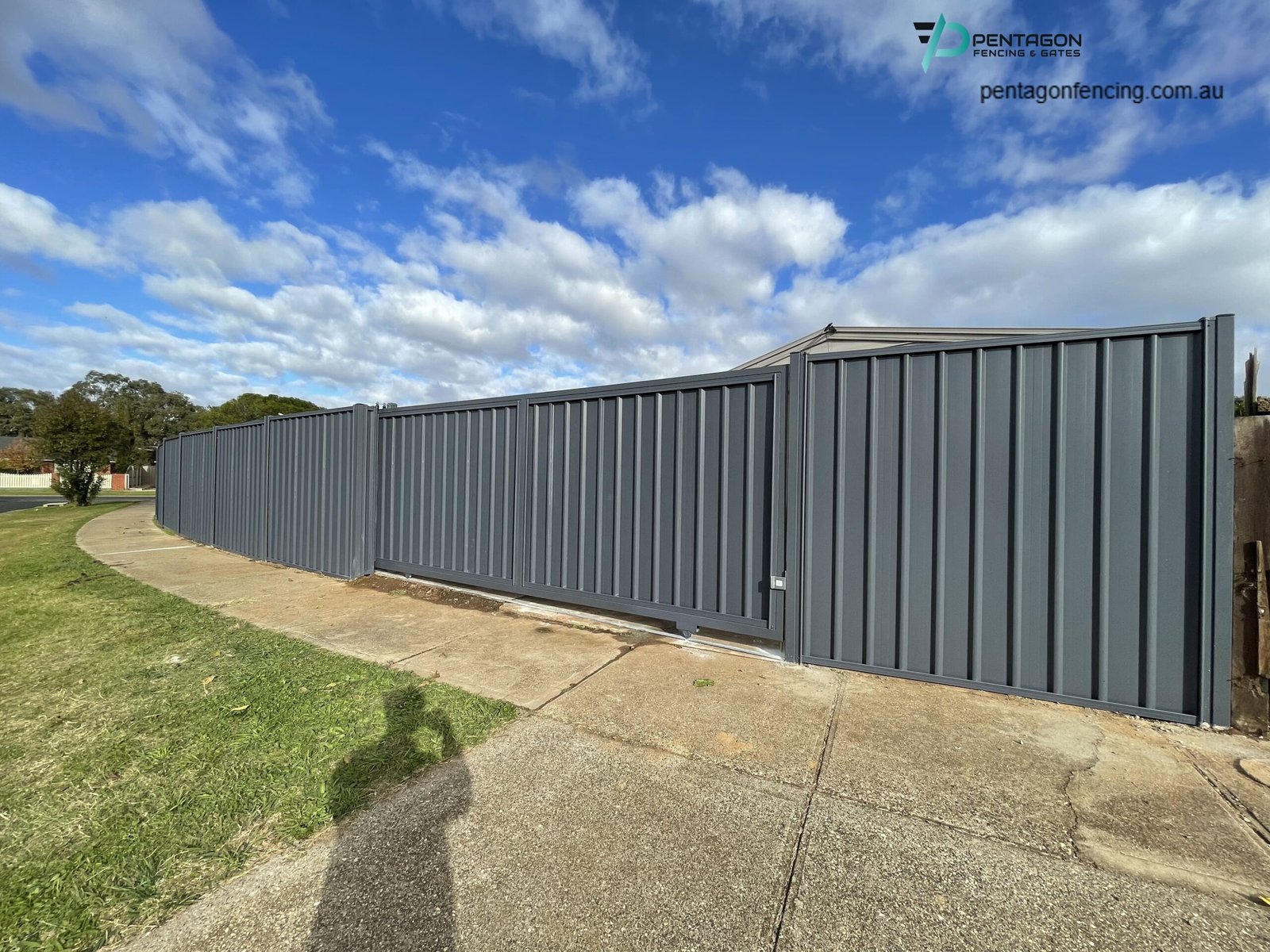
| Matching solid gate | Maintains screening at an opening when closed. | Residential side access, service yards and controlled commercial entries. | Heavy or wide leaves, wind, slope, bottom clearances and automation can change the gate design. | Opening width, operating method, frame, locks, safety and access-control interface. |
| Mixed perimeter | High privacy only where needed; visibility retained elsewhere. | Commercial, industrial, school and healthcare sites with different risk and privacy zones. | Transitions between Colorbond, weldmesh, tubular steel or aluminium must avoid weak points and awkward level changes. | Zone plan, transition posts, matching heights, gate infill and surveillance coverage. |
| Purpose-designed modular or acoustic wall | High visual screening, with project-specific performance available from specialist systems. | Sites where certified acoustic, structural or architectural performance is part of the brief. | A standard Colorbond fence should not be represented as a certified acoustic barrier without system-specific evidence. | Required rating, engineering, foundations, fire or planning constraints and supplier evidence. |
Commercial and industrial Colorbond fencing use cases
For commercial and industrial properties, Colorbond is most useful as a privacy and presentation tool rather than a universal security specification. Common applications include screening bins, plant, loading support areas, stored materials and back-of-house operations; separating lower-risk yards; and creating a clean side or rear boundary beside neighbouring properties.
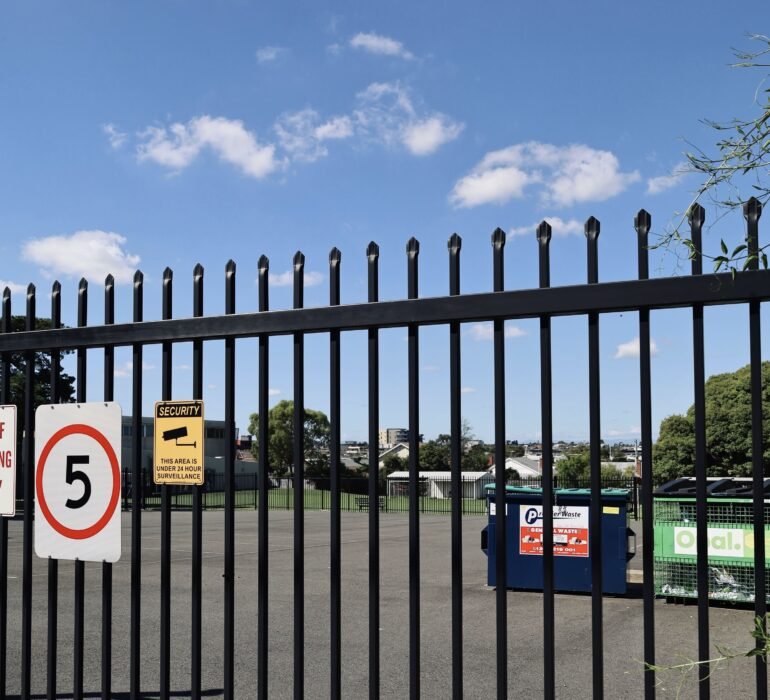
Where theft, repeated climbing or unauthorised access is the primary risk, the site may need weldmesh, palisade, security gates, bollards, lighting or electronic access control instead of, or alongside, a solid steel boundary. Victoria Police recommends combining maintained fences and gates with suitable locks, exterior lighting and a perimeter kept clear of potential climbing aids [5].
A mixed perimeter can therefore be more effective than using one fence everywhere: Colorbond around a service yard, transparent steel fencing at a monitored frontage and a higher-security system around critical assets.
Residential Colorbond fencing and dividing boundaries
For homes and residential developments, the key benefits are usually privacy, consistent appearance and reduced routine upkeep. The same system can be repeated across side and rear boundaries, private courtyards and pedestrian-gate locations without exposing a different front and back face to adjoining properties.
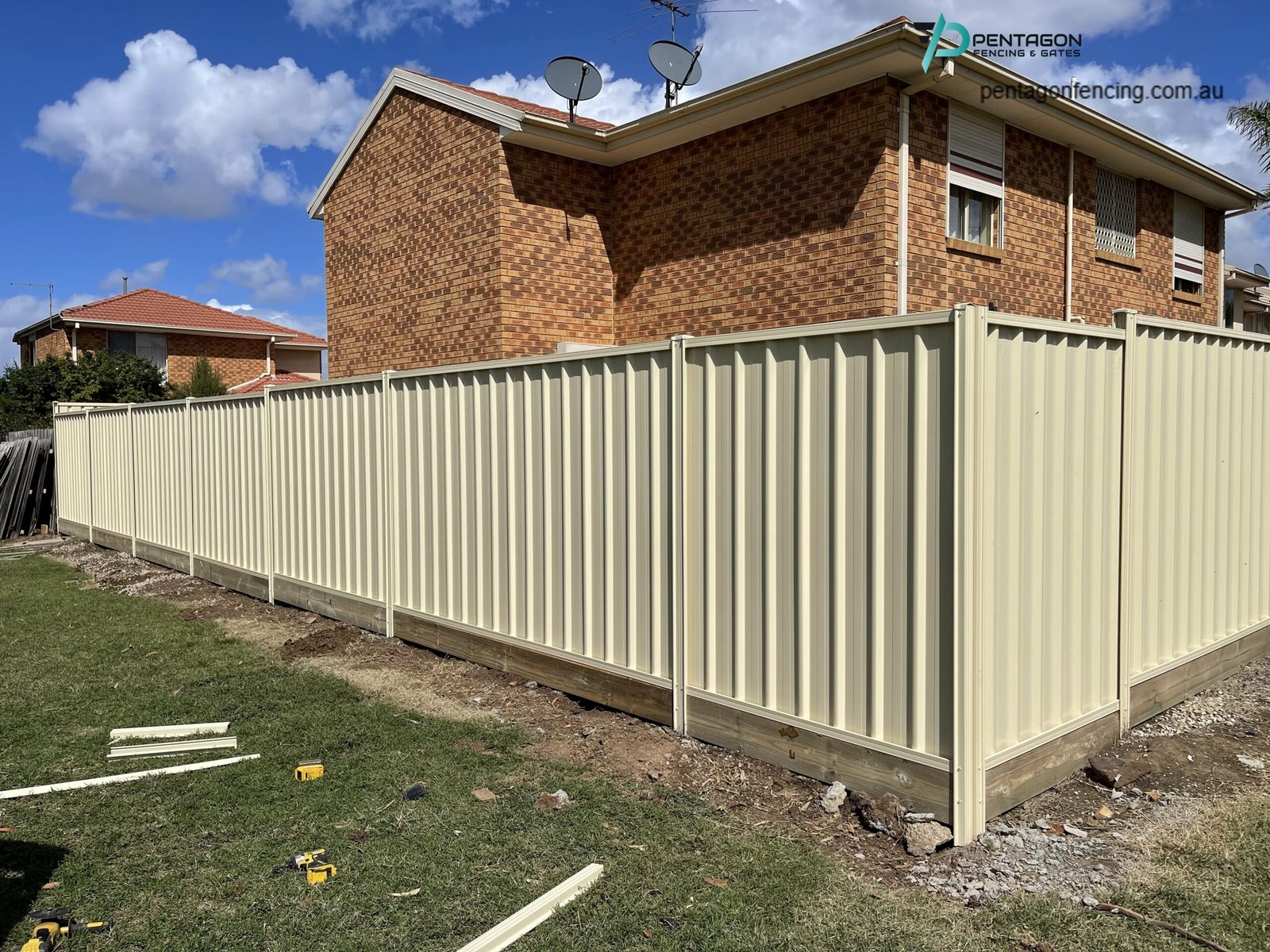
A boundary fence is also a property and neighbour process, not only a product choice. Victorian guidance notes that a sufficient dividing fence depends on factors such as the use of the adjoining land, reasonable privacy and security concerns, and the types of fences commonly used in the area. Property owners should also check local council planning rules before construction [6].
Before ordering materials, confirm the title boundary, who is responsible for the work, the agreed colour and height, removal of the existing fence, access through either property, pets and temporary separation during installation.
When Colorbond is not the best fit
- High-security or anti-climb perimeter: use a system designed and specified for the actual intrusion risk rather than relying on visual privacy.
- Public frontage needing passive surveillance: a lower or partially transparent fence may support safer sightlines and a more open streetscape [3].
- Certified acoustic requirement: select a purpose-designed wall with evidence for the required acoustic performance.
- Pool or safety barrier: do not assume a standard boundary-fence configuration satisfies all barrier, gate and compliance requirements.
- Retaining or major level change: fencing and soil retention are separate structural functions unless a designed system explicitly combines them.
- Severe exposure or unusual structural conditions: obtain project-specific advice for wind, corrosive environments, large extensions, long gates or other non-standard loads.
Colorbond extension panels, fence height and approval checks
Colorbond extension panels, lattice and slat toppers can increase privacy or change the appearance of an existing or new boundary. They should not be treated as a purely decorative add-on. Added height changes the total exposed area, can increase wind demand and may require different posts, rails, fixings or footing details.
Planning and building requirements can vary with the fence location, height, property controls and local council. Planning Victoria notes that each council has its own planning scheme, that permit requirements vary and that a planning permit is separate from a building permit [7]. Local council guidance also confirms that some fences require a building permit and that a registered building surveyor may need to be involved [8]. Check the combined height of the fence and any screen or topper rather than assessing the extension in isolation.
- Confirm the existing fence is straight, stable and compatible with the proposed extension.
- Measure from the relevant ground level and document the total finished height.
- Check title restrictions, planning controls, easements and neighbour obligations.
- Review wind exposure, post spacing, footing condition and manufacturer compatibility.
- Match the extension colour and profile to both sides of the boundary where appearance matters.
Match Colorbond fencing with gates and access control
A matching gate can preserve privacy and visual consistency, but it must be designed as a moving structure rather than as another fixed fence panel. Wide sliding or swing gates need suitable frames, posts, guides or hinges, stops, clearances and locks. Automated entries also need safety devices, power, access control and a duty cycle matched to site traffic.
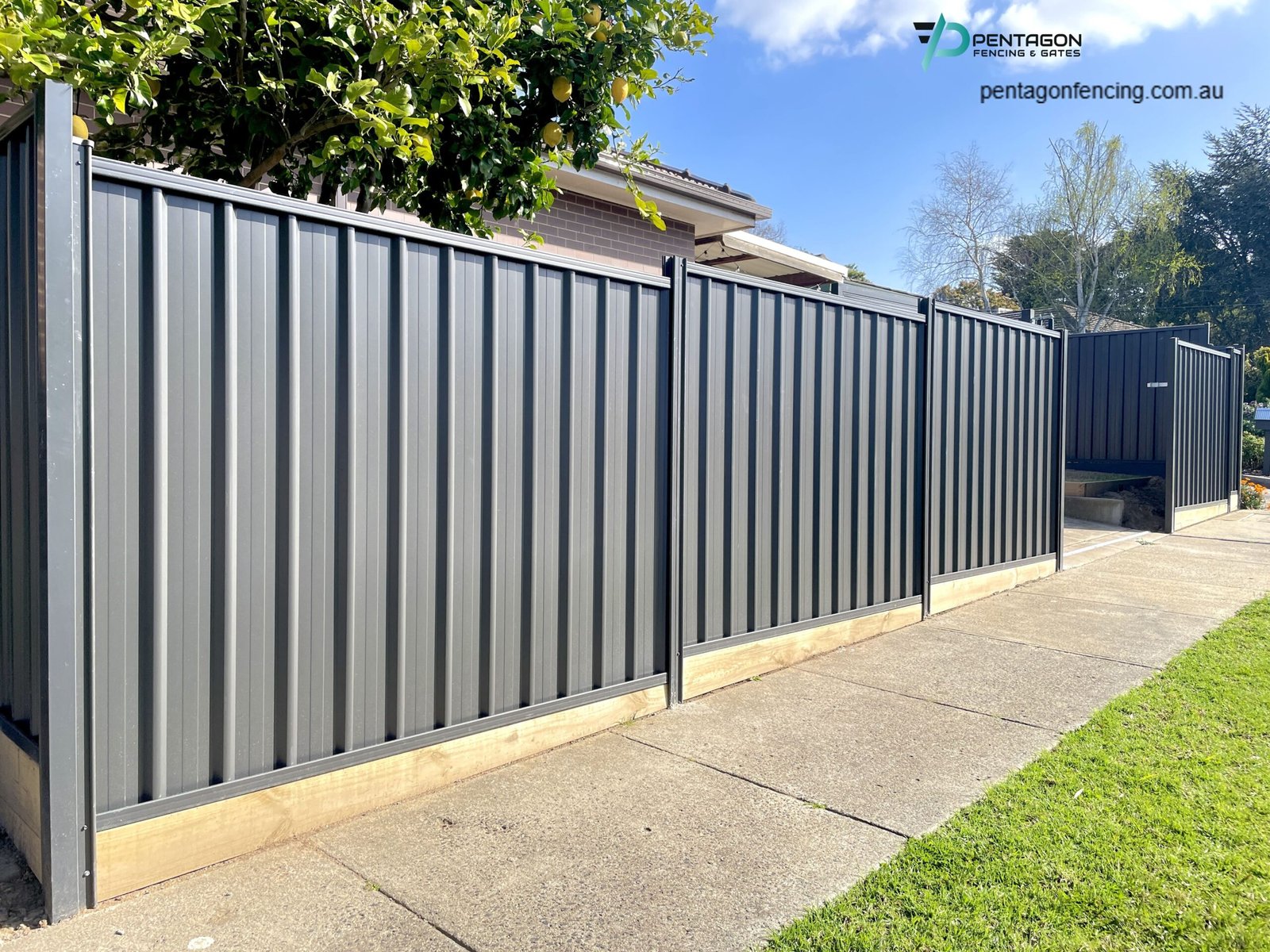
Pentagon supplies COLORBOND® steel sliding gates and automated sliding-gate systems for residential, commercial and industrial properties in Melbourne [9].
- Pedestrian gate: confirm clear opening, latch or lock, self-closing needs, privacy gaps and path levels.
- Swing gate: check opening arc, wind, driveway slope, hinge posts and whether leaves remain inside the property boundary.
- Sliding gate: allow sufficient run-off, guides, stops, track or cantilever structure and a stable base.
- Automated gate: coordinate controls, vehicle detection, safety edges or beams, intercoms and emergency access.
- Mixed-material entrance: use transparent infill where driver and pedestrian visibility is more important than complete screening.
What affects Colorbond fencing cost in Melbourne?
Published per-metre figures rarely describe the complete project. A useful quote comparison checks whether each contractor has priced the same fence, gate package and site conditions.
| Cost driver | Effect on the quote | Caveat | Evidence to request |
|---|---|---|---|
| Fence length and layout | Long runs increase panels, posts, rails, concrete and labour; corners and short returns add set-out and end details. | A simple measured length can exclude corners, gates, obstructions or stepped sections. | Dimensioned fence plan, bay layout and gate schedule. |
| Height, profile and finish | Taller panels and selected profiles can change material quantities, posts, handling and installation requirements. | Height should follow the site need and approvals, not be increased automatically. | Finished height by zone, product profile and colour schedule. |
| Posts, rails and footings | Wind exposure, height, soil and gate interfaces can require different post or foundation details. | A lower panel price may hide lighter supporting components or assumptions about easy ground. | Post and rail schedule, footing assumptions and product data. |
| Slope, retaining and drainage | Stepping, custom sheet treatment, sleepers, retaining interfaces and drainage protection add materials and labour. | A fence should not be assumed to retain soil or block natural drainage without a designed solution. | Level survey, retaining detail, drainage route and maximum bottom gaps. |
| Existing fence removal | Demolition, concrete removal, vegetation clearing, disposal and temporary separation add scope. | Buried footings, asbestos-containing materials or unknown services can require separate assessment. | Clear removal limits, disposal inclusions and excluded hazardous materials. |
| Extension panels or toppers | Lattice, slats and added height increase components and may require upgraded support. | Retrofitting to an existing fence can cost more than integrating the detail into a new system. | Total height, compatibility, structural assumptions and approval responsibility. |
| Gates and automation | Gate frames, support posts, hardware, motors, controls and safety equipment are separate from fixed-fence metre rates. | A wide automated opening can be one of the largest project components. | Gate type, width, frame, infill, hardware, power, controls and safety scope. |
| Access, staging and live-site constraints | Restricted working hours, narrow access, occupied properties, traffic control and temporary security increase labour and sequencing. | Photo-only pricing may change after a site inspection identifies services, rock or access limits. | Site measure, access plan, work hours, temporary controls and exclusions. |
Seven-step selection flow
- Define the boundary purpose. Separate privacy, presentation, neighbour separation, containment, security and noise expectations.
- Divide the site into zones. The street frontage, residential boundary, service yard, critical asset compound and vehicle entry may need different fence types.
- Confirm sightline requirements. Identify CCTV views, pedestrian paths, driveways, intersections and public edges before selecting solid panels.
- Set the complete fence specification. Record profile, colour, height, posts, rails, caps, ground gaps, slopes, extensions and transitions.
- Design gates at the same time. Match infill and colour while resolving frames, posts, locks, movement, automation and safety.
- Check approvals and boundary obligations. Confirm title, neighbour, council, planning and building requirements before fabrication.
- Compare equivalent quotes. Require the same removal, disposal, foundations, access, gates, extensions and handover scope from each contractor.
Colorbond boundary fencing installation checklist
- Boundary and set-out: confirm title information, fence line, corners, offsets, easements, services and interfaces with buildings.
- Levels: record slopes, retaining walls, drainage paths, sleepers, step locations and permitted ground gaps.
- Fence system: document manufacturer, profile, colour, height, bay widths, posts, rails, caps, fixings and footing assumptions.
- Extensions: identify topper type, total finished height, support requirements and approval responsibility.
- Gates: define opening widths, frames, infill, posts, locks, clearances, automation and access-control interfaces.
- Removal and protection: plan demolition, disposal, vegetation, adjoining surfaces, pets, public protection and temporary separation.
- Live-site security: maintain secure gates and joints throughout staged work. WorkSafe Victoria advises that temporary construction fencing should be stable, securely connected and difficult to climb or pass underneath [10].
- Handover: obtain product details, colour records, gate instructions, keys or credentials, maintenance guidance and a defects process.
Maintenance and repair planning
COLORBOND® steel fencing does not require routine repainting in the same way as an exposed timber fence, but it is not maintenance-free. The manufacturer recommends regular washing with clean fresh water to help maintain appearance and service life [1].
- Remove soil, leaves and stored materials that hold moisture against the lower fence.
- Keep garden chemicals, fertilisers, concrete residue and incompatible metal debris away from the steel surface.
- Inspect sheets, rails, caps and posts after impact, storms, excavation or nearby construction.
- Check gates for alignment, loose hardware, damaged coatings, safe clearances and reliable locking.
- Use product-compatible repair or replacement methods rather than covering damage without identifying its cause.
Common mistakes to avoid
- Using privacy as the only selection criterion. Solid panels can conflict with surveillance, streetscape and vehicle sightlines.
- Assuming every prepainted steel fence is genuine COLORBOND® steel. Request product identification and a complete system specification.
- Adding an extension without checking the base fence. Review total height, compatibility, wind exposure, posts and approvals first.
- Expecting a standard fence to deliver certified acoustic or high-security performance. Route those requirements to evidence-backed specialist systems.
- Comparing metre rates with different inclusions. Removal, slopes, retaining interfaces, gates and access can materially change the project.
- Leaving the gate package until the end. Openings must align with the fence height, privacy, traffic flow and access-control plan.
How Pentagon Fencing can help
Pentagon Fencing & Gates can plan and install Colorbond boundaries, matching gates and mixed fence packages for residential, commercial and industrial sites across Melbourne [2].
- Map where solid Colorbond panels are appropriate and where visibility, anti-climb performance or another fence type should take priority.
- Coordinate profiles, colours, heights, extensions, slopes, pedestrian gates, vehicle gates and automation as one project scope.
- Prepare a site-specific quote covering removal work, ground conditions, access constraints and installation staging.
FAQ
Is Colorbond fencing good for privacy?
Yes. Solid steel infill can provide continuous visual screening when the panels, posts, rails and ground gaps are correctly planned. Privacy at gates, slopes and transitions still depends on the complete installed layout.
Is Colorbond fencing suitable for commercial and industrial sites?
It can suit service yards, plant screens, storage areas and side or rear boundaries where privacy and a clean appearance are priorities. Higher-risk perimeters may require weldmesh, palisade or other security measures instead.
Can Colorbond extension panels be added to an existing fence?
Sometimes, but the existing posts, rails, footings, alignment and product compatibility need inspection. The added height may also affect wind demand, neighbour agreement and permit requirements.
Can sliding, swing and pedestrian gates match Colorbond fencing?
Yes. Colorbond infill can be used in matching gate frames, subject to the opening width, wind, slope, support posts, clearances, locking and any automation or safety equipment.
Do I need approval for a Colorbond fence in Melbourne?
Requirements depend on the fence location, height, property controls and local council. Check planning, building, title and dividing-fence obligations before ordering, especially for front fences, corner sites, extensions, pool barriers or non-standard heights.
What to Keep in Mind
- Use Colorbond where privacy and boundary presentation are the main requirements, not as a default answer for every security or frontage condition.
- Zone commercial, industrial and residential sites so solid panels do not obstruct essential sightlines or monitored entries.
- Specify the complete system, including posts, rails, levels, extension panels, gates, automation and removal work.
- Check neighbour, title, planning and building requirements before fabrication or increasing fence height.
- Compare equivalent site-specific scopes rather than relying on an isolated per-metre figure.
References
- COLORBOND® steel, “Fencing,” COLORBOND® steel. Accessed: Jun. 18, 2026. [Online]. Available: https://colorbond.com/products/fencing
- Pentagon Fencing, “Commercial & Residential Colorbond Fencing,” Pentagon Fencing. Accessed: Jun. 18, 2026. [Online]. Available: https://pentagonfencing.com.au/service/commercial-residential-colorbond-fencing/
- Department of Transport and Planning Victoria, “6.4 Barriers and fences,” Planning Victoria. Accessed: Jun. 18, 2026. [Online]. Available: https://www.planning.vic.gov.au/guides-and-resources/guides/urban-design-guidelines-for-victoria/objects-in-the-public-realm/barriers-and-fences
- Lysaght, “Steel fencing with classic rib and pan infill sheets,” Lysaght. Accessed: Jun. 18, 2026. [Online]. Available: https://lysaght.com/profiles/neetascreen
- Victoria Police, “Business premises security,” Victoria Police. Accessed: Jun. 18, 2026. [Online]. Available: https://www.police.vic.gov.au/securing-business-premises
- State Government of Victoria, “Fencing in Victoria,” vic.gov.au. Accessed: Jun. 18, 2026. [Online]. Available: https://www.vic.gov.au/fencing-victoria
- Department of Transport and Planning Victoria, “Guidance for applying for a planning permit,” Planning Victoria. Accessed: Jun. 18, 2026. [Online]. Available: https://www.planning.vic.gov.au/planning-approvals/planning-enquiries-and-requests/applying-for-a-planning-permit
- Glen Eira City Council, “Do I need a building permit?” Glen Eira City Council. Accessed: Jun. 18, 2026. [Online]. Available: https://www.gleneira.vic.gov.au/services/planning-and-building/building/permits/do-i-need-a-building-permit
- Pentagon Fencing, “Sliding Gates,” Pentagon Fencing. Accessed: Jun. 18, 2026. [Online]. Available: https://pentagonfencing.com.au/service/sliding-gates/
- WorkSafe Victoria, “Construction site security fencing,” WorkSafe Victoria. Accessed: Jun. 18, 2026. [Online]. Available: https://www.worksafe.vic.gov.au/construction-site-security-fencing