
Table of Contents
Why public-facing steel fencing needs more than a smooth top
- You want a non-pointed fence, but the rail positions, gaps or nearby objects may still create climbing opportunities.
- You need security around a school or public facility, but the broader access, supervision, emergency and pedestrian-flow requirements have not been mapped.
- You are treating rod top as a universal substitute for spear top, even though higher-risk zones may need weldmesh, palisade or another security-specific system.
- You have selected fence panels before planning pedestrian gates, vehicle gates, self-closing hardware, automation or access control.
- You are comparing powder-coated finishes without confirming the galvanising, surface preparation, damaged-coating repair and maintenance requirements behind the colour.
Key Takeaways
- Steel rod top fencing can be a stronger fit than pointed spear top fencing where public-facing safety and open visibility matter.
- A smooth top does not establish full safety or security performance. Height, gaps, rails, gates, footholds and surrounding objects must be reviewed as one system.
- Planning Victoria recommends non-injurious top details for public-realm barriers and notes that low fences with pointed prongs can create accidental injury hazards [2].
- Victorian school and early-learning requirements can be more specific than a generic product description, including controls for climbing, entrapment, gate operation and unauthorised access [3].
- Rod-top panels can use welded steel construction and protective finishes, but coating selection should match the exposure environment and long-term maintenance plan.
What is rod top steel fencing?
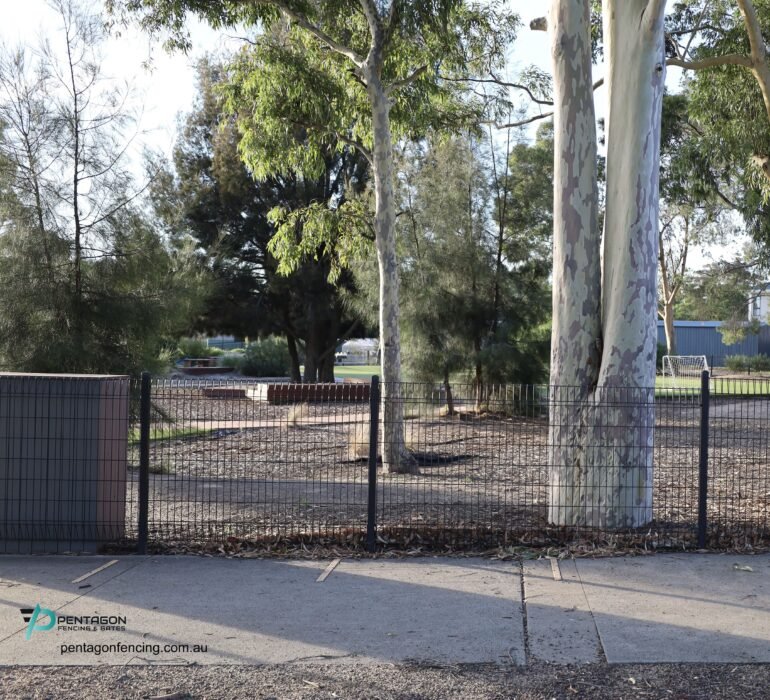
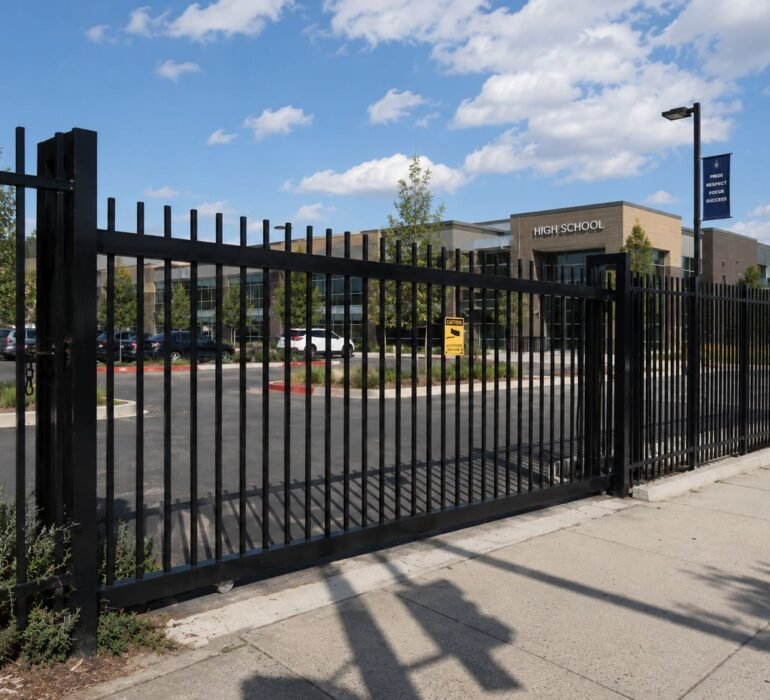
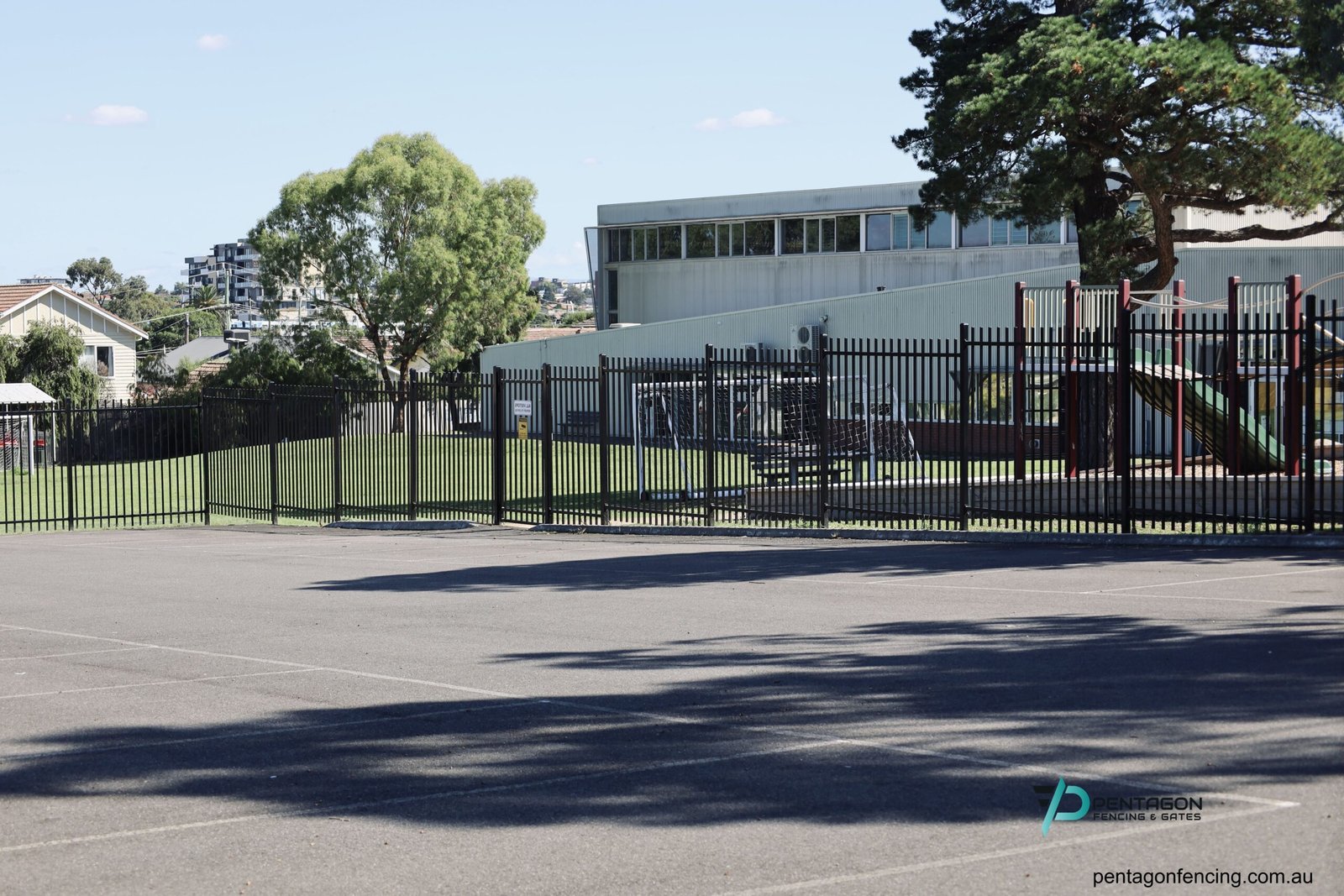
Steel rod top fencing is an open steel panel system with vertical rods, pickets or square hollow sections that terminate without an exposed spear point. Suppliers may also use terms such as square top fencing, smooth top steel fencing or rod-top tubular fencing.
A typical system includes:
- vertical rods or pickets
- two or more horizontal rails
- steel posts and brackets or welded connections
- in-ground or base-plated post installation
- galvanised, painted, powder-coated or combined protective finishes
- matching pedestrian, swing, sliding or automated gates
The exact layout matters. A product manufacturer, for example, describes rod-top panels using vertical pickets fitted through horizontal rails, welded construction, galvanised steel and powder-coated finish options, with panel size and colour able to vary by project [4]. Treat those details as examples of configurable construction rather than a universal specification.
Rod top steel fencing Melbourne decision matrix
Use this matrix to decide whether steel rod top security fencing deserves a place on the project shortlist.
| Decision requirement | When rod top is a strong shortlist | When rod top may not be enough | Contractor check |
|---|---|---|---|
| Non-pointed top profile | The site needs an open steel boundary without exposed spear points near pedestrians, students or visitors. | The project needs specialised child-safety, pool-barrier, balustrade or other regulated performance that a generic rod-top label does not prove. | Confirm the top shape, edge treatment, finished height and who can approach the fence. |
| Visibility and supervision | Open rods support views through the boundary for staff, security personnel and passive surveillance. | The site needs privacy, acoustic screening or concealment of plant, bins or service areas. | Review rod spacing, sightlines, lighting, CCTV views and landscaping from both sides. |
| Moderate security and access control | The goal is to define the perimeter, discourage casual access and channel people through controlled gates. | The site requires a documented high-security, anti-cut or high-deterrence system for valuable or critical assets. | Assess rails, climb points, post foundations, fixings, gates, locks and adjacent objects. |
| Public-facing presentation | The facility needs a durable steel boundary with a cleaner appearance than palisade or spear top. | The streetscape requires decorative ring, loop, picket or architectural screen detailing. | Coordinate height, colour, posts, gate frames, signage and adjoining landscape. |
| Complete fence-and-gate package | Pedestrian and vehicle openings can use matching rod-top infill while controlling movement through designated access points. | Gate movement, self-closing needs, emergency access or high traffic cannot be resolved within the selected layout. | Plan gate type, clear opening, bottom gap, locks, closers, automation and manual release before fabrication. |
Public site fit table
This table keeps the article focused on product and use-case selection. It does not replace the broader planning required for a complete school security fencing or public facility fencing strategy.
| Site type | Potential rod-top role | Critical checks | Route to another solution when |
|---|---|---|---|
| Primary or secondary school | Visible perimeter or selected internal boundary where a non-pointed steel profile supports supervision and access control. | School-specific design requirements, climbing opportunities, gates, emergency access, pedestrian peaks and vulnerable users. | The zone requires tighter anti-climb mesh, privacy, traffic separation or a different safety specification. |
| Early-learning or childcare area | Only where the complete design is verified against the applicable early-learning requirements. | Victorian guidance addresses minimum enclosure height, passing through or under, climbing, entrapment, self-closing and self-latching gates, high handles and reach-over risk [3]. | The proposed rods, rails, gaps, gates or surrounding objects do not satisfy the project-specific child-safety design. |
| Park, playground or recreation area | Boundary definition, pedestrian routing and protection of selected operational or restricted zones in park fencing Melbourne projects. | Non-injurious top detail, visibility, accessible routes, fall or traffic hazards, gate positions and likely public interaction. | The fence functions as a balustrade, fall-protection barrier, pool barrier or high-security enclosure requiring a different design pathway. |
| Government or community facility | Open boundary around public buildings, car parks, service areas and controlled entries where appearance and visibility both matter. | After-hours access, staff and visitor flows, accessibility, security zoning, vehicle interfaces and gate controls. | Critical assets or repeated intrusion require security-grade weldmesh, palisade or another higher-deterrence system. |
| Commercial or healthcare frontage | Durable, visible boundary that looks less aggressive than pointed security fencing. Melbourne steel manufacturers offer custom heights and designs for schools, healthcare and public buildings [5]. | Customer access, patient or visitor safety, loading/service separation, visibility and gate operation. | Privacy, hostile-vehicle protection or high-risk perimeter control is the primary requirement. |
Why rod top can be safer than spear top without being universally safe
The main advantage is straightforward: a rod or square top removes exposed spear points from the upper fence line. That can reduce one obvious injury concern where students, visitors, maintenance staff or the public can approach the boundary.
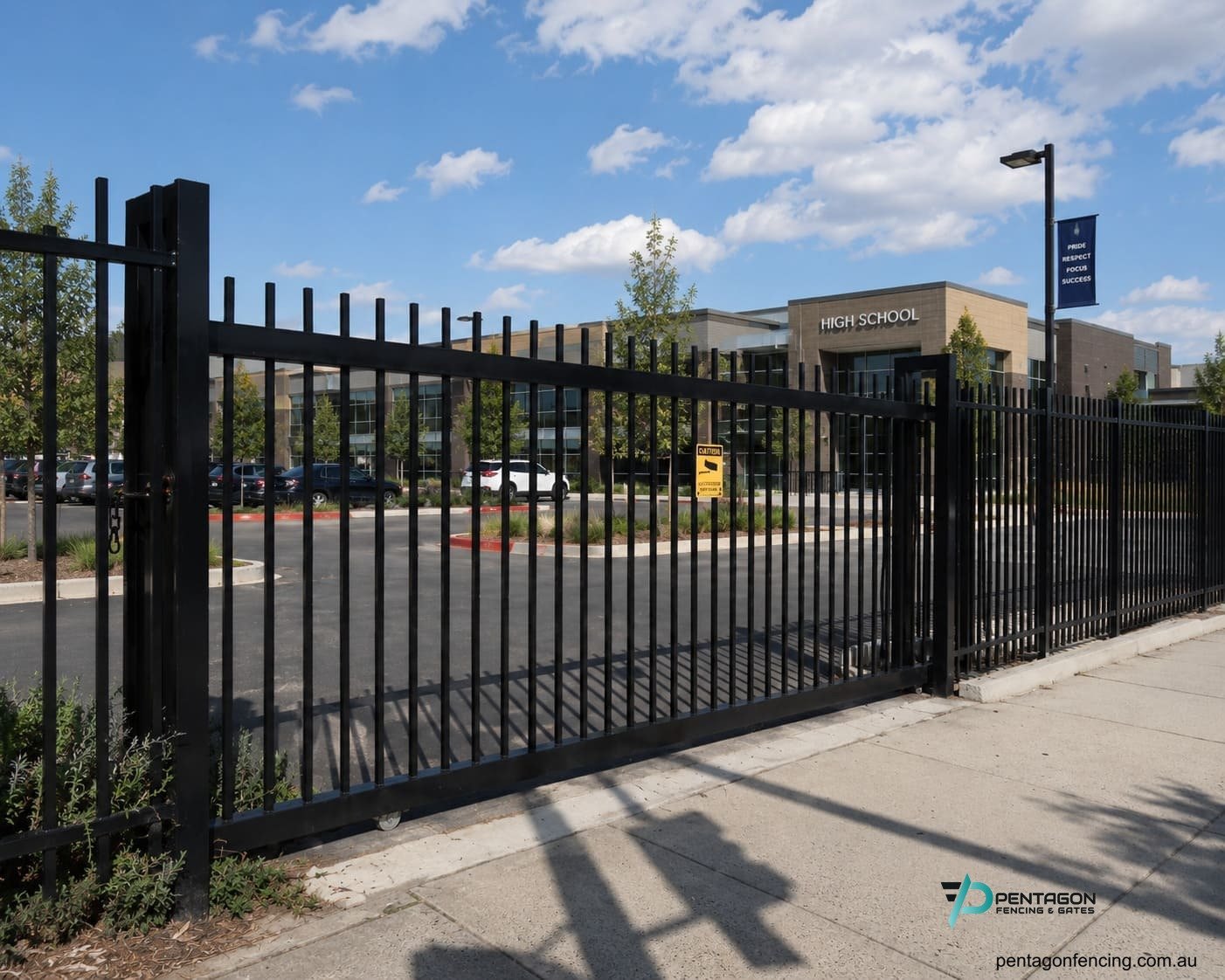
However, public safety depends on more than the end of the picket. Planning Victoria recommends non-injurious top details and partially transparent front fences where visibility to streets and public spaces is important [2]. For early-learning and certain school settings, Victorian guidance also requires designers to prevent children from passing through, climbing over or under, and to manage footholds and objects near the perimeter [3] [6].
A useful specification therefore asks:
- Can a person grip the rods or use the rails as a ladder?
- Do trees, air-conditioning units, benches, bins or play equipment create nearby footholds?
- Can a child pass through, become entrapped in or dig beneath the proposed gaps?
- Does the gate use equivalent gaps, height and anti-climb logic?
- Does the fence preserve the required supervision and CCTV sightlines?
Security performance: what rod top can and cannot do
Rod top can provide a durable physical boundary, channel people toward controlled gates and discourage casual trespass. Its open design can also support surveillance because staff and security systems can see through the perimeter.
It should not automatically be described as a high-security or anti-climb fence. The security result depends on:
- finished height
- rod dimensions and clear spacing
- number and position of horizontal rails
- post and footing strength
- brackets, welds and tamper resistance
- ground clearance and changes in level
- gate frames, hinges, locks and automation
- nearby walls, services, vegetation and movable objects
If the site must resist deliberate climbing, cutting or forced penetration, compare the proposed rod-top system with security-grade weldmesh or palisade rather than relying on its steel construction or security appearance alone.
Welded construction, rods, rails and posts
Product sources show that rod-top panels may be manufactured with vertical steel pickets running through two or more horizontal rails, welded joints, galvanised steel and configurable panel heights [4].
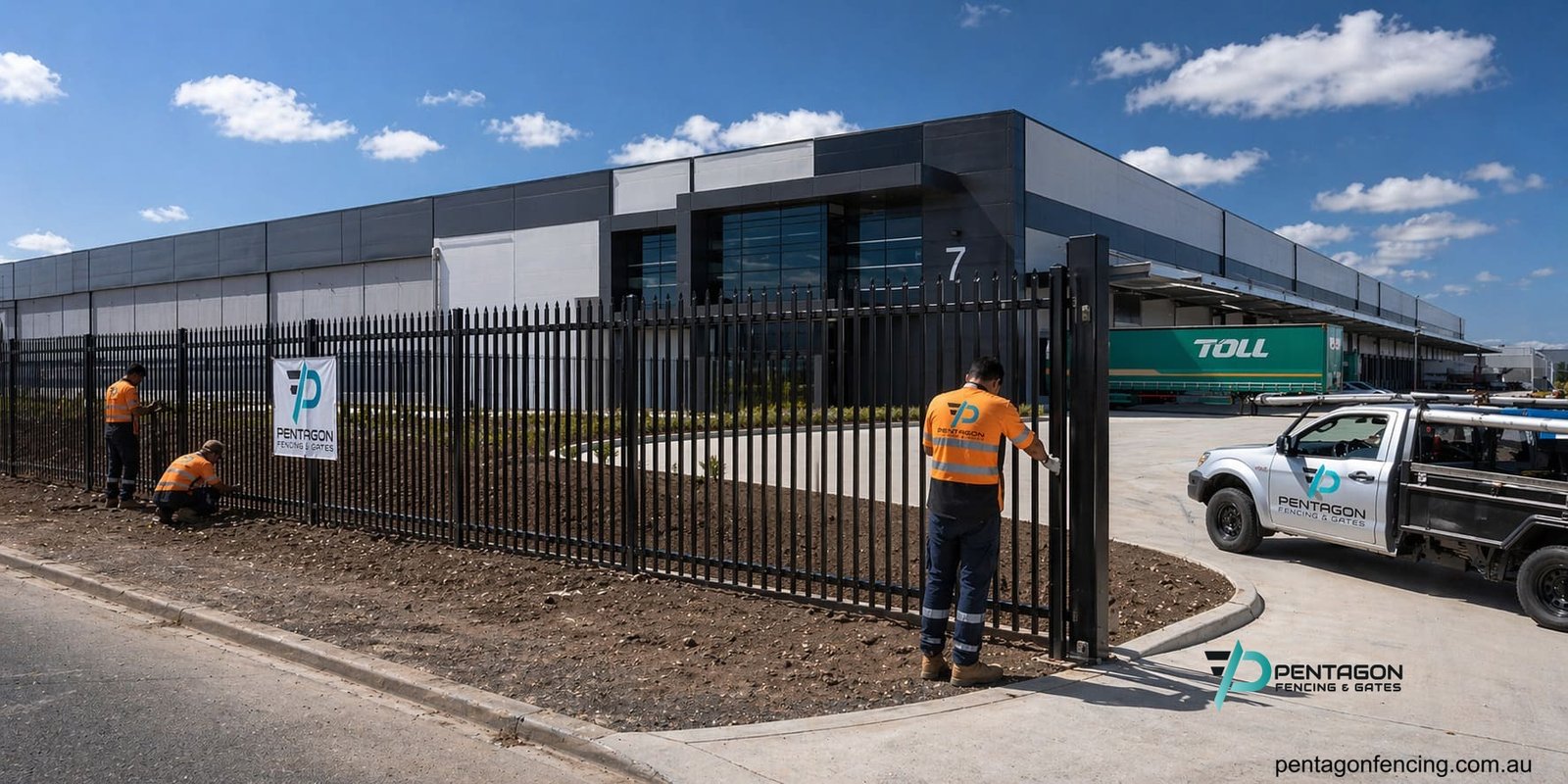
A Melbourne tubular-fencing supplier also describes galvanised steel panels, welded fabrication, powder coating and rod-top designs with compatible gates [7].
For a commercial or public project, ask the contractor to document:
- Rod or picket section: round or square, outside dimensions and wall thickness.
- Clear spacing: gap between verticals and below the panel.
- Rail arrangement: rail size, number and position relative to likely climb access.
- Panel and post system: panel width, post centres, brackets, welds and tamper-resistant details.
- Footings: in-ground depth, concrete, base plates or engineered interfaces where relevant.
- Slope response: raked, stepped or custom panels so ground changes do not create excessive gaps.
- Gate equivalence: consistent height, spacing, bottom clearance, top profile and locking performance.
Powder-coated finish and corrosion protection
A powder-coated steel fence can provide a consistent colour and architectural finish, but powder coating should not be treated as the entire corrosion specification. The Australian Steel Institute states that protective-coating selection should consider the intended corrosion environment, fabrication, surface preparation and whole-of-life maintenance, including the choice between paint systems and hot-dip galvanising [8].
Before accepting the finish schedule, clarify:
- whether the steel is pre-galvanised, hot-dip galvanised after fabrication, painted, powder coated or protected by a combined system
- how welds, cut edges, drilled areas and installation damage are treated
- whether the site has coastal, industrial, irrigation or ground-contact exposure
- how chips, scratches and corrosion will be repaired during service
- whether the gate frames, panels, posts and replacement components use compatible finishes
Gates and access control are part of the safety decision
A strong fence can still produce poor access outcomes if its gates are added late. Pentagon’s gate range includes sliding, swing, side and cantilever gates for different residential, commercial and industrial access conditions [9].
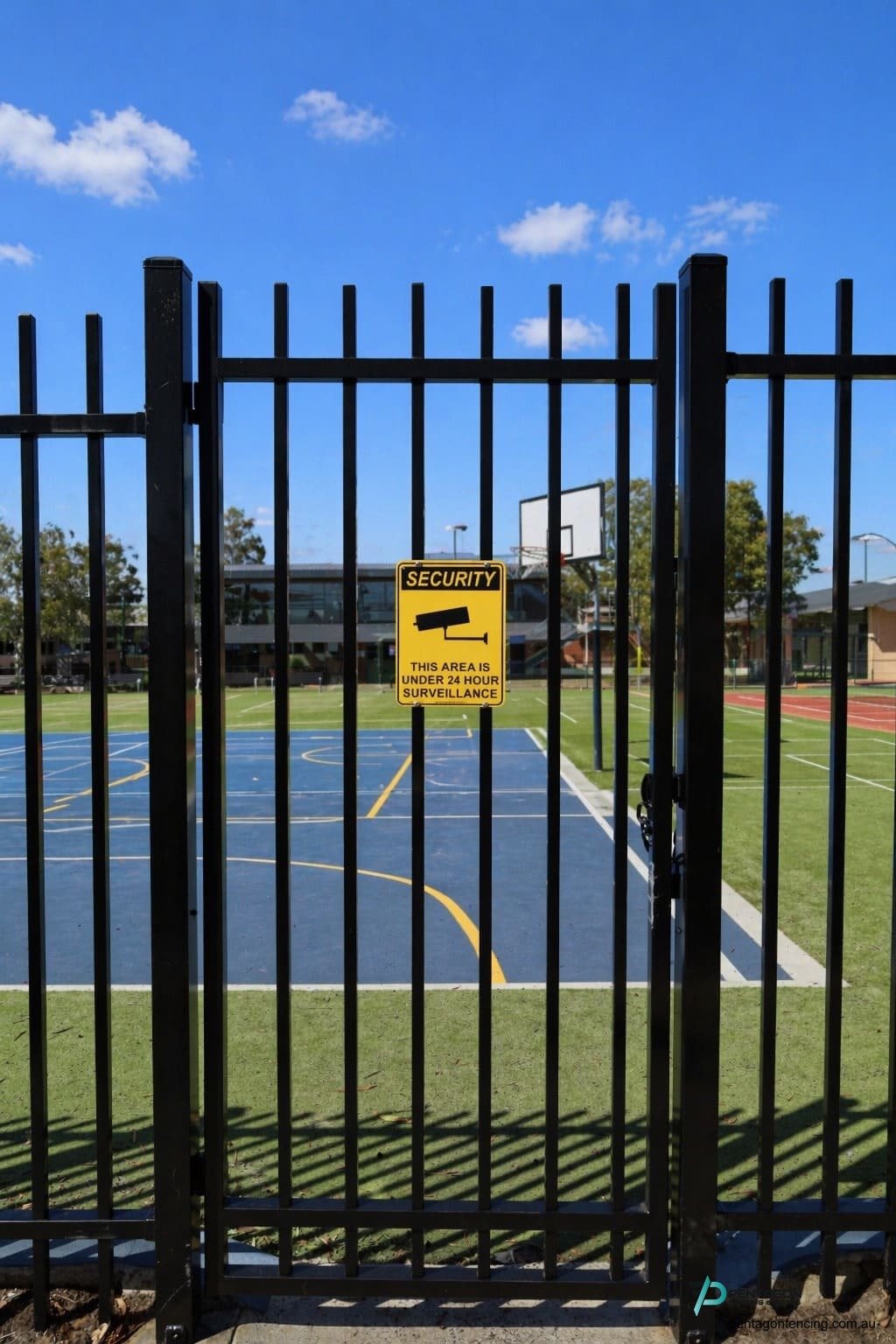
For schools, parks and public facilities, the gate brief should address:
- Pedestrian movement: peak arrival times, queues, accessible paths and separation from vehicles.
- Gate operation: manual, self-closing, self-latching, automated or controlled by staff.
- Hardware location: handles, latches, closers, hinges, intercoms, keypads and emergency release.
- Supervision: whether staff can see and control the entry from the operational area.
- Security equivalence: whether the gate creates larger gaps, footholds or a lower effective height than the fence.
- Service access: maintenance, deliveries, emergency vehicles and after-hours operations.
Five-step selection flow
- Define the zone. Separate the public frontage, student or visitor areas, service yards, car parks and restricted assets.
- Define the user and hazard. Identify children, pedestrians, cyclists, staff, vehicles, climbing risk, traffic exposure and after-hours access.
- Test rod top against the requirement. Decide whether open visibility and a non-pointed steel profile solve the main problem.
- Specify the complete system. Lock the rods, rails, posts, footings, coating, gates, clearances and surrounding landscape.
- Escalate where needed. Route early-learning, pool, balustrade, high-security, traffic-barrier or specialist compliance issues to the appropriate designer, authority or alternative system.
Front boundary and streetscape checks in Melbourne
Rod top can suit a front boundary because its open construction supports visibility, but front-fence controls depend on the property and planning context. Planning Victoria states that residential front fences should complement the dwelling and adjoining fences and provides height guidance for fences within 3 metres of a street, subject to the zone schedule and street type [10].
Schools, parks, government sites and commercial properties can have different authority, planning, building and project-specific requirements. Check the property address, council, zone, overlays, title conditions, traffic sightlines and the role of the fence before fabrication. This article is decision support, not legal, planning or compliance advice.
Quote-readiness checklist
Prepare the following before contacting a rod top fencing Melbourne contractor:
- Site type and zone: school frontage, playground edge, park, public building, car park, service yard or commercial boundary.
- Purpose: boundary definition, controlled access, visibility, public safety, moderate deterrence or asset protection.
- Dimensions: approximate length, target height, corners, slopes, retaining walls and changing ground levels.
- Panel details: rod section, clear gaps, rail positions, posts, brackets and footing approach.
- Gate package: pedestrian, swing, sliding or cantilever gates, plus self-closing, automation or access-control needs.
- Finish: galvanising, powder-coated colour, exposure environment and maintenance expectations.
- Site constraints: existing fence removal, public access, underground services, vegetation and working-hour restrictions.
- Project requirements: school, early-learning, council, asset-owner, planning, building or other documented criteria.
Decision shortcut
- Shortlist rod top when the site needs an open, durable steel boundary without exposed spear points.
- Keep rod top conditional when children, climbing, entrapment, traffic or regulated-barrier requirements affect the design.
- Route to weldmesh or another system when the project needs tighter anti-climb control or smaller openings.
- Route to palisade or a higher-security design when deliberate intrusion and asset protection outweigh public-facing presentation.
- Route to privacy fencing when screening, rather than visibility, is the dominant requirement.
Common mistakes to avoid
- Calling rod top “safe” without defining the users and hazards. A smooth top addresses one issue, not the complete site risk.
- Assuming it is anti-climb. Rails, gaps, nearby objects and gate hardware can create climbing routes.
- Using the school application as proof of school compliance. The actual school or early-learning requirements must be verified for the project.
- Choosing the fence before the gates. Access hardware, self-closing needs, emergency access and vehicle movement can change the layout.
- Specifying colour instead of corrosion protection. Ask what sits beneath the powder-coated finish and how damage will be maintained.
How Pentagon Fencing can help
Pentagon Fencing & Gates supplies and installs steel rod top, tubular, weldmesh, palisade and matching gate systems across Melbourne, allowing the fence type and access package to be matched to the site’s public-facing safety and security priorities [1].
- Review whether rod top fits the proposed school, park, public facility or commercial boundary zone.
- Plan panels, pedestrian gates, vehicle gates, automation and access control as one perimeter package.
- Prepare a site-specific quote covering dimensions, steel construction, coating, removals and installation constraints.
FAQ
Is rod top fencing safer than spear top fencing?
Rod top removes exposed spear points, so it can be a better shortlist where people can approach the boundary. It is not universally safe by product name alone. Height, gaps, rails, gates, footholds and the requirements for the specific site still need review.
Is steel rod top fencing suitable for schools?
It can suit selected school perimeter or internal-boundary applications where visibility and a non-pointed top are important. The complete design must still satisfy the school project’s requirements for climbing, entrapment, access, supervision, gates and emergency operation.
Can rod top fencing be used around parks and public facilities?
Yes, it can define boundaries and control access while retaining sightlines. Check whether the fence is also expected to manage fall hazards, traffic, pools, crowds or high-security risks, because those functions may need another system or specialist design.
Is rod top fencing anti-climb?
Not automatically. Anti-climb performance depends on height, vertical spacing, rail placement, footholds, gates and nearby objects. Ask the contractor to assess the installed system rather than relying on the rod-top shape.
What finish is used on steel rod top fencing?
Systems may use galvanised steel, paint, powder coating or combined protective systems. The suitable option depends on fabrication, exposure and maintenance conditions. Confirm how welds, cut edges and installation damage are protected.
Can rod top fencing include matching gates?
Yes. Pedestrian, swing, sliding or cantilever gates can use matching rod-top infill. Gate frames, gaps, locks, closers, automation and access-control hardware should be designed with the fence from the start.
What to Keep in Mind
- Use rod top when a non-pointed, visible steel boundary fits the site’s actual safety and security needs.
- Check rods, gaps, rails, footholds, gates and nearby objects rather than judging the fence by its top profile alone.
- Verify school, early-learning, park and public-facility requirements for the specific Melbourne project.
- Specify corrosion protection and matching gate systems before fabrication and installation.
- Route higher-security, privacy or specialist barrier needs to the appropriate alternative system.
References
- Pentagon Fencing, “Palisade Fencing & Steel Security Fencing Melbourne,” Pentagon Fencing. Accessed: Jun. 14, 2026. [Online]. Available: https://pentagonfencing.com.au/service/steel-security-fencing-melbourne/
- Department of Transport and Planning Victoria, “6.4 Barriers and Fences,” Planning Victoria. Accessed: Jun. 14, 2026. [Online]. Available: https://www.planning.vic.gov.au/guides-and-resources/guides/urban-design-guidelines-for-victoria/objects-in-the-public-realm/barriers-and-fences
- Victorian School Building Authority, “5. Technical Specifications,” School Buildings Victoria. Accessed: Jun. 14, 2026. [Online]. Available: https://www.schoolbuildings.vic.gov.au/building-quality-standards-handbook/technical-specifications
- Fence Depot, “Rod Top Steel Fence Panel, Rod Top Security Fence,” Fence Depot. Accessed: Jun. 14, 2026. [Online]. Available: https://www.fencedepots.com/au/products/rod-top-steel-fence-rod-top-security-fence.html
- Doogood Australia, “Industrial / Commercial Fencing,” Doogood Australia. Accessed: Jun. 14, 2026. [Online]. Available: https://www.doogoodaustralia.com.au/industrial-commercial-fencing
- Victorian School Building Authority, “3. Planning,” School Buildings Victoria. Accessed: Jun. 14, 2026. [Online]. Available: https://www.schoolbuildings.vic.gov.au/building-quality-standards-handbook/planning
- Macedon Fencing, “Tubular Fencing Melbourne,” Macedon Fencing. Accessed: Jun. 14, 2026. [Online]. Available: https://macedonfencing.com.au/products/tubular-fencing
- Australian Steel Institute, “Corrosion Protection,” Australian Steel Institute. Accessed: Jun. 14, 2026. [Online]. Available: https://www.steel.org.au/what-we-do/focus-areas/steel-and-design/corrosion-protection/
- Pentagon Fencing, “Gates,” Pentagon Fencing. Accessed: Jun. 14, 2026. [Online]. Available: https://pentagonfencing.com.au/service-category/gates/
- Department of Transport and Planning Victoria, “PPN27: Understanding the Residential Development Provisions,” Planning Victoria. Accessed: Jun. 14, 2026. [Online]. Available: https://www.planning.vic.gov.au/guides-and-resources/guides/planning-practice-notes/understanding-the-residential-development-provisions