
Table of Contents
Why a low headline price can produce the wrong chain wire fence
- You compare quotes by linear metre without checking mesh aperture, wire diameter, fence height, posts, bracing, rails, strain wires or gates.
- You use the same chain wire specification for a sports enclosure, warehouse boundary, temporary work zone and restricted compound.
- You choose an open perimeter for visibility but do not plan lighting, CCTV sightlines, vegetation control or the location of pedestrian and vehicle gates.
- You treat chain wire as a high-security anti-climb system even though climbing, cutting or repeated forced entry is the site’s main risk.
- You specify galvanised or PVC-coated mesh without matching the coating system to coastal, industrial, wet, high-impact or long-term maintenance conditions.
- You add barbed or other security toppings without confirming that they are appropriate, permitted and safe for the site’s users and public exposure.
Key Takeaways
- Chain wire fencing is strongest as a flexible, visible and cost-controlled perimeter solution for large boundaries, sports facilities, industrial yards, storage zones and selected temporary applications.
- It should not be positioned as the highest-security option. Pentagon’s security guide routes chain wire to coverage, visibility and budget control, while recommending stronger mesh or steel systems where climbing, cutting or forced entry is the main risk [2].
- Chain link fencing Melbourne quotes should define aperture, wire diameter, height, selvedge, posts, supports, finish, gates and ground conditions rather than rely on price per metre alone.
- Standards Australia lists AS 1725.1-2010 as the current general-requirements standard for chain-link fabric security fences and gates [3].
- Galvanised, PVC-coated and other coating options should be selected for the exposure and lifecycle requirement, not colour alone.
What is chain wire, chain link or chain mesh fencing?
Chain wire fencing is made from steel wire woven into repeated diamond-shaped openings. The terms chain wire, chain link and chain mesh are commonly used for the same product family, although suppliers may use different names for the full post, rail, cable and gate system.
A typical installation can include:
- woven chain-link fabric with a selected diamond aperture and wire diameter
- line, corner, end and gate posts
- top rails, bottom rails or tension/strainer wires depending on the design
- bracing at corners, ends, gates and long straight runs
- knuckled or barbed selvedges at the top and bottom of the mesh
- galvanised, PVC-coated, fusion-bonded or other protective finishes
- pedestrian, swing, sliding or cantilever gates with matching chain-wire infill
Australian supplier specifications show why the product name alone is not enough. Profence lists chainwire apertures from 25 mm to 60 mm, several wire diameters, a broad range of heights and multiple finishes, with the selected selvedge nominated for the project [4].
What affects chain wire fencing cost?
The following pricing-factor table explains why two commercial chain wire fencing quotes can differ even when they cover the same boundary length. It deliberately avoids fixed price ranges because labour, material supply, access and project requirements change over time and by site.
| Cost driver | Why it changes the quote | Evidence to request | Common quote gap |
|---|---|---|---|
| Perimeter length and layout | Long straight runs can use repeatable components, while corners, returns, short sections and changing directions add posts, bracing and labour. | Measured plan showing fence runs, corners, ends, gates and internal enclosures. | A price based on approximate metres without counting corner, end and gate assemblies. |
| Fence height | Higher fences require more mesh, longer posts and often stronger supports, footings and installation equipment. | Finished height by site zone, including ground changes and gate heights. | Assuming one nominal height applies along a sloping or stepped boundary. |
| Mesh aperture and wire diameter | Smaller apertures and heavier wire change material quantity, weight, handling and the level of resistance expected from the fabric. | Exact diamond aperture, wire diameter and relevant product data. | Quotes that say only “chain mesh” without identifying the mesh specification. |
| Posts, rails, cables and bracing | Post section, spacing, rails, tension wires, stays and bracing determine how the flexible mesh is supported and strained. | Post schedule, support system, bracing locations and footing method. | Comparing mesh supply with a complete installed fencing system. |
| Selvedge and security toppings | Knuckled and barbed edge treatments, extension arms or approved toppings change material, installation and safety requirements. | Top and bottom selvedge, topping design and confirmation that it fits the site’s users and requirements. | Adding deterrent toppings without reviewing public exposure, maintenance or approvals. |
| Coating system | Heavy galvanising, PVC coating and bonded coating systems have different supply, exposure and maintenance implications. | Wire, posts, rails and fittings finish schedule, including repairs to damaged coatings. | Selecting black or green mesh by colour without checking the underlying protection. |
| Gates and access control | Pedestrian and vehicle gates add frames, gate posts, hinges or rollers, locks, automation and access-control interfaces. | Gate type, opening width, infill, operation, hardware and automation scope. | A fence-only price that excludes the highest-cost openings. |
| Ground, access and removals | Rock, concrete, retaining edges, buried services, restricted machinery access, traffic management and old-fence removal add labour and risk. | Site measure, service information, access plan and clear inclusions for removal and disposal. | Using a standard rate for a constrained or operational industrial site. |
Where chain wire is a good fit and where it is not
Doogood describes chain mesh as a flexible, cost-effective system used for large perimeters, warehouses, construction sites, sports facilities and public spaces, while also acknowledging that it is not as impenetrable as close-aperture security mesh [5]. The fit table below keeps that limitation explicit.
| Application | Why chain wire can fit | When it is not the best fit | Project check |
|---|---|---|---|
| Warehouse, factory or logistics perimeter | Provides visible coverage across large boundaries and can connect to chain-wire pedestrian, sliding or cantilever gates. | Repeated intrusion, cutting or climbing requires a stronger anti-climb or high-deterrence system. | Separate lower-risk outer runs from loading areas, restricted assets and main access points. |
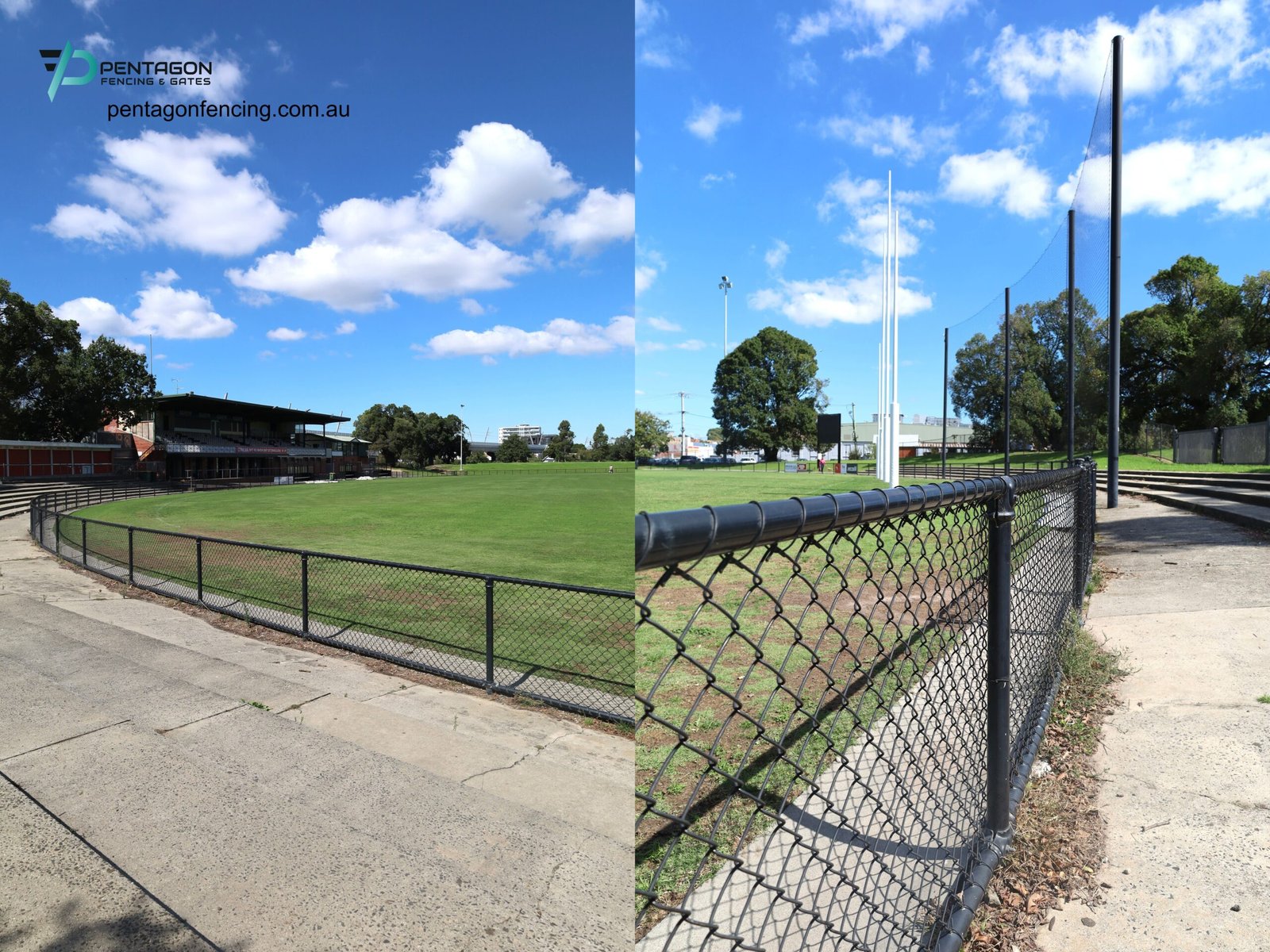
| Sports field, court or ball-stop enclosure | Open mesh retains visibility and can be produced in specialised apertures and taller formats for sporting enclosures. | The project requires an architectural spectator barrier, impact-rated system or regulated fall protection rather than sports containment. | Confirm sport type, ball size, required height, gates, player contact zones and the relevant sports-fencing specification. |
| Temporary construction or staged work zone | Can provide visible temporary or semi-permanent separation when the risk assessment and installation method support it. | A generic fence is being used instead of controlling the actual excavation, demolition, plant or public-access hazards. | WorkSafe Victoria requires appropriate site-security measures to address changing construction hazards and protect workers and the public, including outside working hours [6]. |
| Storage, utility or controlled compound | Supports visibility into the compound and can be paired with locked access gates. | The stored hazard or asset requires impact protection, specialist separation, restricted visibility or a higher-security enclosure. | Some applications have explicit requirements. WorkSafe Victoria, for example, calls for a locked chain-link security fence complying with AS 1725-2010 around specified public-event fuel compounds [7]. |
| Public park, school or community boundary | Maintains sightlines and can use knuckled edges and project-specific gates where public interaction is expected. | Child-safety, pool, playground, entrapment, privacy or anti-climb requirements call for another system or tighter specification. | Check edge treatment, clear openings, footholds, supervision sightlines and all applicable project requirements. |
| Premium street frontage | Can work where utility, visibility and budget are more important than architectural presentation. | Street appeal, privacy or a premium facade is a central project objective. | Compare tubular steel, weldmesh, aluminium slat or architectural screening before confirming chain mesh. |
Security-level routing for large perimeters
Chain wire security fencing can cover a wide range of applications, but the system should be routed by risk rather than described as secure in the same way for every site.
| Perimeter need | Possible chain-wire direction | Upgrade or route-away trigger |
|---|---|---|
| Boundary definition and casual access control | Standard project-specific mesh, suitable height, secure posts, controlled gates and maintained ground clearance. | Frequent climbing, cutting or tampering suggests heavier wire, smaller aperture, upgraded gates or another system. |
| Low-to-medium-risk commercial perimeter | Heavier wire, risk-appropriate aperture, increased height, secure bottom condition, lighting, CCTV and locked gates. | High-value assets, repeated after-hours intrusion or tool-assisted cutting may justify weldmesh or palisade. |
| Sports and public enclosure | Sport-specific aperture and height, smooth public-facing edge treatment, well-positioned gates and regular tension inspection. | Impact, crowd, fall, pool or child-safety functions require their own applicable design pathway. |
| High-security or critical asset perimeter | Do not select chain wire on cost grounds alone. | Assess close-aperture weldmesh, palisade, monitored access, detection and other layered controls. |
Mesh aperture, wire diameter and selvedge
These three variables affect the performance, appearance and cost of chain mesh fencing Melbourne projects:
- Aperture: the size of the diamond-shaped opening. A smaller opening uses more material and can reduce available hand or foot purchase compared with a larger opening, but it should not be labelled anti-climb without assessing the complete system.
- Wire diameter: thicker wire changes strength, rigidity, weight and price. Suppliers offer multiple diameters for standard, high-strength and site-specific requirements [4].
- Selvedge: the treatment at the mesh edge. Knuckle/knuckle, knuckle/barb and barb/barb configurations can serve different public-facing and deterrence purposes [5].
The quote should show the exact values and edge treatment. “Heavy-duty”, “commercial grade” and “security mesh” are not sufficiently precise on their own.
Posts, rails, strain wires and ground conditions
Chain-link fabric is flexible, so the supporting framework and tensioning are essential parts of the system. Corner, end and gate posts carry different loads from line posts. Long runs may require planned bracing, while sloping ground, retaining edges and uneven levels can create excessive bottom gaps if they are not measured correctly.
Before fabrication or installation, confirm:
- post sections, centres and footing method
- corner, end and gate-post bracing
- top rail, bottom rail and/or tension-wire arrangement
- mesh attachment and tensioning method
- maximum permitted bottom gap and how ground changes are handled
- vehicle impact exposure near gates, car parks and loading zones
- underground services, drainage and access for installation equipment
Galvanised, PVC-coated and bonded finishes
Chain mesh is available in several finish systems. Profence lists heavy-galvanised, PVC-coated and fusion-bonded options, while Doogood supplies galvanised, PVC-coated and bonded chain mesh for different environments and appearance requirements [4] [5].
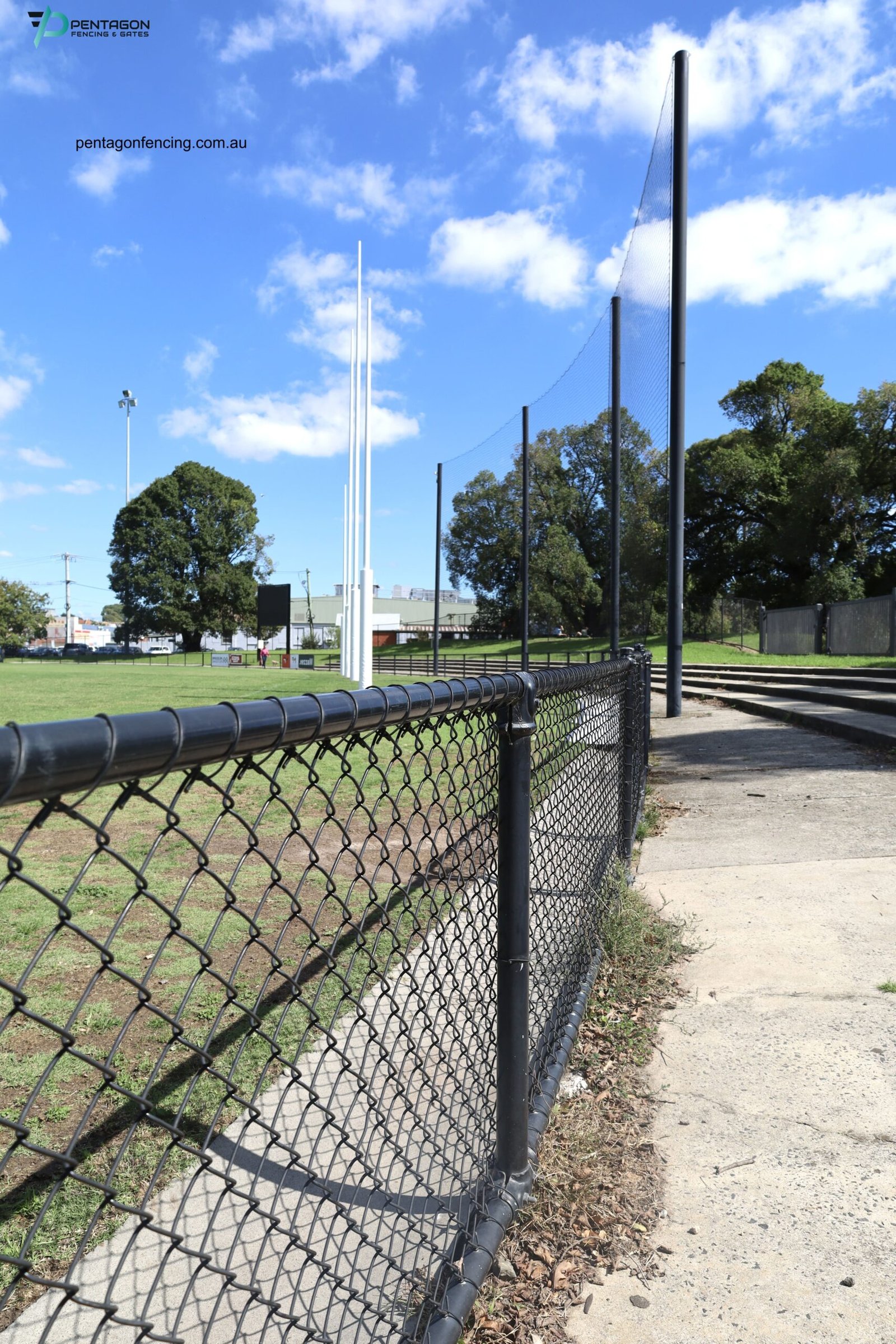
The Australian Steel Institute advises that corrosion protection should be selected through a technically robust, fit-for-purpose specification that considers the exposure environment and whole-of-life maintenance rather than initial appearance alone [8].
- Specify the mesh, posts, rails, fittings and gates, not only the wire finish.
- Check coastal, industrial, irrigation, soil-contact and high-impact exposure.
- Confirm how cut edges, welds, drilled holes and installation damage are repaired.
- Inspect coating damage, loose ties, mesh tension, corrosion, gate alignment and vegetation during maintenance.
- Do not assume black or green PVC coating automatically suits every coastal or industrial environment.
Matching chain-wire fencing with gates
Large perimeter projects usually require more than fence fabric. Pedestrian gates, vehicle gates and controlled entries should match the height, mesh, bottom clearance and security logic of the adjoining fence.
Pentagon supplies chain-wire cantilever gates using galvanised steel frames and chain-link infill for industrial sites, construction compounds, rural properties and utility yards. The gate is designed around the opening width, weight and daily use, with galvanised or powder-coated finish options [9].
- Pedestrian gate: confirm clear width, latch, lock, closer, approach path and whether staff or visitors require controlled access.
- Swing vehicle gate: check leaf size, hinge posts, ground clearance, wind and available opening arc.
- Sliding or cantilever gate: check run-off, support, counterbalance, stops, automation, pedestrian separation and maintenance access.
- Gate infill: match aperture, wire diameter, selvedge and attachment so the gate is not easier to climb or cut than the fence.
- Access control: plan locks, intercoms, keypads, credentials, CCTV and manual release before posts and conduits are fixed.
Temporary versus permanent chain wire fencing
Chain wire can be used in temporary, semi-permanent and permanent projects, but those labels should not be confused. A permanent industrial boundary needs a full post, footing, tensioning, gate and coating specification. Temporary site fencing needs stability, inspection and a current risk-control purpose.
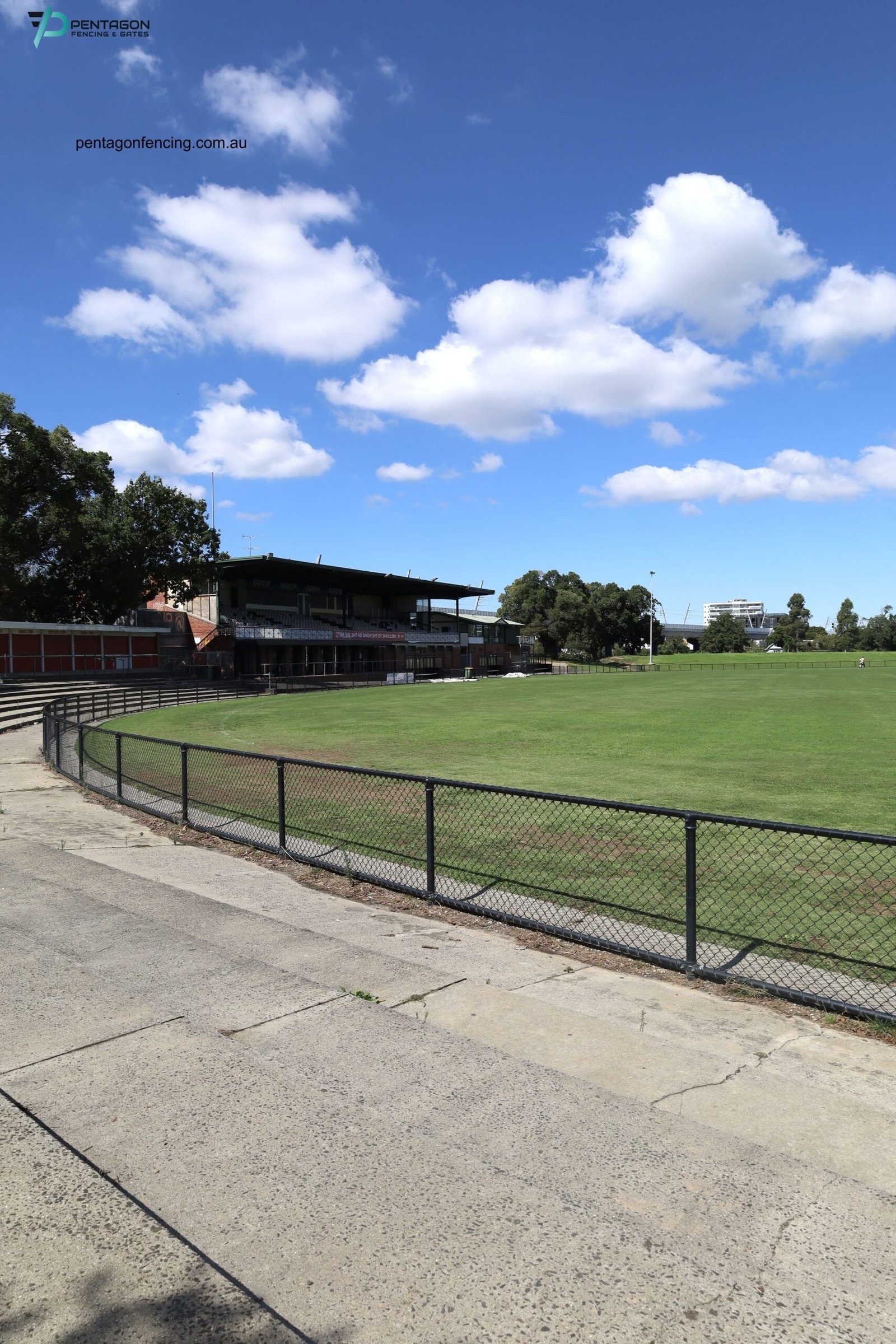
WorkSafe Victoria states that construction-site security must reflect changing hazards and protect members of the public even when work is not taking place [6]. A temporary fence is therefore not adequate merely because it exists; it needs to remain stable, secure and appropriate to the hazards behind it.
Standards and project-specific requirements
Standards Australia states that AS 1725.1-2010 specifies requirements for chain-link fabric security fencing and gates for general applications where restricted access is desirable [3]. Melbourne chain-link manufacturers also reference AS 1725.1-2010 for commercial and industrial fencing systems [10].
The applicable requirements still depend on the application. Sports courts, dangerous-goods compounds, schools, public facilities, temporary works and other specialised sites can have additional standards, owner requirements or authority controls. Ask the contractor which documents apply to the exact project and how the proposed fence and gate specification addresses them.
Quote-readiness checklist for chain wire steel fencing Melbourne
Prepare the following before requesting a chain wire fence quote in Melbourne:
- Use case: warehouse, factory, storage compound, sports enclosure, construction zone, park, school or internal separation.
- Risk level: boundary definition, casual trespass, climbing, cutting, asset theft, public access and after-hours exposure.
- Dimensions: approximate length, height, slopes, corners, returns, gates and retaining interfaces.
- Mesh specification: aperture, wire diameter, selvedge and any sport- or site-specific requirement.
- Framework: posts, rails, cables, braces, ties, footings and bottom restraint.
- Gates: pedestrian, swing, sliding or cantilever; manual or automated; locks and access-control requirements.
- Finish: galvanised, PVC-coated or bonded system and the site’s exposure environment.
- Site works: removals, disposal, vegetation, buried services, concrete, traffic management and restricted access.
- Approvals and standards: applicable Australian Standard, council, authority, owner, WorkSafe or specialised-use requirements.
- Maintenance: inspection, tension adjustment, coating repair, gate servicing and vegetation control.
Decision shortcut
- Shortlist chain wire when large-area coverage, visibility, flexible configuration and budget control are the main priorities.
- Upgrade the chain-wire specification when heavier wire, tighter aperture, more height, stronger gates or improved bottom security can address a moderate risk.
- Route to weldmesh or palisade when deliberate climbing, cutting, forced entry or repeated intrusion is the dominant risk.
- Route to tubular or architectural fencing when public-facing appearance and frontage design outweigh economical coverage.
- Use a mixed-perimeter design when long lower-risk runs and high-risk gates, compounds or frontage zones need different systems.
Common mistakes to avoid
- Comparing only price per metre. Mesh, wire, framework, footings, gates, coating and site access must be equivalent.
- Using “chain mesh” as the full specification. State aperture, wire diameter, height, selvedge and support system.
- Positioning chain wire as maximum security. It is valuable for coverage and visibility, but higher risks may require another system.
- Under-specifying gates. The opening should match the fence’s effective height, infill, locks and access-control requirements.
- Ignoring tension and maintenance. Loose mesh, damaged coatings, vegetation and misaligned gates reduce performance over time.
- Adding deterrent toppings without review. Confirm safety, public exposure, maintenance and applicable requirements first.
How Pentagon Fencing can help
Pentagon Fencing & Gates supplies and installs chain wire, chain link, steel security fencing and matching gate systems across Melbourne for industrial, commercial, temporary and large-perimeter applications [1].
- Match mesh aperture, wire diameter, height, framework and coating to the site’s coverage and security priorities.
- Plan pedestrian, swing, sliding or cantilever gates with locks, automation and access control as part of the perimeter.
- Prepare a site-specific quote covering removals, ground conditions, access constraints, installation and maintenance requirements.
FAQ
Is chain wire fencing the same as chain link or chain mesh fencing?
Yes. The terms chain wire, chain link and chain mesh commonly describe the same woven diamond-mesh fence family. The complete installed system still varies by mesh, wire, posts, supports, gates, finish and height.
Is chain wire fencing suitable for large industrial perimeters?
It can be a practical option where visibility, coverage and cost control are priorities. Divide the site into risk zones and consider stronger fencing around high-value assets, vulnerable gates or areas exposed to repeated climbing and cutting.
What makes chain wire fencing more expensive?
Major cost drivers include fence height, aperture, wire diameter, posts and bracing, rails or tension wires, coating, gates, security toppings, ground conditions, removals and installation access.
Is chain wire fencing anti-climb?
It should not be assumed to be anti-climb by default. Smaller apertures, increased height and other details may improve resistance, but the complete system and site risk should be assessed. Close-aperture weldmesh or palisade may be more appropriate for higher-risk perimeters.
Can chain wire fencing be used for sports facilities?
Yes. Chain mesh is widely used for courts and field enclosures because it maintains visibility and can be produced in different apertures and heights. The specification should match the sport, ball size, player contact, gates and applicable sports-fencing requirements.
Can chain wire fences include automated gates?
Yes. Chain-wire infill can be used in swing, sliding and cantilever gates. Gate frames, posts, rollers or hinges, locks, automation, safety devices and access-control equipment should be designed with the fence from the start.
What to Keep in Mind
- Use chain wire where large-perimeter coverage, visibility and cost control matter more than maximum deterrence.
- Compare complete specifications mesh, wire, framework, gates, coating and site work, not headline price per metre.
- Match the fence to each site zone and route higher climbing, cutting or intrusion risks to stronger systems.
- Verify applicable standards and specialised-use requirements before fabrication or installation.
- Include tension, coatings, gates and vegetation in the long-term inspection and maintenance plan.
References
- Pentagon Fencing, “Palisade Fencing & Steel Security Fencing Melbourne,” Pentagon Fencing. Accessed: Jun. 17, 2026. [Online]. Available: https://pentagonfencing.com.au/service/steel-security-fencing-melbourne/
- Pentagon Fencing, “Security Fencing Melbourne: 5 Things Should Know about How to Avoid Choosing the Wrong Fence,” Pentagon Fencing. Accessed: Jun. 17, 2026. [Online]. Available: https://pentagonfencing.com.au/security-fencing-melbourne/
- Standards Australia, “AS 1725.1-2010: Chain Link Fabric Fencing, Part 1: Security Fences and Gates — General Requirements,” Standards Australia. Accessed: Jun. 17, 2026. [Online]. Available: https://store.standards.org.au/product/as-1725-1-2010
- Profence, “Chainwire Fencing, Gates, Security Gates and Fittings,” Profence. Accessed: Jun. 17, 2026. [Online]. Available: https://profence.com.au/chainwire/
- Doogood Australia, “Chain Mesh Wire Fencing & Chain Link Fencing,” Doogood Australia. Accessed: Jun. 17, 2026. [Online]. Available: https://www.doogoodaustralia.com.au/chainmesh-wire-fencing
- WorkSafe Victoria, “Construction Site Security Fencing,” WorkSafe Victoria. Accessed: Jun. 17, 2026. [Online]. Available: https://www.worksafe.vic.gov.au/construction-site-security-fencing
- WorkSafe Victoria, “Fuel Storage at Public Events,” WorkSafe Victoria. Accessed: Jun. 17, 2026. [Online]. Available: https://www.worksafe.vic.gov.au/fuel-storage-public-events
- Australian Steel Institute, “Corrosion Protection,” Australian Steel Institute. Accessed: Jun. 17, 2026. [Online]. Available: https://www.steel.org.au/what-we-do/focus-areas/steel-and-design/corrosion-protection/
- Pentagon Fencing, “Cantilever Gates,” Pentagon Fencing. Accessed: Jun. 17, 2026. [Online]. Available: https://pentagonfencing.com.au/service/cantilever-gates/
- Otter Fencing, “Chain-Link Fencing Melbourne,” Otter Fencing. Accessed: Jun. 17, 2026. [Online]. Available: https://otterfencing.com.au/pages/chain-link-fencing