
Table of Contents
Why palisade security projects are easy to under-specify
- You ask for palisade fencing without defining whether the project needs W-section pales, another pale profile, straight or curved tops, or single-point, triple-point or blunt details.
- You assume a pressed spear top automatically makes the complete perimeter anti-climb, even though rails, pale spacing, gates, nearby objects and ground gaps can create weaker routes.
- You select a strong fence panel before mapping vehicle gates, pedestrian access, automation, locks, lighting and CCTV.
- You compare quotes by fence height or price per metre without checking steel thickness, post and rail system, fixings, coatings, slope treatment or removal work.
- You specify pointed tops for a boundary close to public access without checking whether the location, finished height and user group make that profile appropriate.
Key Takeaways
- Spear top security fencing in a pressed palisade format is strongest where visible deterrence, rigid steel construction and a clearly restricted perimeter matter more than privacy or a soft architectural appearance.
- Anti-climb palisade fencing performance depends on the entire installed system, including pale profile, spacing, height, rails, posts, fixings, gates and adjacent climbing aids.
- Australian palisade systems are available with W-section steel pales, anti-tamper components and multiple top profiles; the selected configuration should be written into the quote and drawings [2].
- Palisade is often a strong fit for industrial and commercial boundaries, but it may be unsuitable for low, public-facing or injury-sensitive locations where pointed tops can create an avoidable hazard.
- Protective coatings should be selected for the site’s corrosion exposure and expected maintenance cycle, not treated as a colour choice.
What is palisade fencing?
Palisade fencing is a rigid steel perimeter system made from vertical steel pales secured to horizontal rails and posts. The pales are formed to increase stiffness and may use pointed, rounded or flat tops depending on the deterrence and safety brief. Profence describes its system as W-profile steel pales fixed to post-and-rail construction with anti-tamper accessories, with several pale-top options available [2].
A complete palisade system normally includes:
- pressed or formed steel pales
- single-point, triple-point, rounded, curved or flat top profiles
- horizontal steel rails
- line, corner, end and gate posts
- bolts, shear nuts or other project-specific anti-tamper fixings
- in-ground or engineered base-plated foundations
- galvanised, painted, powder-coated or duplex protective finishes
- matching pedestrian, swing, sliding or cantilever gates
Profence’s specification guidance also describes palisade as a modular post, rail and pale system whose profile and fixings contribute to climbing and impact resistance [3]. This means “palisade” is a product family rather than one universal security rating.
Pressed spear top, curved spear and flat pale boundaries
The top profile changes deterrence, appearance and public-facing suitability. The table below defines the main boundary between common palisade configurations.
| Pale-top direction | Security and visual effect | Stronger-fit context | Watch-out |
|---|---|---|---|
| Pressed straight spear top | Creates a clear pointed silhouette and strong deterrent message along a restricted boundary. | Industrial compounds, warehouses, utilities, infrastructure and rear or side security zones with controlled public access. | Check finished height, setback, maintenance access and whether people can approach or fall onto the pointed profile. |
| Curved spear top | Retains an aggressive deterrent profile while changing the direction and appearance of the upper pale. | High-risk industrial and infrastructure perimeters where the chosen system’s technical documentation supports the application. | Do not assume curved and straight profiles provide identical performance; obtain the product drawing and system specification. |
| Single-point or triple-point pale | Changes the number and arrangement of pointed tips and therefore the visual severity of the fence. | Sites where the risk assessment justifies an assertive top profile and the location limits unintended contact. | Top type should be identified in the quote rather than described only as “spear top”. |
| Rounded or flat pale top | Keeps the rigid palisade form while reducing the pointed upper detail. | Selected public-facing, institutional or mixed-use areas where palisade strength is desired but exposed spear points are not appropriate. | A flat top does not automatically prove child safety, anti-climb performance or compliance with a specialised barrier requirement. |
Manufacturer documentation confirms that palisade systems can use straight, curved, single-point, triple-point and flat top forms [2]. A quote should therefore identify the precise pale and top configuration rather than treating all spear-top systems as equivalent.
Best fit and not best fit
This table helps determine whether commercial palisade fencing or industrial spear top fencing belongs on the shortlist before the project moves into detailed specification.
| Project scenario | Why palisade can fit | When it is not the best fit | Next check |
|---|---|---|---|
| Warehouse or logistics perimeter | Strong visual deterrence, open visibility and a rigid boundary can support after-hours asset protection and controlled vehicle access. | The customer-facing frontage requires a softer architectural treatment or the site risk can be met by a less severe fence. | Map loading gates, truck circulation, pedestrian entry, CCTV and nearby climb aids. |
| Factory or industrial compound | The post, rail and pale system can create a durable perimeter around restricted production, storage or service zones. | Privacy, dust screening, acoustic control or vehicle-impact protection is the main problem. | Separate perimeter security from privacy screens, bollards and internal hazard controls. |
| Utility, infrastructure or critical asset boundary | Rigid pales, anti-tamper components and a clear restricted-access appearance can support layered security. | The authority or asset owner requires a tested close-mesh, detection or other specified security system instead. | Request the applicable asset-owner standard, threat assessment and gate/access-control requirements. |
| Commercial frontage or car yard | Open steel construction preserves visibility while the spear profile signals restricted access. | Pedestrians can closely approach a low pointed fence, or brand presentation requires a cleaner tubular or weldmesh system. | Review public setback, gate queues, lighting, sightlines and top-profile suitability. |
| School, park or highly public-facing site | Only selected non-pointed or carefully located palisade configurations may be considered where the project specification supports them. | Exposed pressed spear tops, low fence heights or uncontrolled contact make injury risk and public perception unacceptable. | Compare rod top, flat-top tubular or weldmesh and verify the site’s safety and authority requirements. |
| Long lower-risk perimeter | Palisade may still fit if deterrence is consistent across the full boundary and the budget supports it. | Economical coverage is more important than rigid high-deterrence panels. | Consider a mixed perimeter using chain wire or another system on lower-risk runs and palisade around critical zones. |
How palisade supports deterrence and anti-climb outcomes
The vertical pale format reduces broad horizontal surfaces across the face of the fence. W-shaped pales are designed to be stiff and difficult to grip or penetrate, while anti-tamper components can make panel disassembly harder. Profence states that its W-pale system is intended to resist climbing and penetration using conventional hand tools [2]. Doogood similarly describes solid formed steel pales and anti-tamper fasteners as central features of its palisade product [4].
Those are product-level claims, not proof that every installed palisade fence will perform identically. A site-specific review should consider:
- finished height and changes in ground level
- clear spacing between pales
- rail position and whether rails can be reached as footholds
- posts, foundations, bolts, shear nuts and other fixings
- gaps below panels and beside gates
- walls, bins, trees, signs, vehicles and other nearby climbing aids
- gate frames, hinges, rollers, locks and access-control hardware
Victoria Police recommends well-built, maintained and secured fences and gates, quality locks, boundary lighting and keeping the perimeter clear of potential climbing aids [5]. Palisade should therefore operate as one layer in the site’s wider security plan rather than as an isolated panel purchase.
Public-facing safety and pointed-top caveat
Pressed spear top is intentionally pointed, so the profile should be used where its deterrent value is justified and unintended contact is controlled. Planning Victoria’s public-realm guidance recommends non-injurious top details and notes that low fences with pointed prongs have caused accidental injuries [6].
This does not prohibit every pointed industrial fence. It means the project should review:
- the finished fence height and whether the top can be reached from either side
- setback from footpaths, entries, waiting areas and pedestrian desire lines
- children, visitors, maintenance workers and other foreseeable users
- nearby walls, platforms, landscaping or stored items that raise a person closer to the top
- whether a flat or rounded pale, rod top, tubular or weldmesh option can meet the risk with less injury exposure
This is a design and risk checkpoint, not legal or compliance advice. Confirm project-specific requirements with the relevant authority, designer or safety professional.
What affects palisade fencing cost?
The table below explains the main cost drivers without publishing unsupported price ranges. It is designed to make palisade fencing installation quotes easier to compare on an equivalent scope.
| Cost driver | Why it affects the quote | What to confirm | Common comparison error |
|---|---|---|---|
| Fence length and site layout | Corners, returns, short bays, changes in direction and secure enclosures add posts, rails, fabrication and installation time. | Measured plan with all runs, corners, ends and gate openings. | Comparing approximate linear metres without counting end, corner and gate assemblies. |
| Finished height | Greater height changes pale length, post and footing requirements, installation equipment and gate construction. | Finished height by zone, including slopes, retaining walls and ground clearances. | Using one nominal height for an uneven site. |
| Pale profile, thickness and spacing | W or other pale profiles, steel thickness and pale centres change material weight, fabrication and security characteristics. | Product data, pale section, pre-coating thickness, centres and top profile. | Treating lightweight spear top tubular fencing as equivalent to formed palisade pales. |
| Posts, rails, fixings and foundations | Post and rail size, anti-tamper hardware, footing depth, base plates and difficult ground affect structural scope and labour. | Post schedule, rail count, fastener type, footing method and engineering assumptions. | Comparing panels only rather than complete installed systems. |
| Top profile and custom fabrication | Straight, curved, single-point, triple-point, flat and site-specific details can have different production and handling requirements. | Approved elevation or product reference showing the selected top. | Using “pressed spear top” without defining the exact pale form. |
| Galvanising, paint and powder coating | Surface preparation, galvanising, paint or duplex systems affect production, appearance and future maintenance. | Coating system for pales, rails, posts, fasteners and gate frames, plus repair requirements. | Comparing colour names without comparing the underlying corrosion-protection system. |
| Gates, automation and access control | Heavy vehicle gates require frames, posts, supports, locks, motors, safety devices, controls and power or communications infrastructure. | Gate type, clear opening, cycles, infill, motor, intercom, credentials, detection and manual release. | Accepting a fence-only price that excludes the critical access openings. |
| Removal, access and operating-site constraints | Existing fence removal, rock or concrete, underground services, traffic control and restricted work windows add labour and coordination. | Site access plan, service information, removals, disposal and staging requirements. | Applying a standard rate to an active or constrained industrial site. |
Posts, rails, fixings and sloping sites
The pale is the most visible component, but rails, posts and foundations determine how the panels transfer loads and stay aligned. A palisade quote should show the rail count and size, pale centres, post system, fixings, footing approach and how corners, gates and ground changes are handled.
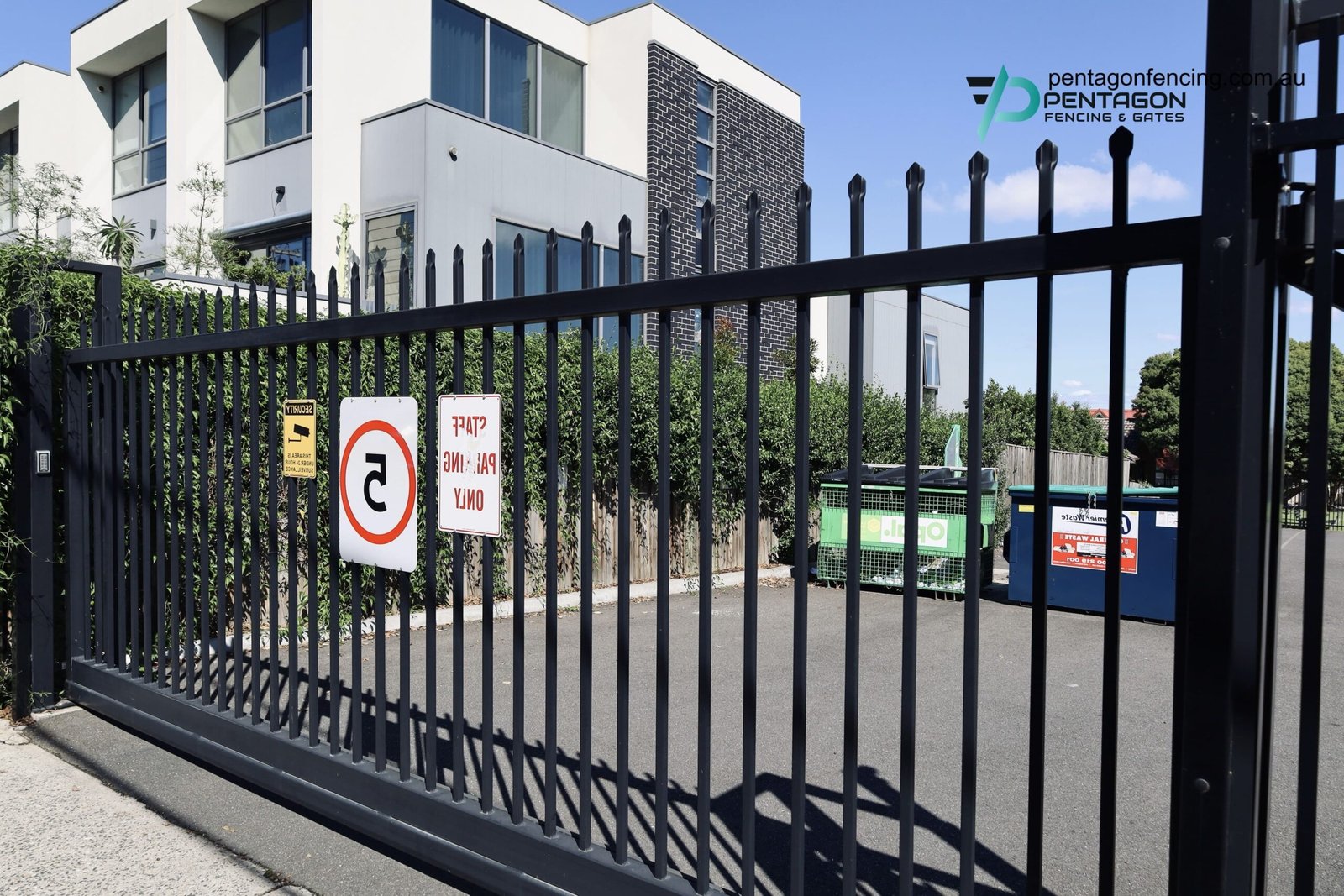
Profence publishes palisade systems with project-specific posts, rails, pale centres and arrangements for gradients [2]. On a sloping Melbourne site, ask whether panels will rake, step or use telescopic details, and check that changes in ground level do not create excessive openings beneath the fence.
For construction-related boundaries, WorkSafe Victoria states that security fencing should be well constructed, securely connected, stable, difficult to climb and able to prevent access from underneath [7]. Those requirements are specific to construction-site risk control, but they reinforce the broader principle that joints, gates and ground interfaces cannot be weaker than the main panels.
Coating and corrosion protection
Powder coating provides colour and a finished appearance, but it should not be treated as the complete corrosion specification. The Australian Steel Institute recommends a technically robust, fit-for-purpose approach that considers exposure, fabrication, surface preparation, quality assurance and whole-of-life maintenance. It identifies paint systems and hot-dip galvanising under AS/NZS 2312 as key protective-coating pathways [8].
- Confirm whether components are pre-galvanised, hot-dip galvanised after fabrication, painted, powder coated or protected by a duplex system.
- Ask how cut edges, drilled holes, welds, fixings and installation damage are treated.
- Consider coastal air, industrial contaminants, irrigation, soil contact and trapped vegetation around posts.
- Include chips, scratches, corrosion, loose bolts, damaged pales and gate alignment in routine inspections.
- Require compatible protection across pales, rails, posts, fasteners and gate frames rather than a panel-only finish.
Match palisade fencing with gates and access control
A palisade perimeter can be undermined by a low gate, wide frame gaps, exposed hinges or a lock that is easier to defeat than the fence. The gate should continue the effective height, pale spacing, top profile, bottom clearance and anti-tamper intent of the fixed panels.
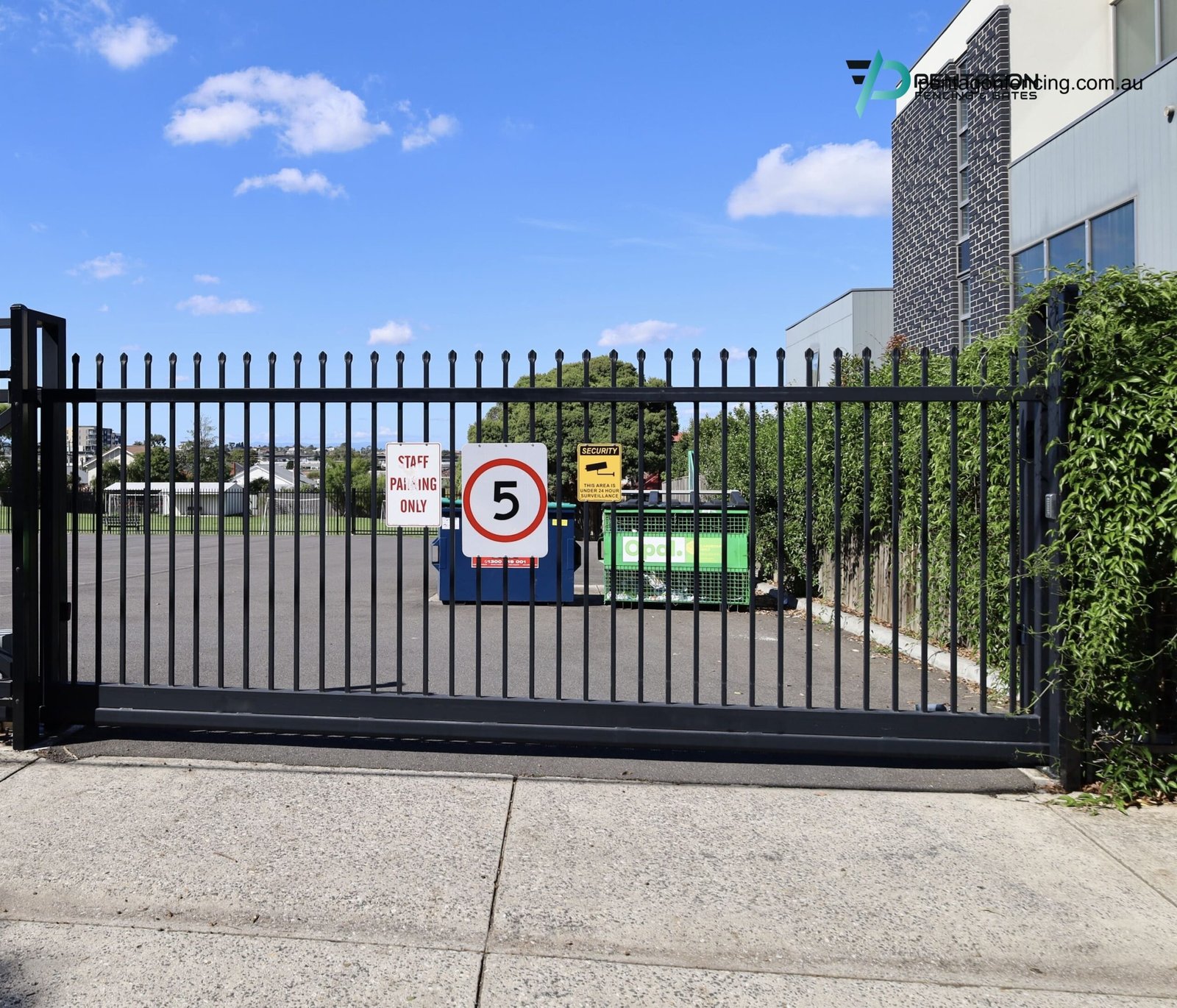
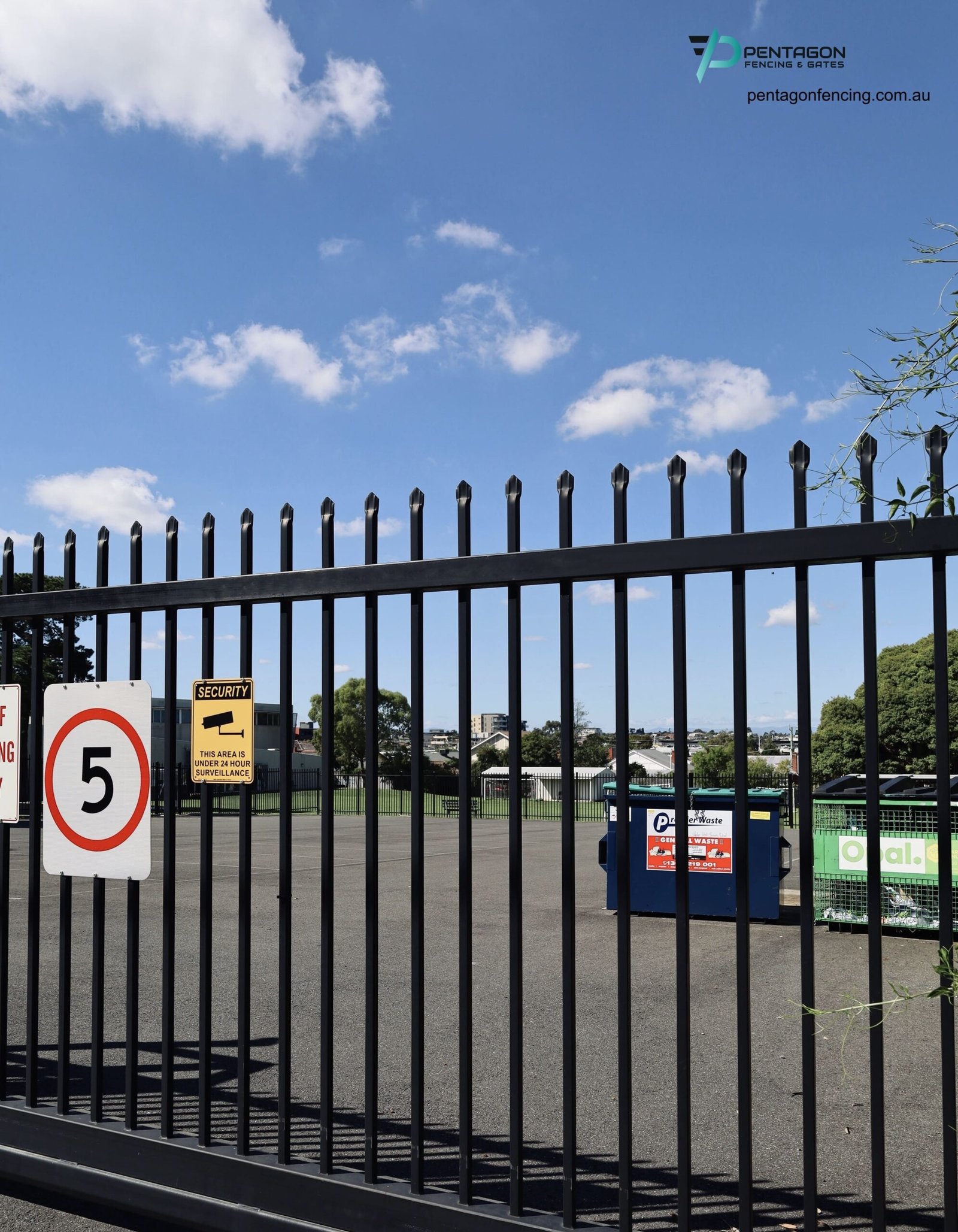
Pentagon shows pressed spear top palisade integrated with commercial sliding-gate projects in Melbourne [9]. Its cantilever-gate range also supports heavy-duty industrial openings and custom steel infill, allowing access design to be matched to high-cycle sites and larger vehicle entries [10].
- Pedestrian gate: define clear width, lock, latch, closer, intercom or credential reader and emergency access.
- Sliding or cantilever gate: check run-off, support, guides, end stops, foundations, automation and pedestrian separation.
- Swing gate: check hinge-post strength, opening arc, wind exposure, slope and secure closing against the receiving post.
- Access control: map staff, visitors, deliveries, after-hours users, CCTV and failure or emergency procedures.
- Security equivalence: prevent larger gaps, reachable rails or vulnerable hardware from making the gate the easiest route through the perimeter.
Quote-readiness checklist for Palisade steel fencing Melbourne
Prepare these details before requesting a quote for pressed spear top fencing or palisade installation in Melbourne:
- Site and risk: warehouse, factory, utility, infrastructure, car yard or restricted compound; identify climbing, cutting, theft and vehicle-access concerns.
- Fence zones: front boundary, secure rear perimeter, internal compound, loading area and all pedestrian or vehicle openings.
- Pale specification: W or other profile, thickness, centres and straight, curved, single-point, triple-point or flat top.
- Dimensions: approximate length, finished height, corners, slopes, retaining walls and ground clearances.
- Structure: rails, posts, fixings, footings, base plates and any engineering or asset-owner requirements.
- Gates: pedestrian, swing, sliding or cantilever; manual or automated; locks, intercom and access control.
- Coating: galvanising, paint, powder coat or duplex system and the site’s exposure conditions.
- Site works: removals, disposal, traffic management, buried services, concrete, restricted access and operational staging.
- Evidence: product data, drawings, coating description, inclusions, exclusions and any relevant system or project requirements.
Decision shortcut
- Shortlist pressed spear top palisade when visible deterrence and a rigid anti-climb-oriented industrial perimeter are central to the brief.
- Use a flat or rounded pale, rod top or weldmesh alternative when the site is highly public-facing or exposed pointed tops create an avoidable injury concern.
- Route to 358 weldmesh when CCTV visibility and close-aperture resistance are more important than the visual severity of palisade.
- Route to chain wire when large lower-risk runs and economical coverage matter more than rigid high-deterrence panels.
- Use a mixed perimeter when critical assets, public frontages and lower-risk boundaries need different levels of security and presentation.
Common mistakes to avoid
- Calling every spear-top steel fence palisade. Tubular spear top and formed palisade pales are different product systems.
- Claiming universal anti-climb performance. Verify the complete installed system, including gates and adjacent climbing aids.
- Leaving the pale top undefined. Straight, curved, single-point, triple-point and flat profiles are not interchangeable.
- Choosing pointed tops without a public-facing review. Finished height, setback and foreseeable users matter.
- Comparing only the panel price. Posts, rails, foundations, coatings, gates, removals and operating-site constraints can materially change the quote.
- Specifying colour instead of corrosion protection. Ask how steel preparation, galvanising, coatings and repairs will be handled.
How Pentagon Fencing can help
Pentagon Fencing & Gates supplies and installs palisade, pressed spear top steel fencing and matching gate systems across Melbourne for industrial, commercial, government and infrastructure projects [1].
- Compare pale profiles, heights and security configurations against the site’s risk, public exposure and access requirements.
- Plan the palisade perimeter together with pedestrian, sliding, swing or cantilever gates, automation and access control.
- Prepare a site-specific quote covering posts, rails, fixings, coatings, removals and installation constraints.
FAQ
What is pressed spear top palisade fencing?
It is a rigid steel fence made from formed vertical pales with pointed tops fixed to horizontal rails and posts. The pressed pale shape, spacing, fixings and height are selected to create a strong visual and physical deterrent.
Is palisade fencing anti-climb?
Palisade can be designed to resist climbing, especially when it uses stiff formed pales, restricted spacing, secure fixings and sufficient height. It should not be called anti-climb based on appearance alone; rails, gates, ground gaps and nearby objects must also be assessed.
Is palisade better than weldmesh?
Neither is universally better. Palisade provides an assertive deterrent profile, while close-aperture weldmesh can provide strong climbing resistance with clearer CCTV sightlines and a less aggressive appearance. Choose according to the site’s threat, visibility, public exposure and access needs.
Can palisade fencing include automated gates?
Yes. Pedestrian, swing, sliding and cantilever gates can use palisade or compatible steel infill. The gate frame, effective height, pale spacing, locks, motor, safety devices and access control should be designed with the fence.
What affects palisade fencing cost in Melbourne?
Key factors include length, height, pale profile and thickness, spacing, top type, posts, rails, fixings, footings, slope, coating, gates, automation, removals and installation access.
Is pressed spear top suitable near public areas?
It requires careful review. Pointed profiles may be inappropriate where people can approach or contact a low fence. Assess finished height, setback, user groups and safer alternatives, and confirm any project-specific requirements.
What to Keep in Mind
- Specify the pale profile, top type, spacing, height, rails, posts and fixings rather than purchasing from the word “palisade” alone.
- Use pressed spear top where the risk justifies strong deterrence and foreseeable public contact can be controlled.
- Match gates, locks, automation and access control to the security level of the fixed palisade perimeter.
- Compare complete installation scopes, including coatings, foundations, removals and site constraints—not only price per metre.
- Route public-facing, visibility-led or lower-risk zones to rod top, tubular, weldmesh or chain wire where those systems fit better.
References
- Pentagon Fencing, “Palisade Fencing & Steel Security Fencing Melbourne,” Pentagon Fencing. Accessed: Jun. 17, 2026. [Online]. Available: https://pentagonfencing.com.au/service/steel-security-fencing-melbourne/
- Profence, “Palisade Fencing,” Profence. Accessed: Jun. 17, 2026. [Online]. Available: https://profence.com.au/palisade-fencing/
- Profence, “How to Specify Palisade Fencing – The Right Way,” Profence. Accessed: Jun. 17, 2026. [Online]. Available: https://profence.com.au/how-to-specify-palisade-fencing/
- Doogood Australia, “Palisade Fencing,” Doogood Australia. Accessed: Jun. 17, 2026. [Online]. Available: https://www.doogoodaustralia.com.au/palisade
- Victoria Police, “Business Premises Security,” Victoria Police. Accessed: Jun. 17, 2026. [Online]. Available: https://www.police.vic.gov.au/securing-business-premises
- Department of Transport and Planning Victoria, “6.4 Barriers and Fences,” Planning Victoria. Accessed: Jun. 17, 2026. [Online]. Available: https://www.planning.vic.gov.au/guides-and-resources/guides/urban-design-guidelines-for-victoria/objects-in-the-public-realm/barriers-and-fences
- WorkSafe Victoria, “Construction Site Security Fencing,” WorkSafe Victoria. Accessed: Jun. 17, 2026. [Online]. Available: https://www.worksafe.vic.gov.au/construction-site-security-fencing
- Australian Steel Institute, “Corrosion Protection,” Australian Steel Institute. Accessed: Jun. 17, 2026. [Online]. Available: https://www.steel.org.au/what-we-do/focus-areas/steel-and-design/corrosion-protection/
- Pentagon Fencing, “Sliding Gate Automation in Melbourne,” Pentagon Fencing. Accessed: Jun. 17, 2026. [Online]. Available: https://pentagonfencing.com.au/service/sliding-gates/
- Pentagon Fencing, “Cantilever Gates,” Pentagon Fencing. Accessed: Jun. 17, 2026. [Online]. Available: https://pentagonfencing.com.au/service/cantilever-gates/