
Table of Contents
For a useful industrial fencing quote Melbourne businesses can compare, provide more than a perimeter length. A contractor needs the fence purpose, height, product family, gate openings, automation requirements, site access, ground conditions, removal scope and operating constraints. Without those details, the first price is likely to contain assumptions, provisional sums or exclusions that make quote comparison unreliable.
The most effective approach is to prepare one written scope and issue it to every contractor. This article provides a quote-readiness checklist, preliminary budget formulas and worked examples. The published price ranges are planning benchmarks rather than fixed Melbourne tender rates. National cost guides note that fence pricing changes with material, height, terrain, foundations, access, removal and local market conditions, so an itemised site quote remains necessary.[1]
Key Takeaways
- Issue the same measured scope, drawings, photos and operating requirements to every contractor.
- Separate the fence line, gates, automation, civil work, removal, electrical work and approvals into individual quote lines.
- Use public price ranges only as a sense-check. Industrial products, heavy-duty gates and live-site requirements need project-specific pricing.
- Ask contractors to identify assumptions, exclusions, provisional sums, GST treatment and quote-validity dates.
- Do not choose the lowest total until the quantities, specifications, inclusions and handover requirements have been normalised.
Why incomplete quote requests create misleading prices
A request such as “price 150 metres of security fencing” leaves several commercial decisions unresolved. One contractor may assume chain mesh with manual gates, while another may allow for anti-climb panels, heavy-duty posts, powered sliding gates and staged installation around an operating warehouse. Both prices may be internally valid, but they do not describe the same project.
- Unclear quantities can cause the fence length, gate openings and returns to be measured differently.
- Unclear performance requirements can produce different fence families, heights and footing assumptions.
- Unclear site conditions can move rock excavation, access equipment, removal and temporary security into provisional sums.
- Unclear gate duty can hide major differences in gate frame, track, motor, safety devices and access control.
What to prepare for an industrial fencing quote
The following table is the first decision asset to complete before sending an industrial fencing quote Melbourne request. Each row includes a budget signal and calculation method so the information can be checked before the contractor attends site. Where the market does not publish a reliable universal rate, the table uses a quoted unit variable rather than inventing a fixed price.
| Scope item | What to provide | Why it affects the quote | Indicative 2026 budget signal | Common estimating formula |
|---|---|---|---|---|
| Fence-line quantity | Dimensioned plan or measured perimeter, gate openings, corners, returns and tie-in points. | The quoted fence quantity should exclude gate openings but include all separate runs and terminations. | Tubular metal is publicly benchmarked at about $180–$350 per metre installed. Chain or metal mesh material may be advertised at around $70–$120 per 15-metre roll, before posts, fittings and installation.[1][2] | Net fence length = gross fence line − total gate openings Base fence allowance = net fence length × selected $/m rate |
| Fence purpose and security level | State whether the fence is for boundary definition, vehicle separation, privacy, asset protection, anti-climb security or construction-site control. | Performance requirements change panel type, aperture, rail configuration, post size, height, toppings and footing design. | Use $180–$350/m only as a broad tubular-metal sense-check. Weldmesh, palisade, anti-ram and high-security assemblies require a supplier or fabricator rate for the selected specification. | Security fence allowance = net length × quoted system rate where the system rate includes the stated panel, post, coating and footing specification. |
| Height | Nominate the required finished height for each fence run and identify any changes along the boundary. | Greater height can increase panel area, post section, wind loading, footing size, access equipment and installation time. | The selected supplier must provide a separate $/m rate for each height. Do not multiply a standard-height rate without confirming structural and footing changes. | Height-zone allowance = length at that height × verified $/m rate for that height |
| Fence material and finish | Specify chain mesh, welded mesh, tubular steel, palisade, Colorbond, aluminium or another system; include colour, coating and corrosion exposure. | Material weight, fabrication, galvanising, powder coating, fasteners and environmental exposure affect supply and installation. | Public guides place Colorbond around $85–$100/m installed and tubular metal around $180–$350/m installed. These are broad consumer-market benchmarks, not industrial specifications.[1] | Material-zone allowance = zone length × quoted finished-system $/m Add any specified coating or corrosion-protection line item only if it is not included in the system rate. |
| Manual gates | Provide quantity, clear opening, height, swing or slide direction, vehicle type, frequency of use and locking requirement. | Width, frame strength, posts, hinges, tracks, rollers, cantilever hardware and civil work change the gate cost. | Published residential-market benchmarks are approximately $1,500–$3,000 for a swing gate, $2,000–$3,500 for bi-fold and $2,500–$4,000 for sliding. Industrial gates may be materially higher.[3] | Manual gate allowance = sum of each gate’s quoted frame, posts, hardware, track and civil-work price |
| Automation and access control | State gate weight, duty cycle, opening speed, power source, remotes, keypads, intercom, card access, loops, photocells, safety edges and emergency release. | A motor alone is not a complete automated-gate system. Safety devices, controls, power and commissioning can be separate packages. | Public guides place a standard automation package around $1,950–$2,300 in addition to the gate, and more advanced systems around $3,500–$6,000. Heavy-duty industrial duty cycles require specific engineering and product selection.[3] | Automated gate allowance = gate package + motor/control package + safety devices + electrical works + commissioning |
| Ground, post holes and civil works | Provide geotechnical information if available; identify fill, rock, concrete, asphalt, drainage, retaining walls and known underground services. | Rock, deep footings, core drilling, saw cutting, spoil removal and reinstatement can exceed the standard post-installation allowance. | Excavation guides indicate about $95/hour for a bobcat or 2-tonne excavator, $105/hour for a 6-tonne excavator and $140/hour for an excavator with tip truck. Typical small excavation work may range from $400–$1,500 before special attachments and disposal.[4] | Civil allowance = equipment hours × equipment rate + operator/crew + concrete + disposal + reinstatement |
| Existing fence removal | Record fence type, length, footing condition, access for loading, hazardous coatings or materials, and whether posts and concrete must be removed. | Cutting, excavation, sorting, loading, cartage, tip fees and temporary security are separate from installing the new fence. | A general replacement guide places replacement projects around $1,600–$3,100, but this is not a commercial demolition rate. Contractor labour may be $50/hour or more, plus plant and disposal.[2] | Removal allowance = crew hours × labour rate + plant hours × plant rate + bins/cartage + disposal fees + temporary barrier |
| Access, staging and operating hours | State delivery access, vehicle restrictions, work zones, inductions, permits, shutdown windows, traffic management and after-hours requirements. | Restricted access can reduce daily output and require smaller plant, additional handling, spotters or repeated mobilisation. | Use published plant benchmarks of roughly $95–$140/hour and labour of $50/hour or more only for preliminary allowances. Mobilisation, traffic control and after-hours premiums must be quoted separately.[2][4] | Access/staging allowance = extra crew hours + extra plant hours + mobilisation events + traffic-management quote + after-hours premium |
| Services, boundaries and approvals | Include title or survey information, council correspondence, service plans, landlord approval and adjoining-owner requirements where relevant. | Unverified boundaries or services can stop excavation, relocate the fence or create rework. | Before You Dig Australia plans are available at $0. Private locating, surveying, permits and professional advice are charged at the provider’s current invoice rate.[5] Victorian guidance also recommends checking local council rules because requirements may differ by location.[6] | Approval/service allowance = $0 BYDA plan request + locator quote + survey quote + council/permit fees + redesign allowance, if required |
Pricing caveat: the ranges above are public planning benchmarks, mostly drawn from national consumer cost guides. They are not a substitute for an itemised Melbourne industrial quote. Confirm whether each rate includes supply, posts, footings, installation, coatings, freight, removal, electrical work, commissioning and GST.
Build the fence-line measurement before the site visit
A contractor will normally verify dimensions during a site measure, but a preliminary take-off helps identify missing information and allows all tenderers to begin with the same quantity. The purpose of a site measure fencing appointment is to validate the plan, not to discover the project scope for the first time.
Record these dimensions
- Total length of every straight fence run.
- Width and position of each pedestrian, vehicle, sliding, swing or cantilever gate opening.
- Number of corners, ends, returns, steps in level and tie-ins to buildings or existing fences.
- Required height for each section.
- Changes in ground level, retaining walls, drainage paths and concrete or asphalt surfaces.
Preliminary measurement formulas
Net fence length = gross measured fence line − total clear gate openings
Base fence allowance = net fence length × installed fence rate per metre
Preliminary project allowance = base fence allowance + gates + automation + civil work + removal + access/staging + approvals + contingency
Keep every variable visible. A single blended rate can hide expensive gate or civil-work assumptions and make later variations difficult to trace.
Worked budget sense-check
Assume a project has a 100-metre gross boundary, one 6-metre sliding-gate opening and no other openings. The net fence length is 94 metres. Using the published tubular-metal benchmark of $180–$350 per metre gives a preliminary fence-line allowance of:
94 m × $180–$350/m = $16,920–$32,900
Add a public sliding-gate benchmark of $2,500–$4,000, standard automation of $1,950–$2,300 and six hours of preliminary excavation allowance at $95–$140 per hour:
Preliminary sense-check = $16,920–$32,900 + $2,500–$4,000 + $1,950–$2,300 + $570–$840 = $21,940–$40,040
This example is deliberately limited. It does not price a heavy-duty industrial gate, upgraded posts and footings, anti-climb features, access control, electrical supply, removal, traffic management, freight, engineering, permits, GST or live-site staging. Its purpose is to expose the variables that must be defined before requesting a price.
Choose the security outcome before the product
A contractor can recommend an appropriate fence family only when the operational outcome is clear. Avoid requesting a named product solely because it was used on another site. The correct system depends on visibility, climb resistance, privacy, impact exposure, corrosion conditions, public interface and the consequences of unauthorised access.
| Required outcome | Possible fence families to assess | Information to include | Price basis | Formula |
|---|---|---|---|---|
| Basic boundary demarcation | Chain mesh or another economical open fence. | Height, mesh aperture, wire coating, top and bottom restraint, post spacing and gate integration. | Mesh material may be advertised around $70–$120 per 15-metre roll, excluding posts, fittings, concrete and labour.[2] | Total = mesh rolls + posts + fittings + concrete + installation + gates |
| Visible perimeter security | Welded mesh or anti-climb mesh. | Aperture, wire diameter, panel width, post section, anti-climb requirement and corrosion protection. | Project-specific panel and post rate. A public tubular-metal range of $180–$350/m may be used only as a broad sense-check, not as the weldmesh price. | Total = net length × verified weldmesh system $/m + gates + toppings + civil work |
| Strong visual deterrence | Palisade, heavy tubular steel or another purpose-designed security system. | Pale or rail profile, spacing, height, toppings, post and footing design, coating and gate match. | Fabricator or system-supplier quoted $/m. Do not substitute a residential tubular rate for a high-security specification. | Total = system quantity × engineered system rate + special footings + security gates |
| Privacy or visual screening | Colorbond, aluminium slats, louvres or solid screening systems. | Privacy percentage, wind exposure, panel orientation, acoustic expectations and colour. | Colorbond is broadly benchmarked around $85–$100/m installed; custom aluminium or louvre screening requires a supplier-specific rate.[1] | Total = screen area or fence length × verified finished-system rate + structural upgrades |
| Construction-site access control | Temporary proprietary fencing or a project-specific secure perimeter. | Risk assessment, duration, gate locking, wind exposure, signage, shade cloth and public interface. | Supplier hire or installation quote per panel/week. WorkSafe Victoria states that security fencing used to control unauthorised entry should generally be at least 1.8 metres high and stable for anticipated loads; extra coverings can require additional support.[7] | Temporary-security cost = panels × hire rate × weeks + delivery + installation + gates + ballast/supports |
WorkSafe guidance applies to construction-site security fencing and should not be interpreted as a universal design rule for every industrial boundary. The required height and system for an operating facility should be determined from the site’s risk, planning context and chosen product specification.
Specify every gate and access-control function
Gate scope is often the largest source of variation in a commercial fencing quote Melbourne businesses receive. Describe each gate as an operating system rather than a width on a plan.
| Gate component | Details to provide | Indicative public benchmark | Estimating formula |
|---|---|---|---|
| Manual swing gate | Clear opening, one or two leaves, swing arc, ground clearance, wind exposure, hold-open and locking. | $1,500–$3,000 for a general-market swing-gate benchmark.[3] | Gate total = frame/infills + posts + hinges + locks + footings + installation |
| Bi-fold gate | Opening width, folding direction, available stacking area, operating speed and collision risks. | $2,000–$3,500 as a general-market benchmark.[3] | Gate total = leaves + folding hardware + posts + guides + civil work + installation |
| Sliding or cantilever gate | Clear opening, run-back space, track or cantilever preference, pavement condition, drainage and vehicle envelope. | $2,500–$4,000 for a general sliding-gate benchmark. Industrial cantilever assemblies can be significantly higher.[3] | Gate total = frame + posts + track/cantilever hardware + foundation beam + installation |
| Standard automation | Gate weight, daily cycles, power, remotes, basic safety devices and manual release. | $1,950–$2,300 in addition to the base gate.[3] | Automation total = motor/control kit + safety devices + power + installation + commissioning |
| Advanced automation and access control | High duty cycle, keypads, intercom, credential system, vehicle loops, photocells, safety edges, backup power and system integration. | $3,500–$6,000 as a broad advanced-automation benchmark, before complex enterprise integration.[3] | Access total = automation package + devices + cabling + software/integration + testing + training |
| Installation labour | Confirm whether fabrication, civil work, electrical work and commissioning are included or separately subcontracted. | Gate installation labour is publicly benchmarked around $80–$140/hour. Manual installations may take 4–6 hours, while automatic or complex work may require up to 12 hours.[3] | Labour allowance = crew size × hours × applicable hourly rate |
For an industrial gate, ask the contractor to state the assumed gate weight, design duty, cycles per day, wind exposure, motor capacity, safety-device package and electrical boundary. Those assumptions determine whether two automation prices are genuinely comparable.
Record site conditions that create provisional sums
A clear scope does not require you to know every underground condition. It does require you to identify known risks and ask how unknown conditions will be valued. Photos should show the entire fence line, both sides of the boundary where accessible, gate locations, corners, slopes, surfaces and delivery routes.
| Site condition | Evidence to provide | Budget signal | Formula or quote instruction |
|---|---|---|---|
| Rock, fill or hard surfaces | Geotechnical reports, service drawings, previous excavation records and photos of exposed ground. | $95–$140/hour for common excavation plant combinations, plus attachments, transport and disposal.[4] | Require a stated included quantity and an hourly/unit rate for excess excavation. |
| Slope and stepped fence lines | Levels, survey, photos and preferred raked or stepped appearance. | Quoted $/panel, $/metre or labour-hour adjustment; no universal market rate applies. | Slope adjustment = affected length × verified slope premium, or extra crew hours × labour rate |
| Restricted delivery or plant access | Access width, turning area, weight limits, loading zone, lift restrictions and permitted work times. | Preliminary plant sense-check of $95–$140/hour, plus repeated mobilisation or manual handling.[4] | Access premium = extra plant hours + handling labour + additional deliveries + mobilisation |
| Underground and overhead services | BYDA plans, private locator results, potholing requirements and asset-owner permit conditions. | $0 for the BYDA plan request; locator, potholing, permit and standby costs are provider-specific.[5] | Services allowance = $0 plan request + locator quote + potholing + permit/standby charges |
| Fence removal and temporary security | Length, material, footings, disposal access, required security continuity and acceptable open-boundary duration. | General replacement guides show $1,600–$3,100 for smaller projects, but industrial removal and temporary barriers require a measured quote.[2] | Total = demolition labour + plant + disposal + temporary-fence hire × duration + reinstatement |
| Live-site staging | Shift windows, exclusion zones, inductions, pedestrian and vehicle routes, shutdown periods and daily make-safe requirements. | Quoted labour hours, mobilisation events and traffic-management package; public rates are not reliable enough for a universal total. | Staging premium = additional shifts × crew-hours + remobilisation + traffic control + daily temporary works |
| Boundary and planning uncertainty | Title plan, survey marks, lease obligations, adjoining-owner correspondence and council advice. | $0 for an initial council-rule check; survey, legal, planning and permit costs are charged by the relevant provider or authority. Victorian guidance notes that local council rules can differ.[6] | Boundary/approval allowance = survey quote + authority fees + professional advice + redesign or relocation, if required |
A practical quote brief template
Copy the following structure into an email, tender document or project brief. Attach a marked-up site plan and labelled photos. A strong brief does not prevent the contractor from recommending alternatives; it makes each recommendation traceable to the same operational need.
Project and site
- Project name and site address:
- Site type, operating hours and primary fencing objective:
- Contact person and site-access procedure:
- Requested quote date, decision date and target installation window:
Fence scope
- Gross measured fence line:
- Total gate openings and net fence length:
- Required height by fence run:
- Preferred fence family or performance requirement:
- Finish, colour and corrosion-protection requirement:
- Anti-climb, privacy, visibility, toppings or impact requirements:
Gate and access scope
- Gate ID, location, clear opening, height and movement type:
- Vehicle type and largest turning envelope:
- Expected cycles per day and peak-hour demand:
- Manual or automated operation:
- Access devices, safety devices, power, network and integration requirements:
- Emergency access and manual-release requirements:
Site and delivery conditions
- Known soil, rock, concrete, asphalt and drainage conditions:
- Underground and overhead services information:
- Slope, retaining walls and level changes:
- Delivery route, plant access and storage area:
- Existing fence removal and disposal scope:
- Temporary-security and daily make-safe requirements:
- Inductions, permits, traffic management, staging and restricted work hours:
Required quote format
- Fence quantities and installed $/m by system and height.
- Each gate, automation package and access-control component separately priced.
- Civil work, electrical work, removal, disposal and temporary security separately priced.
- Assumptions, exclusions and provisional sums clearly identified.
- Product specification, coating system, post spacing and footing basis stated.
- Programme, lead time, warranty, handover documents and maintenance requirements stated.
- GST treatment, payment terms and quote-validity date stated.
How to compare two quotes on the same scope
A fencing contractor quote should be assessed as a scope document, not only as a total price. Create a comparison sheet and normalise the following items before selecting a contractor:
- Quantities: confirm that net fence length, height zones, gate openings, corners and removal quantities match.
- System specification: compare panel or mesh type, wire or member dimensions, post section, post spacing, rails, fasteners and coating.
- Footing basis: compare assumed soil, hole diameter and depth, concrete quantity, core drilling and treatment of rock or services.
- Gate package: compare frame, posts, hardware, track or cantilever system, motor duty, controls, safety devices and electrical boundary.
- Site delivery: compare removal, disposal, reinstatement, traffic management, temporary security, staging and after-hours work.
- Commercial terms: compare GST, payment milestones, lead time, warranty, exclusions, provisional sums and variation rates.
- Handover: compare commissioning, training, manuals, keys/remotes, test records, maintenance instructions and as-built information.
Quote validity matters when steel, aluminium, fuel, labour and construction inputs are changing. ABS reported that Melbourne house-construction input prices rose 2.6% over the year to March 2026, while Victorian house-construction output prices rose 3.7%. These statistics are not a fence-price escalation formula, but they support asking for a clear validity period and identifying which supplier prices remain subject to confirmation.[8]
How Pentagon Fencing can help
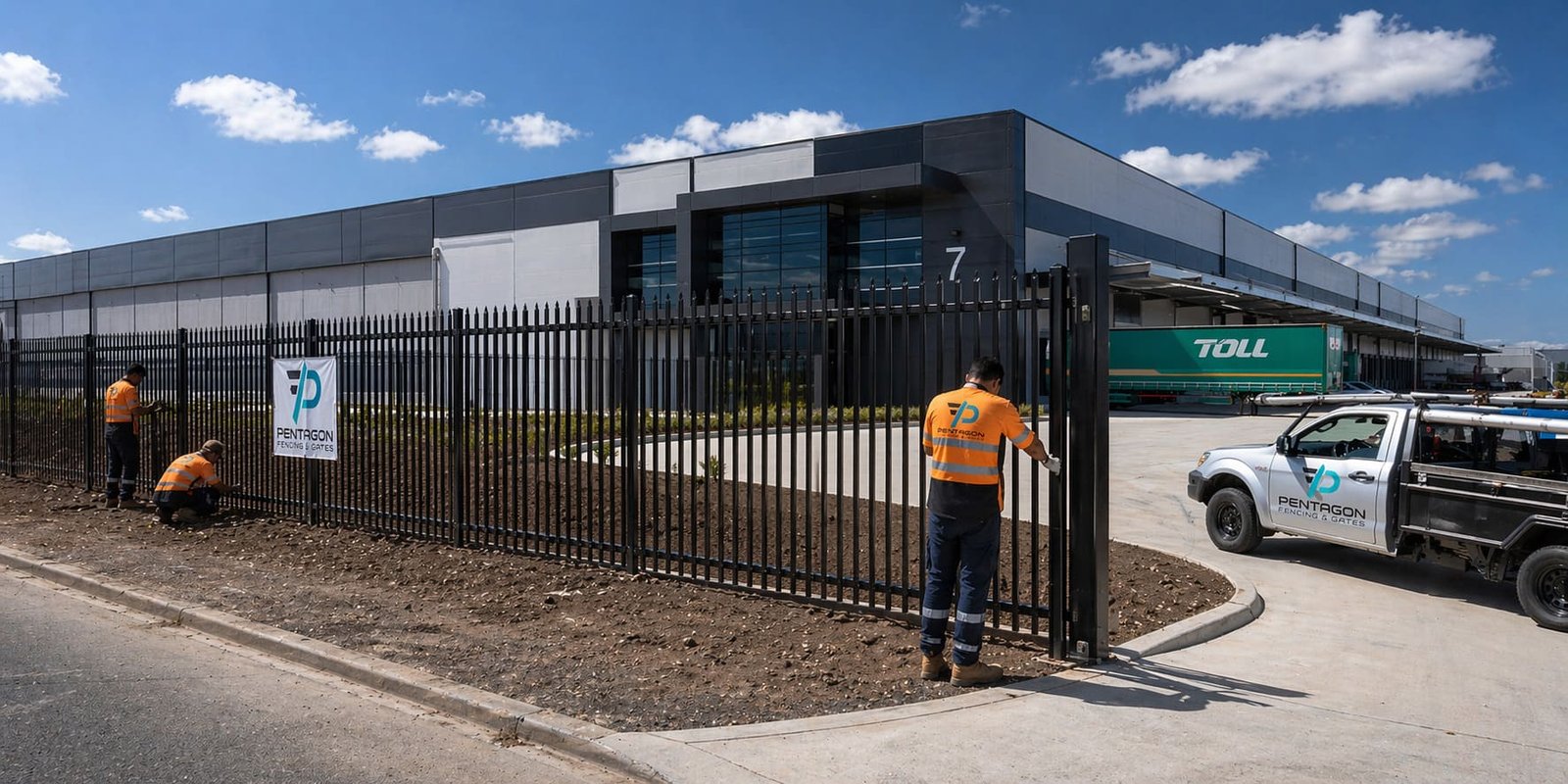
Pentagon Fencing designs, supplies and installs commercial and industrial fencing and gate systems across Melbourne, including steel, aluminium, Colorbond and automated sliding, swing, side and cantilever gates.[9] A structured brief allows the team to verify the site, clarify assumptions and prepare a more useful scope-based quotation.
- Review fence, gate and automation requirements as one perimeter system.
- Identify site-access, removal, civil-work and staging items that should be separated in the quote.
- Provide an itemised proposal based on confirmed measurements and project requirements.
Frequently asked questions
Do I need exact measurements before requesting an industrial fencing quote?
No. A dimensioned plan or careful preliminary measurement is sufficient for the first discussion, provided it identifies gate openings, height changes and uncertain boundaries. The contractor should verify final quantities before the price is accepted or fabrication begins.
Can I request a security fencing quote Melbourne without choosing a material?
Yes. Describe the security outcome, visibility, privacy, height, public interface, corrosion environment and gate operations. The contractor can then recommend suitable systems and price the alternatives against the same requirements.
Why do industrial gate quotes vary so much?
Two gates with the same clear opening can have different frame weights, posts, foundations, tracks, motors, duty cycles, safety devices and access controls. Ask each contractor to state these assumptions and separate the gate, automation, electrical and civil-work prices.
What should be included in a fencing contractor quote?
At minimum, the quote should state quantities, fence and coating specifications, post and footing basis, each gate package, automation and safety devices, removal, civil and electrical boundaries, exclusions, provisional sums, GST, programme, warranty and validity.
Should I accept a quote based only on drawings?
A drawing-based budget can be useful early in planning, but a final price should normally follow a site inspection or documented verification of access, ground, services, levels, boundaries and existing structures. Otherwise, the quote should clearly state which items remain provisional.
What to Keep in Mind.
- The best first price comes from one written scope, not separate verbal instructions to different contractors.
- Keep fence, gate, automation, civil, removal, electrical and approval costs visible as separate line items.
- Use public price ranges only to identify omissions or unusually broad assumptions; do not treat them as a fixed industrial rate.
- Ask how rock, services, restricted access, changed quantities and delayed installation will be valued before work begins.
- Compare specification, inclusions, risk allocation and handover support before comparing the final totals.
References
- hipages, “How Much Does Fencing Cost Per Metre? [2026],” updated Jan. 2, 2026. Available: https://hipages.com.au/article/how_much_does_fencing_cost_per_metre. Accessed: Jul. 13, 2026.
- Service.com.au, “How Much Does Fencing Cost? 2026 Cost Guide,” updated Apr. 14, 2026. Available: https://www.service.com.au/articles/fencing-contractors/how-much-does-fencing-cost. Accessed: Jul. 13, 2026.
- hipages, “How Much Do Driveway Gates Cost? [2026].” Available: https://hipages.com.au/article/how_much_do_driveway_gates_cost. Accessed: Jul. 13, 2026.
- hipages, “How Much Does Excavation Cost? [2026],” updated Jan. 20, 2026. Available: https://hipages.com.au/article/how_much_does_excavation_cost. Accessed: Jul. 13, 2026.
- Before You Dig Australia, “Get Free Plans.” Available: https://www.byda.com.au/. Accessed: Jul. 13, 2026.
- Victorian Government, “Fencing in Victoria,” updated Feb. 26, 2026. Available: https://www.vic.gov.au/fencing-victoria. Accessed: Jul. 13, 2026.
- WorkSafe Victoria, “Construction Site Security Fencing.” Available: https://www.worksafe.vic.gov.au/construction-site-security-fencing. Accessed: Jul. 13, 2026.
- Australian Bureau of Statistics, “Producer Price Indexes, Australia, March 2026.” Available: https://www.abs.gov.au/statistics/economy/price-indexes-and-inflation/producer-price-indexes-australia/latest-release. Accessed: Jul. 13, 2026.
- Pentagon Fencing & Gates, “Commercial and Industrial Fencing and Gates.” Available: https://pentagonfencing.com.au/. Accessed: Jul. 13, 2026.