
Table of Contents
Why steel gates become the weak point in security fencing
- You select the fence type first, then add a gate whose frame, infill or bottom gap does not match the perimeter risk.
- You choose a sliding gate without confirming side run-off, track conditions, slope, vehicle queues or pedestrian separation.
- You choose a swing gate without allowing for the opening arc, wind exposure, driveway gradient or parked vehicles.
- You use a vehicle gate for daily pedestrian entry, creating unnecessary opening cycles and interaction between people and vehicles.
- You add automation late, after posts, conduits, motor position, safety devices and manual release have already been constrained.
- You compare gates by steel appearance or headline dimensions without checking locks, hinges, rollers, stops, guides, foundations and maintenance access.
Key Takeaways
- Steel sliding gates Melbourne are usually a stronger shortlist when swing space is limited, traffic is frequent and sufficient side run-off is available. Pentagon positions steel sliding gates for industrial sites where strength and durability are important [3].
- Steel swing gates Melbourne can suit residential, commercial and industrial entries with enough clear opening arc; single and double-leaf configurations should be selected around the opening width and site layout [4].
- A pedestrian steel gate should provide a dedicated walk-through route where people do not need to share the vehicle opening. Side gates can be customised to match the fencing system and control access [5].
- The security level is determined by the complete opening: gate infill, frame, posts, foundations, locks, gaps, automation, surveillance and nearby climbing aids.
- Powered gates introduce crush, trapping, impact and run-off risks, so risk assessment, restraint, safety devices, competent installation and regular maintenance are essential.
Sliding, swing and pedestrian steel gates compared
This gate-type matrix supports early selection. It does not replace a site measure, structural design, automation risk assessment or the detailed movement guidance owned by gate-specific service articles.
| Gate type | Stronger-fit conditions | Security and access benefit | Main constraint | Quote-ready check |
|---|---|---|---|---|
| Steel sliding gate | Commercial driveways, warehouses, logistics yards and industrial entries where the leaf can travel beside the fence and swing space is limited. | Keeps the movement parallel to the perimeter and can support frequent vehicle access, automation and integration with site security systems [3]. | Needs sufficient run-off, suitable support or track conditions, secure end stops and protected movement zones. | Clear opening, total leaf length, run-off, slope, track/cantilever approach, traffic cycles, motor location and pedestrian route. |
| Steel swing gate | Residential driveways, commercial entries and selected industrial openings with enough clear space for one or two leaves. | Offers a straightforward manual or automated entry and can create a balanced frontage using single or double-leaf construction [4]. | The opening arc can conflict with vehicles, pedestrians, footpaths, sloping ground, wind or internal operations. | Swing direction, leaf widths, hinge posts, gradient, wind exposure, hold-open needs, automation arms and safety zones. |
| Pedestrian steel gate | Staff, visitor, school, public-facility, side-access and controlled walk-in routes separated from vehicle movement. | Reduces unnecessary vehicle-gate cycles and allows the lock, closer, intercom or credential reader to be designed for people. | Poor latch position, narrow clearance, inaccessible hardware or a gate that does not self-close as required can undermine access control. | Clear width, approach path, latch side, lock, closer, accessibility needs, intercom/keypad and emergency-egress requirements. |
Gate material and style matrix: match the gate to the steel fence
The gate should continue the security and visual logic of the adjoining fence. Matching colour alone is not enough.
| Security fence system | Matching steel gate direction | Security details to preserve | Mismatch to avoid |
|---|---|---|---|
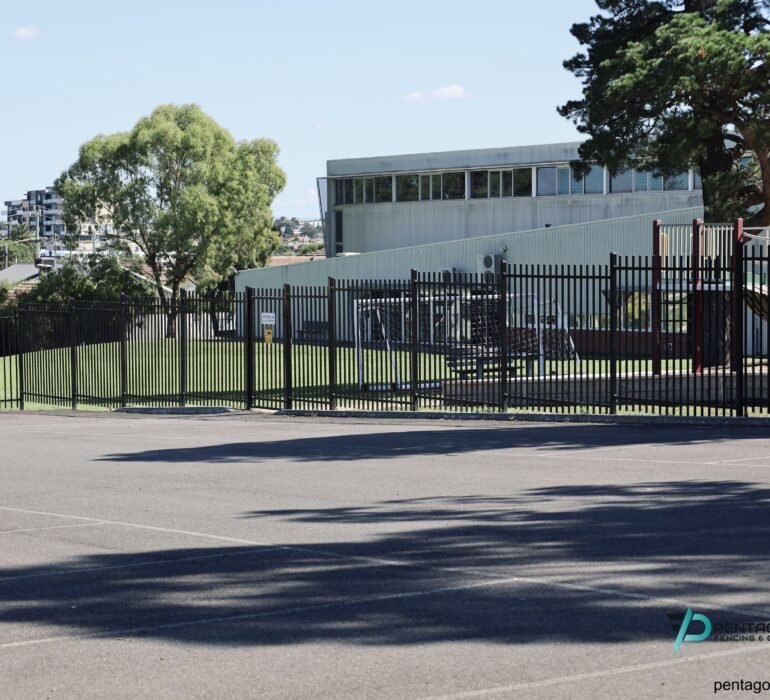
| Palisade or spear-top steel | A sliding, swing or pedestrian spear top gate using compatible pale/picket spacing and top treatment, subject to public-facing safety review. | Finished height, deterrent profile, bottom clearance, anti-tamper fixings, lock protection and secure closing at posts. | A low or open-framed gate that creates an easier climb or forced-entry route than the palisade fence. |
| Weldmesh security fencing | A rigid steel gate with mesh infill selected to match the fence aperture, wire profile and visibility requirement. | Mesh aperture, edge fixing, frame gaps, bottom gap, tamper resistance and visibility through the opening. | Using wider, climbable or lightly fixed gate infill next to a tighter anti-climb mesh fence. |
| Tubular steel or rod top | A tubular steel gate that continues the flat, loop, ring, rod or spear top profile across the opening. | Picket spacing, rail position, top profile, public-facing safety, lock height and frame proportion. | A heavy frame or different top style that breaks the frontage or introduces new footholds. |
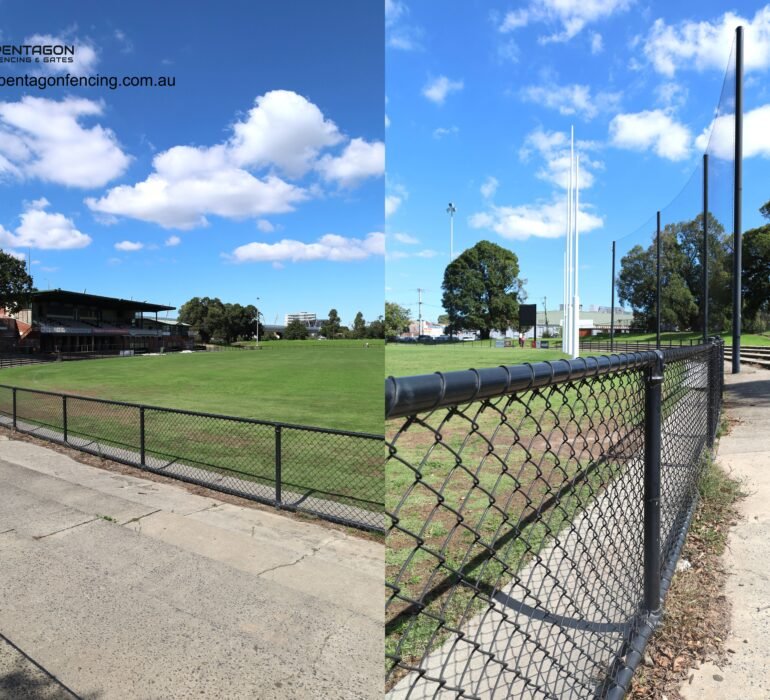
| Chain wire or chain mesh | A braced steel gate with compatible chain-wire infill, tensioning and framework for pedestrian or vehicle access. | Mesh gauge/aperture, ties, bottom restraint, bracing, latch security, gate posts and any approved toppings. | Loose mesh, unrestrained bottom edges or a lightweight latch that is easier to defeat than the fence line. |
Security-fit table: choose by site risk and access flow
Steel security gates should be selected by the behaviour the site needs to control. One property may need different gate specifications at its public frontage, loading yard and restricted compound.
| Site scenario | Gate shortlist | Fence and security match | Access-control priority |
|---|---|---|---|
| Warehouse or logistics yard | Heavy-duty sliding or cantilever vehicle gate plus a separate pedestrian gate. | Match palisade, weldmesh or tubular steel to the perimeter risk; ensure the opening does not reduce effective height or climb resistance. | Vehicle credentials, intercom, remote management, CCTV view, safety detection and after-hours lock-down. |
| Factory or industrial compound | Sliding gate for regular vehicles; swing or pedestrian gates for lower-frequency secondary access where space permits. | Gate frame, infill, locks, posts and foundations should align with the highest-risk perimeter zone being opened. | Role-based credentials, delivery procedures, manual override, fault response and maintenance isolation. |
| School, park or public facility | Dedicated pedestrian gate and a separately controlled vehicle gate; movement type depends on traffic and available space. | Use public-facing steel profiles such as rod top, flat top or suitable weldmesh where the project brief calls for visibility and non-pointed details. | Supervised entry, accessible hardware, visitor control, self-closing needs, emergency access and separation from vehicles. |
| Commercial frontage or car yard | Sliding or swing driveway gate with a matching pedestrian entry. | Tubular, spear top or selected weldmesh can retain visibility while supporting a clear access boundary. | Good-quality locks, maintained gates, lighting and clear boundaries. Victoria Police recommends well-built, maintained and secured fences and gates and keeping boundaries clear of climbing aids [6]. |
| Residential or mixed-use entrance | Swing or sliding driveway gate plus pedestrian or side access where required. | Match the steel gate to the frontage’s tubular, picket, slat or spear details without over-specifying industrial security. | Intercom, remote entry, delivery access, manual release and safe operation around residents and visitors. |
Sliding steel gates: match strength with safe run-off
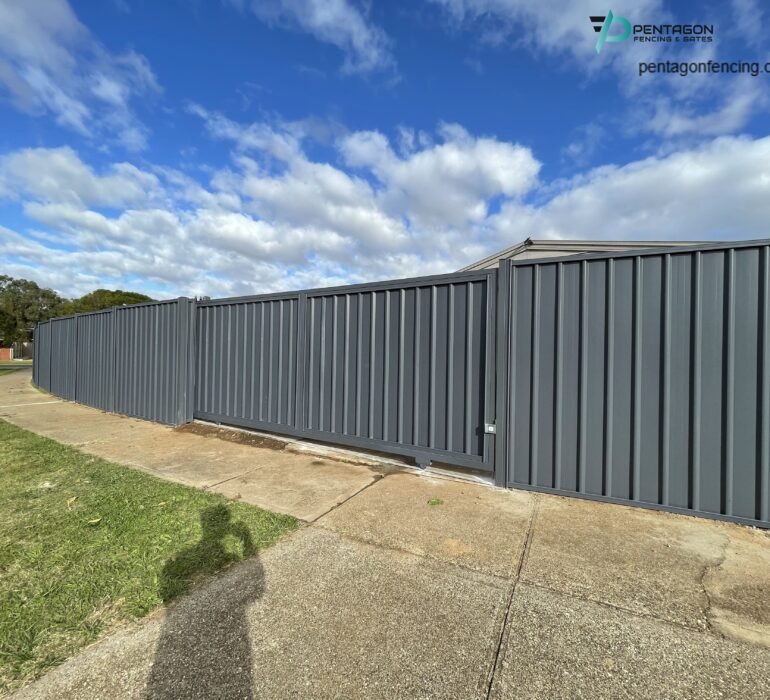
A steel sliding gate Melbourne project can be a strong fit for industrial and commercial entries because the gate moves parallel to the fence and avoids a large swing arc. Pentagon describes steel sliding gates as heavy-duty options for industrial sites and offers automation, remote controls, vehicle detection and integration with CCTV or site security systems [3].
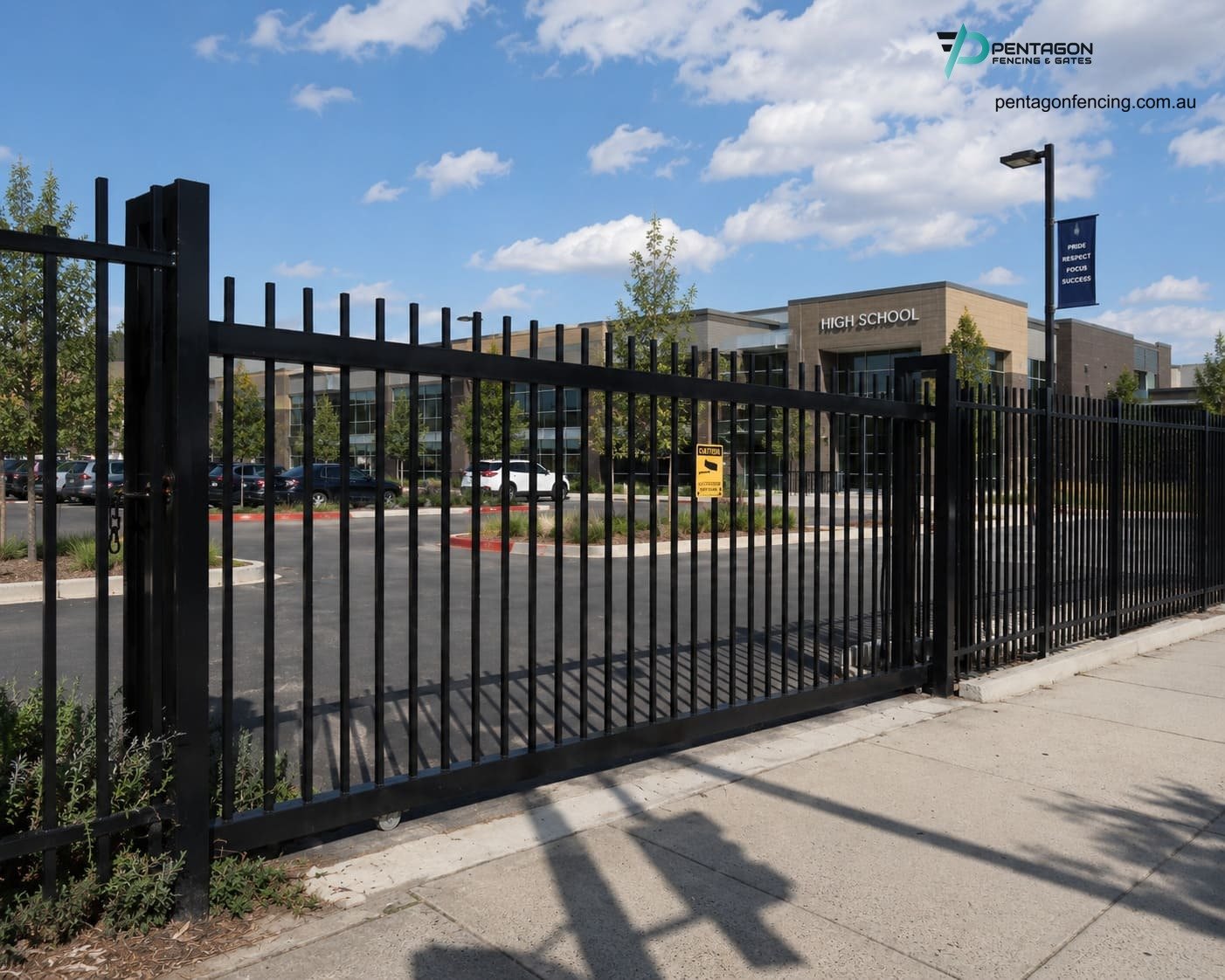
The design still needs to address the complete travel path. The gate must remain supported and restrained at all stages of movement, including when manually released or under repair. A Victorian prosecution following a fatal gate crush involved a sliding gate that could run beyond its support posts after a drive motor was removed, showing why restraint, isolation and safe maintenance arrangements cannot be treated as optional details [7].
Check the run-off zone, track or cantilever configuration, guide rollers, end stops, catcher, foundations, manual release and any crush or trapping points before selecting the automation package.
Swing steel gates: confirm movement space and hinge loads
A steel swing gate Melbourne project may use a single wide leaf or two smaller leaves. Pentagon notes that swing gates need ample space for movement and provides automation for commercial, industrial and residential entries [4].
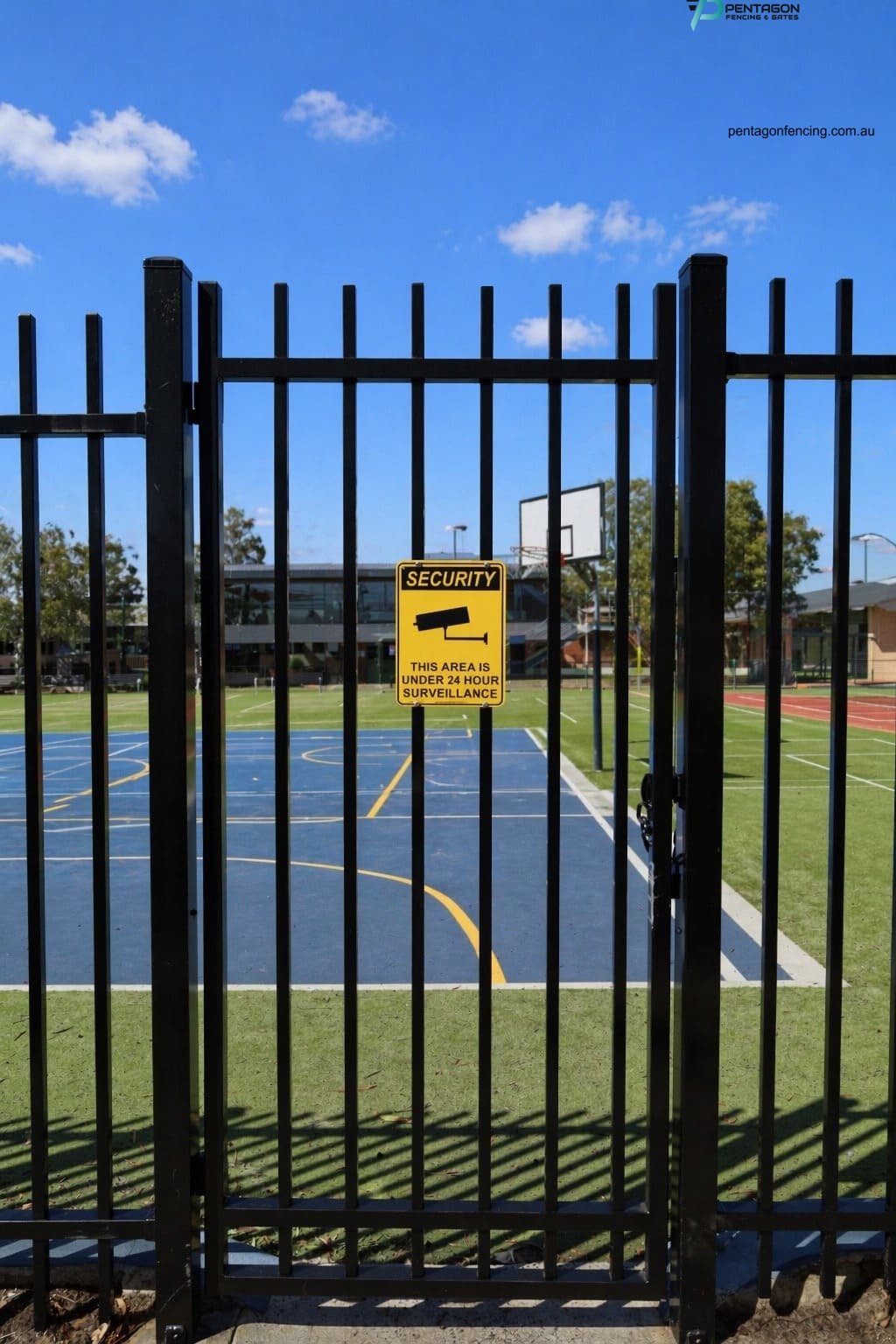
The available opening arc should be checked against sloping ground, parked vehicles, pedestrian routes, landscaping, footpaths and wind exposure. The hinge posts and foundations also carry the gate as a cantilevered load when each leaf is open, so a visually matching fence post should not automatically be assumed to be an adequate gate post.
For automated swing gates, identify the closing and opening danger zones, the position of operator arms, access for servicing and how the gate behaves during a power failure or emergency.
Pedestrian steel gates: separate people from vehicle movement
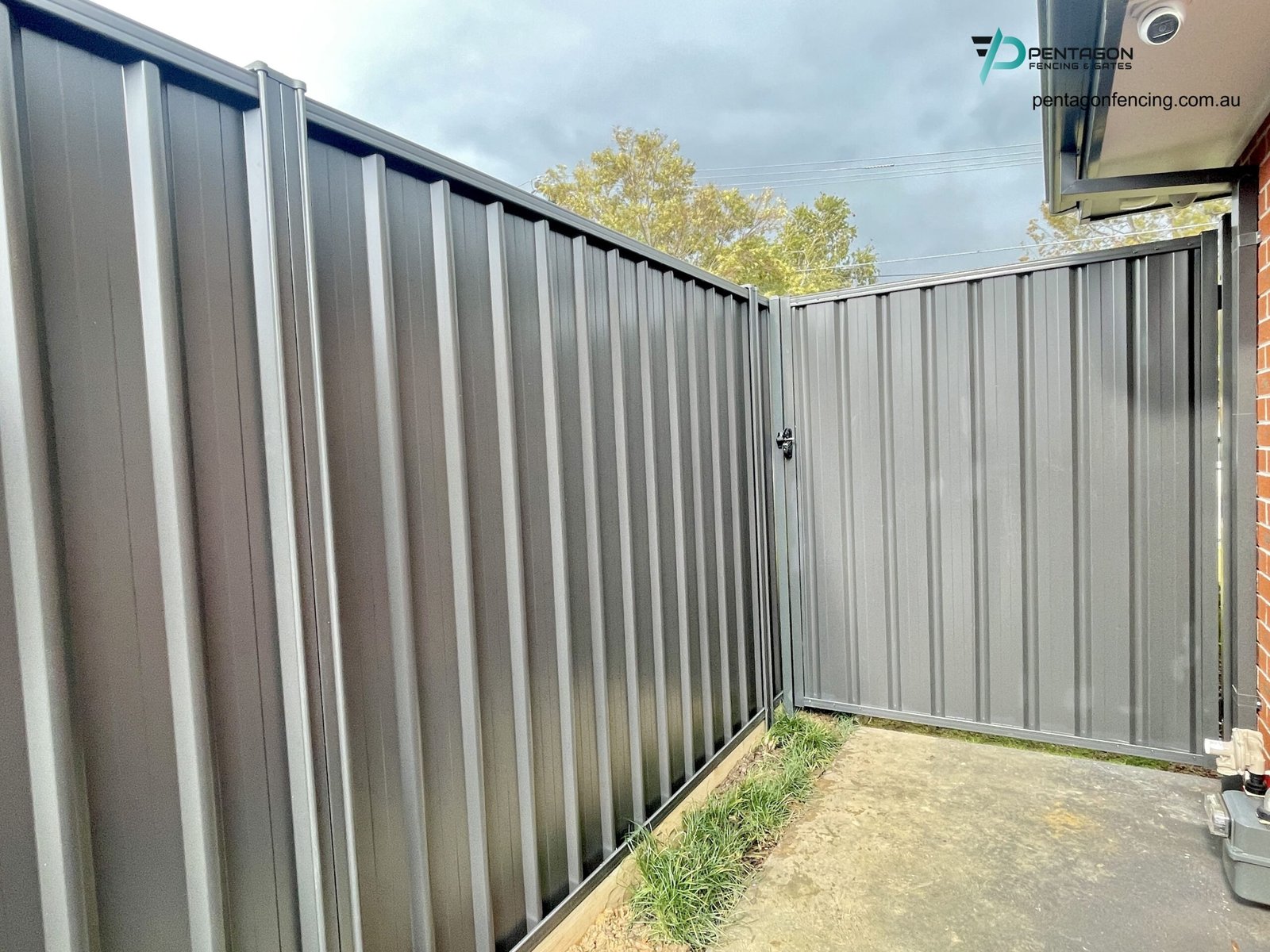
A dedicated pedestrian gate can improve daily access and reduce the need to open a large vehicle gate for staff, residents or visitors. Pentagon describes side gates as secure, practical access points that can be customised to match the fencing system [5].
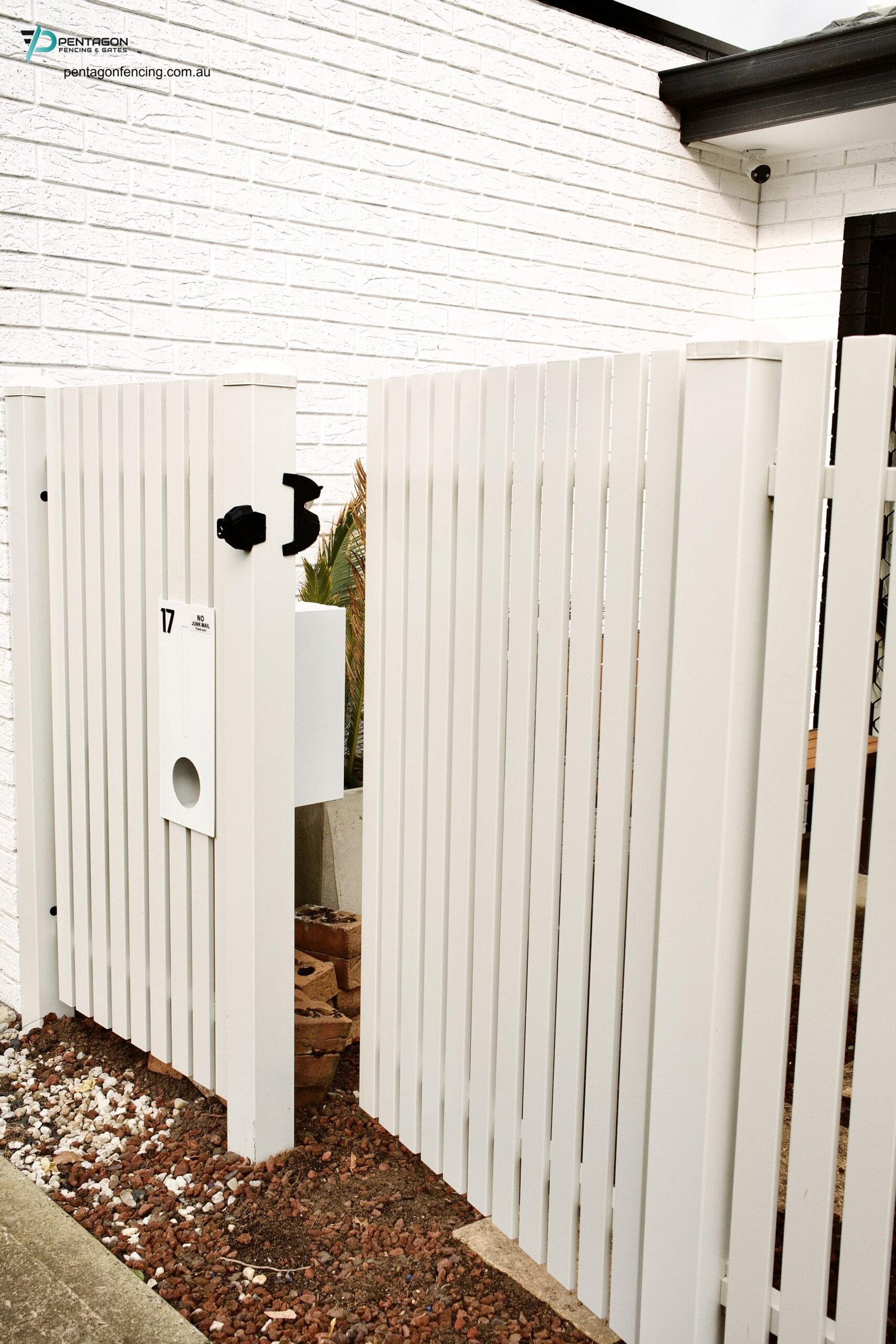
Match the infill and top profile to the steel fence, but design the hardware for human use. Confirm clear opening width, accessible approach, latch side, lock type, closer, intercom or credential reader, visibility and emergency-egress needs. Where self-closing or self-latching performance is required, it should be specified and verified rather than assumed from the term “pedestrian gate”.
Access-control checklist for steel gate projects
Use the following checklist before choosing steel gate automation or credential technology. This article identifies integration questions; detailed control-system design remains within the automation/access-control scope.
- Users: list staff, visitors, residents, delivery drivers, contractors, emergency services and after-hours users.
- Credentials: decide whether access is controlled by keys, remotes, keypad/PIN, intercom approval, cards/RFID, mobile credentials or another managed method.
- Vehicle detection: identify whether loops, beams or other detection are needed for safe and efficient vehicle entry and exit.
- Pedestrian separation: provide a separate walk-through route where people should not interact with the moving vehicle gate.
- Surveillance: position lighting and CCTV so the gate approach, credential point and closing area remain visible.
- Fail behaviour: define what happens during power loss, fire alarm, emergency access, network failure or a damaged credential device.
- Manual release: provide an authorised and documented method to place the gate in a safe condition and operate or secure it when automation is unavailable.
- Logs and management: determine whether access events need to be recorded, credentials revoked and time schedules administered.
Powered gate safety and maintenance are part of the specification
Powered gates are moving machines. HSE guidance identifies hazards including impact, crushing, trapping, entanglement, electrical risks, falling, uncontrolled movement and running off tracks. It recommends proper design for the location and foreseeable users, competent installation, documentation, regular checks and maintenance [8].
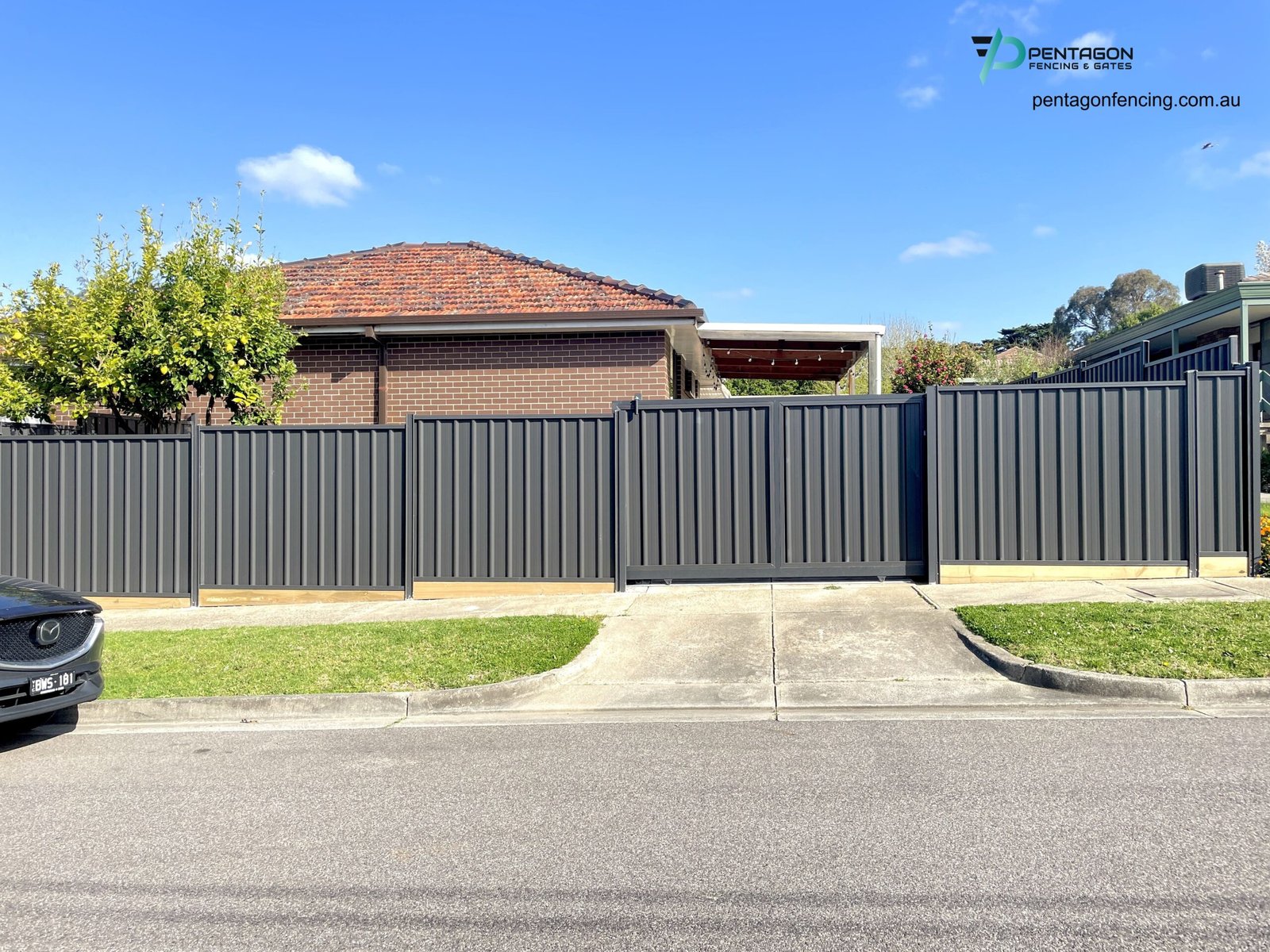
For a Melbourne workplace, the WorkSafe Victoria gate-crush prosecution reinforces the need to prevent unsafe manual operation and to secure a gate when components are removed or the system is left out of service [7]. The exact legal and technical obligations should be confirmed for the Australian project; overseas guidance can inform risk questions but does not replace Australian standards, manufacturer instructions or competent local advice.
- Identify every crushing, trapping, shearing, drawing-in and impact zone along the gate movement.
- Specify physical restraint so the gate cannot fall, derail, overrun or rotate uncontrollably.
- Confirm safety edges, beams, force limitation, guards or other protective measures required by the design.
- Document inspection, testing, adjustment, cleaning, lubrication and fault-response intervals.
- Take a dangerous or unstable gate out of use and secure the area until the risk is addressed.
Public-facing and frontage design checks
Planning Victoria notes that barriers and fences should support amenity and safety, allow pedestrian movement where relevant, remain visible and use non-injurious top details [9]. These principles matter where steel gates sit at schools, parks, commercial frontages, mixed-use developments or other locations approached by the public.
Review gate swing or travel in relation to footpaths, cyclists, visibility splays, vehicle crossovers and adjoining public areas. A gate should not open or project into an unsafe path without the necessary design and approvals. Property-specific council, planning, building and accessibility requirements should be checked before fabrication.
Steel frames, finishes and corrosion protection
Gate frames experience movement, repeated cycles and local stress around hinges, rollers, guides, locks and automation mounts. Corrosion protection should therefore be selected for the fabrication and exposure environment rather than reduced to a colour choice. The Australian Steel Institute recommends a technically robust, fit-for-purpose coating specification that considers surface preparation, environment, fabrication, quality assurance and whole-of-life maintenance [10].
- Confirm whether the frame and infill are pre-galvanised, hot-dip galvanised after fabrication, painted, powder coated or protected by a combined system.
- Ask how welds, cut edges, drilled holes and automation brackets are protected.
- Review drainage and venting where hollow steel sections are used.
- Include chips, scratches, corrosion, loose hardware and gate alignment in routine inspection.
- Specify compatible finishes across the gate leaf, posts and adjoining security fence.
Quote-readiness checklist for steel gates Melbourne
Prepare these details before requesting a quote for steel gates in Melbourne:
- Fence system: palisade, weldmesh, tubular, rod top, chain wire or another adjoining fence type.
- Gate type: sliding, cantilever, single swing, double swing or pedestrian.
- Opening dimensions: clear width, target height, ground levels, run-off or swing space and overhead constraints.
- Traffic: vehicle types, daily cycles, peak queues, pedestrians, deliveries and emergency access.
- Security level: boundary control, commercial deterrence, anti-climb perimeter or managed restricted access.
- Infill and frame: matching profile, aperture/picket spacing, bottom clearance, top style and frame depth.
- Operation: manual or automated, motor duty, power, controls, sensors, intercom, CCTV and credential system.
- Safety and maintenance: movement hazards, restraint, protective devices, manual release, service access and inspection plan.
- Site works: removal, foundations, concrete, trenching/conduits, drainage, traffic management and work near public areas.
- Finish: corrosion-protection system, colour and repair expectations.
Decision shortcut
- Shortlist a sliding steel gate when side run-off is available, swing clearance is limited and vehicle cycles justify parallel movement.
- Shortlist a swing steel gate when there is a clear opening arc and the hinge posts, gradient and wind conditions suit the leaf size.
- Add a pedestrian steel gate where people need regular access without sharing the vehicle-gate movement zone.
- Match the gate to the fence through infill, height, gaps, top profile, locks and anti-climb/security logic—not colour alone.
- Escalate to a detailed automation and safety design before approving motors, controls, sensors or high-cycle operation.
Common mistakes to avoid
- Under-specifying the opening. A secure fence with a lightly framed or poorly locked gate does not provide a consistent perimeter.
- Choosing movement before measuring the site. Sliding needs run-off; swing needs a safe arc; both need stable posts and foundations.
- Mixing pedestrians and vehicles unnecessarily. A dedicated pedestrian gate can improve access flow and reduce gate cycles.
- Adding automation after fabrication. Motor loads, conduits, restraints, safety devices and manual release should influence the original design.
- Treating maintenance as reactive repair. Moving gates need scheduled inspection, adjustment and safe fault-management procedures.
How Pentagon Fencing can help
Pentagon Fencing & Gates supplies and installs steel fencing, sliding gates, swing gates, side gates and automated access solutions across Melbourne for residential, commercial and industrial projects [1] [2].
- Match the steel gate infill and frame to palisade, weldmesh, tubular, rod top or chain wire security fencing.
- Plan vehicle and pedestrian openings together with automation, access control, safety devices and site traffic.
- Prepare a site-specific quote covering gate type, dimensions, foundations, finish, removals and installation constraints.
FAQ
Is a steel sliding gate better than a steel swing gate?
Neither is universally better. Sliding gates usually suit sites with enough side run-off and limited swing space. Swing gates suit openings with a safe arc and appropriate hinge-post support. Traffic frequency, slope, wind, automation and pedestrian movement should decide the shortlist.
How should a steel gate match security fencing?
Match the effective height, infill or picket spacing, top profile, bottom clearance, lock protection and climb resistance of the adjoining fence. The gate frame and hardware should not create an easier access route than the fixed perimeter.
Do commercial sites need a separate pedestrian steel gate?
A separate gate is usually worth considering when staff or visitors need frequent walk-through access. It can reduce vehicle-gate cycles and make pedestrian locks, intercoms, closers and access credentials easier to design.
Can spear top gates be automated?
Yes, a spear top gate can be configured as a sliding or swing gate, but automation does not resolve whether pointed details are suitable for the site’s users and public exposure. The gate still requires a movement-risk assessment and a complete safety design.
What access-control options can be used with steel gates?
Depending on the site, options may include keys, remotes, keypads, intercoms, cards or RFID credentials, mobile access, vehicle detection and CCTV integration. The selection should reflect user groups, operating hours, audit needs, fail behaviour and emergency access.
How often should an automated steel gate be maintained?
The interval depends on the gate design, manufacturer instructions, usage cycles, environment and workplace risk. Establish a documented inspection and maintenance schedule and arrange prompt review if the gate becomes unstable, misaligned, damaged or fails to operate safely.
What to Keep in Mind
- Choose sliding, swing and pedestrian gates by site movement, users and available space before finalising the steel frame.
- Match gate infill, height, gaps, locks and top style to the security level of the adjoining fence.
- Separate pedestrian and vehicle access where shared movement would create avoidable risk or operational friction.
- Plan powered-gate restraint, protective devices, manual release and maintenance before fabrication and installation.
- Keep detailed movement mechanics and access-control engineering within the relevant gate or automation project scope.
References
- Pentagon Fencing, “Gates,” Pentagon Fencing. Accessed: Jun. 16, 2026. [Online]. Available: https://pentagonfencing.com.au/service-category/gates/
- Pentagon Fencing, “Palisade Fencing & Steel Security Fencing Melbourne,” Pentagon Fencing. Accessed: Jun. 16, 2026. [Online]. Available: https://pentagonfencing.com.au/service/steel-security-fencing-melbourne/
- Pentagon Fencing, “Sliding Gate Automation in Melbourne,” Pentagon Fencing. Accessed: Jun. 16, 2026. [Online]. Available: https://pentagonfencing.com.au/service/sliding-gates/
- Pentagon Fencing, “Swing Gate Automation,” Pentagon Fencing. Accessed: Jun. 16, 2026. [Online]. Available: https://pentagonfencing.com.au/service/swing-gates/
- Pentagon Fencing, “Side Gate,” Pentagon Fencing. Accessed: Jun. 16, 2026. [Online]. Available: https://pentagonfencing.com.au/service/side-gate/
- Victoria Police, “Business Premises Security,” Victoria Police. Accessed: Jun. 16, 2026. [Online]. Available: https://www.police.vic.gov.au/securing-business-premises
- WorkSafe Victoria, “Company Fined $350,000 after Fatal Gate Crush,” WorkSafe Victoria. Accessed: Jun. 16, 2026. [Online]. Available: https://www.worksafe.vic.gov.au/news/2024-12/company-fined-350000-after-fatal-gate-crush
- Health and Safety Executive, “The Basics: Powered Gates,” HSE. Accessed: Jun. 16, 2026. [Online]. Available: https://www.hse.gov.uk/work-equipment-machinery/powered-gates/basics.htm
- Department of Transport and Planning Victoria, “6.4 Barriers and Fences,” Planning Victoria. Accessed: Jun. 16, 2026. [Online]. Available: https://www.planning.vic.gov.au/guides-and-resources/guides/urban-design-guidelines-for-victoria/objects-in-the-public-realm/barriers-and-fences
- Australian Steel Institute, “Corrosion Protection,” Australian Steel Institute. Accessed: Jun. 16, 2026. [Online]. Available: https://www.steel.org.au/what-we-do/focus-areas/steel-and-design/corrosion-protection/