
Table of Contents
Warehouses security fencing should be planned as a perimeter, gate and access-control system—not as one fence line priced by the metre. A warehouse can have truck entries, loading docks, staff car parks, visitor reception points, restricted stock zones, plant areas and after-hours yards, and each zone may need a different level of fencing, visibility, gate control and maintenance.
Pentagon Fencing & Gates lists palisade, pressed spear top, rod top, weldmesh, tubular steel and chain wire within its Melbourne steel fencing range, together with matching gate and automation options [1]. For warehouses and logistics sites, the practical question is how those options work together across the whole site.
Why warehouses security fencing is easy to specify incorrectly
- You choose the same fence around the entire warehouse without separating truck gates, staff entries, rear boundaries, visitor access and high-value internal compounds.
- You compare palisade, weldmesh, chain wire and tubular steel as if they solve the same problem, even though deterrence, visibility, anti-climb intent and cost control are different priorities.
- You focus on the fence panels while the main sliding gate, pedestrian gate, latch, intercom or keypad becomes the real weak point.
- You specify privacy screening at a frontage that should remain visible for driver awareness, CCTV, visitors or informal surveillance.
- You leave after-hours lighting, boundary housekeeping, access-control rules, gate maintenance and emergency release out of the original scope.
Key Takeaways
- Warehouse fencing solutions should be selected by site zone: front boundary, truck entry, loading dock, staff path, rear perimeter and restricted stock areas may not need the same fence.
- A warehouse perimeter works best when fencing, gates, access control, lighting, CCTV, locks, traffic flow and maintenance are planned together. NPSA describes fences and gates as part of an integrated perimeter security solution, not isolated products [2].
- Palisade and pressed spear top systems can suit high-deterrence warehouse perimeters, weldmesh can support visibility and security, and chain wire can be practical for long visible boundaries where cost-controlled coverage is more important than maximum deterrence [3].
- A warehouse sliding security gate should be specified with the gate leaf, track or cantilever hardware, motor, safety devices, access-control trigger, manual release and maintenance plan.
- Warehouse access should not release pedestrians into forklift or truck movement. WorkSafe Victoria says a traffic-management plan that separates forklifts from pedestrians can reduce the risk of forklift-related deaths and injuries [4].
What does warehouse security fencing include?
Warehouse security fencing is the fixed and controlled perimeter system used to define the site, delay unauthorised access, guide approved users and protect operational zones. It can include steel security fencing, weldmesh panels, palisade, chain wire, tubular steel, rod top fencing, vehicle gates, pedestrian gates, access-control hardware, lighting, CCTV and barriers.
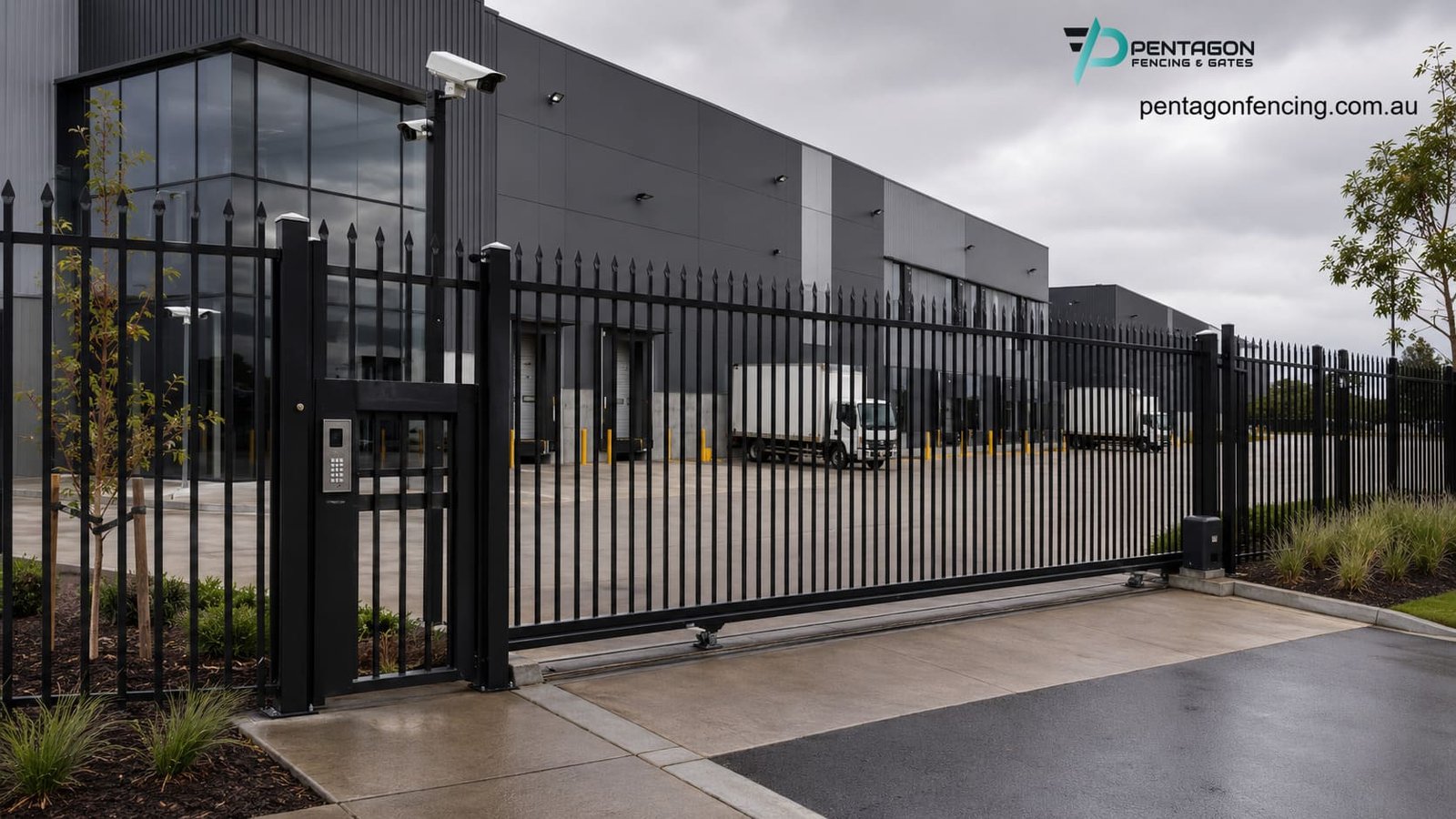
A practical warehouse perimeter fencing scope should identify the protected assets, site zones, entry points, traffic routes, gate types, opening widths, ground conditions, fence height, visibility needs, after-hours controls, maintenance responsibility and emergency access requirements. In many Melbourne projects, this overlaps with industrial perimeter fencing because the warehouse boundary must support logistics, storage, staff access and asset protection at the same time.
The most important shift is to stop thinking of the fence as a continuous product and start treating security fencing for warehouses as a warehouse access system. A high-value asset cage, a delivery gate, a staff side gate and a street frontage may all sit on the same property, but they solve different problems.
Warehouse site-zone matrix
This matrix maps common warehouse zones to fencing, gate and access-control decisions. It keeps the article at use-case level and routes product-specific details to the relevant fence or gate guide.
| Warehouse zone | Main risk or pressure | Fence direction | Gate and access-control direction | Maintenance note |
|---|---|---|---|---|
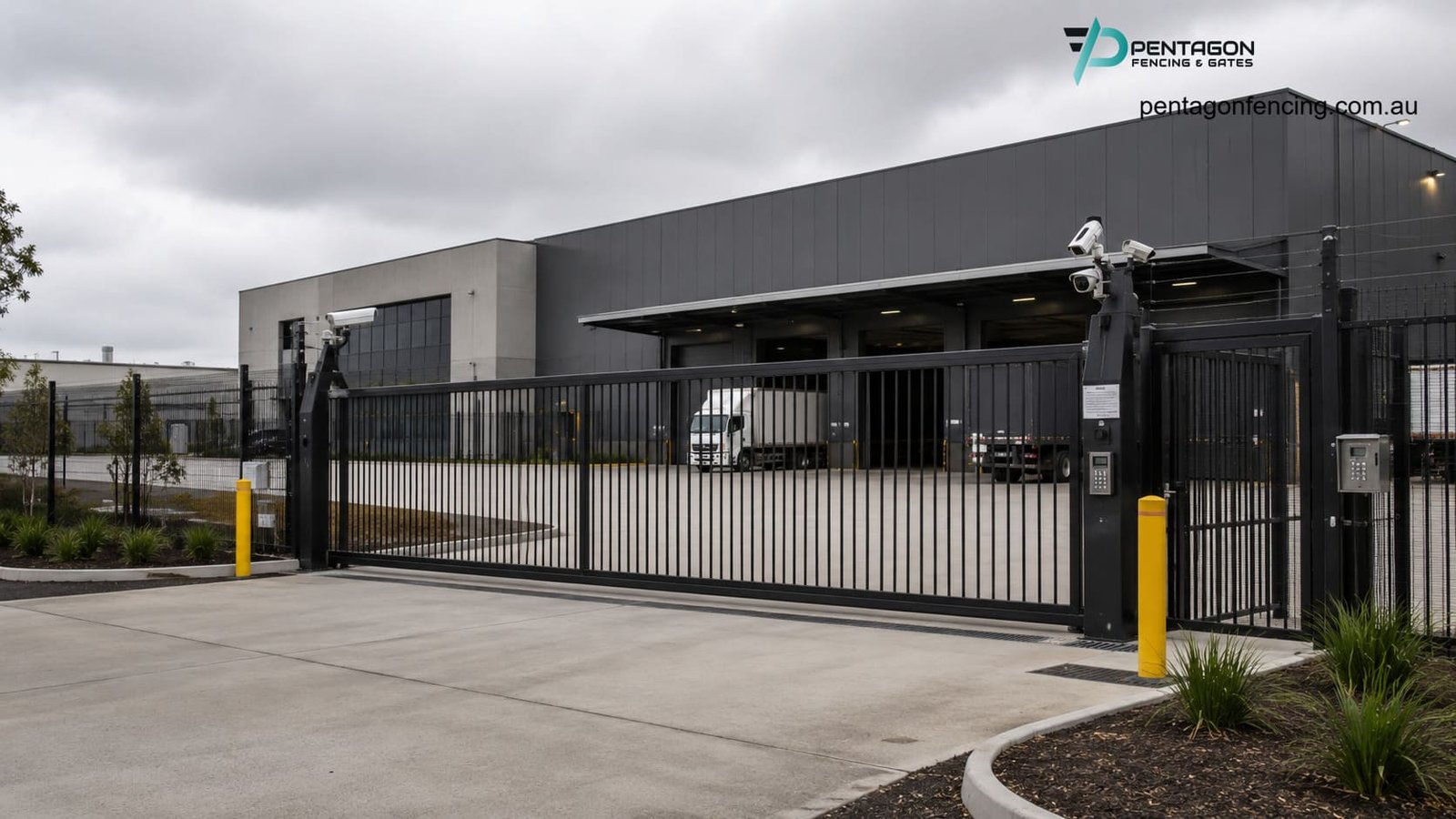
| Main truck entry | Heavy vehicles, queueing, delivery peaks, after-hours access and wide turning paths. | Use visibility-friendly steel fencing where drivers, CCTV and site managers need to see the gate approach. | Shortlist sliding or cantilever gates with access control, vehicle detection, safety devices and manual release. Pentagon’s sliding-gate service is designed for warehouses, logistics hubs and high-traffic industrial environments [5]. | Inspect track or cantilever hardware, end stops, motor load, sensors, loops, locks and impact-prone posts. |
| Loading bay and dispatch yard | Forklifts, reversing trucks, staff movement, pallet storage, delivery windows and visibility around corners. | Use fencing, barriers and line-of-sight decisions that support the site traffic-management plan. | Do not force staff or visitors through the vehicle gate. Add pedestrian access that connects to a protected walkway where practical. | Review the fence and gate layout whenever forklift routes, racking, delivery patterns or loading procedures change. |
| Rear or side warehouse perimeter | Long boundaries, low surveillance, adjoining industrial land, vegetation, stored goods and repeat trespass points. | Use chain wire for visible cost-controlled coverage, weldmesh where rigidity and anti-climb intent matter, or palisade where deterrence needs to be stronger. | Minimise unnecessary openings; secure maintenance gates with the same logic as the adjoining fence. | Keep vegetation, pallets, bins and stored materials away from the fence line so they do not become climbing aids. |
| Staff car park and pedestrian entry | Shift-change peaks, mixed staff and visitor traffic, walkways close to vehicles and after-hours entry. | Use fencing or barriers to guide people toward a clear pedestrian gate or reception route. | Use keypads, RFID, intercom, fobs or staff credentials according to who enters and how access is revoked. | Check gate closers, latches, readers, lighting and sightlines after hours, not only during daytime inspections. |
| Visitor and reception frontage | Visitors may not know where to go and can drift toward truck gates or restricted yards. | Use a frontage fence that supports wayfinding, visibility and the site’s commercial presentation. | Provide clear signage, intercom or controlled visitor release; separate visitor entry from freight entry where possible. | Planning Victoria recommends low-height or partially transparent fence types at street or public-space boundaries to support informal surveillance [6]. |
| High-value internal stock or fleet compound | Theft risk, restricted inventory, equipment, vehicles, fuel, tools or critical materials. | Use a higher-deterrence internal fence such as palisade or weldmesh rather than relying on the outer perimeter alone. | Limit access to authorised credentials, reinforce locks, and align gate opening records with the inventory control process. | Audit the compound gate, lock, hinges, fixings, camera view and lighting as part of stock-security checks. |
Fence type matrix for warehouse sites
Different warehouse boundaries need different levels of deterrence, visibility, privacy and cost control. The matrix below provides a practical routing framework.
| Fence type | Best warehouse fit | What it helps control | Watch-out | Route deeper when |
|---|---|---|---|---|
| Palisade or pressed spear top | High-deterrence outer perimeters, restricted yards, utilities, fleet compounds and high-value warehouse boundaries. | Visible deterrence, climbing difficulty and stronger steel boundary presentation. | Pointed or aggressive profiles may be unsuitable for public-facing edges, staff paths or mixed-use frontages. | The buyer needs W-pale, D-pale, spear top, top-profile, fixing or finish details. |
| Weldmesh or close-aperture mesh | Warehouses that need security while keeping sightlines for CCTV, patrols, drivers and visitors. | Rigid panel shape, visibility and anti-climb intent when the mesh, aperture, posts and fixings match the risk. Weldmesh uses steel wires welded at intersections to create rigid panels [7]. | Panel performance depends on aperture, wire diameter, height, ground gaps, clamps, fixings, posts and gates. | The project is comparing 358 mesh, anti-climb mesh, school/warehouse visibility or public-facing security. |
| Chain wire, chain link or chain mesh | Large warehouse lots, rear boundaries, storage yards, staging areas and long runs where visibility and cost control are important. | Coverage, boundary definition, visibility and practical separation over long fence lines. | It should not be positioned as the highest-security anti-climb option where climbing, cutting or repeated forced entry is credible. Chain wire quotes should define mesh, wire, posts, supports, gates, finish and height [8]. | The quote depends on aperture, wire diameter, posts, rails, bracing, gates, coatings or long-run pricing. |
| Tubular steel, rod top or flat top | Public-facing warehouse frontages, staff car parks and areas where a less aggressive look is preferred. | Boundary definition, clear visibility, commercial presentation and moderate deterrence. | Not automatically equivalent to palisade or close-aperture weldmesh for high-value stock compounds. | The site needs a front-boundary style decision or safer public-facing steel profile. |
| Colorbond, timber or screening panels | Lower-risk service yards, bin areas, plant screens and mixed-use neighbour boundaries where privacy is a real requirement. | Visual screening, cleaner back-of-house presentation and separation from adjoining uses. | Solid screening can reduce surveillance and increase wind or maintenance considerations. | The decision is about privacy, noise, neighbour interface or frontage appearance rather than anti-climb security. |
| Bollards and barriers | Warehouse frontages, roller-door approaches, pedestrian refuges, equipment protection and areas where vehicle movement must be filtered. | Vehicle separation, asset protection and pedestrian guidance where a fence alone is not enough. | A bollard layout must still allow emergency access, pedestrian movement, turning paths and loading operations. | The site needs vehicle impact control, traffic filtering or loading-zone separation. |
Perimeter, gates and access control must be one system
NPSA explains that fences and gates should not be considered in isolation and that a perimeter solution may include detection, surveillance, lighting, vehicle barriers, formal pedestrian and vehicle access points, visitor-management policies and emergency egress or access requirements [2]. This is a useful way to think about warehouse sites even when the project is not a high-security facility.
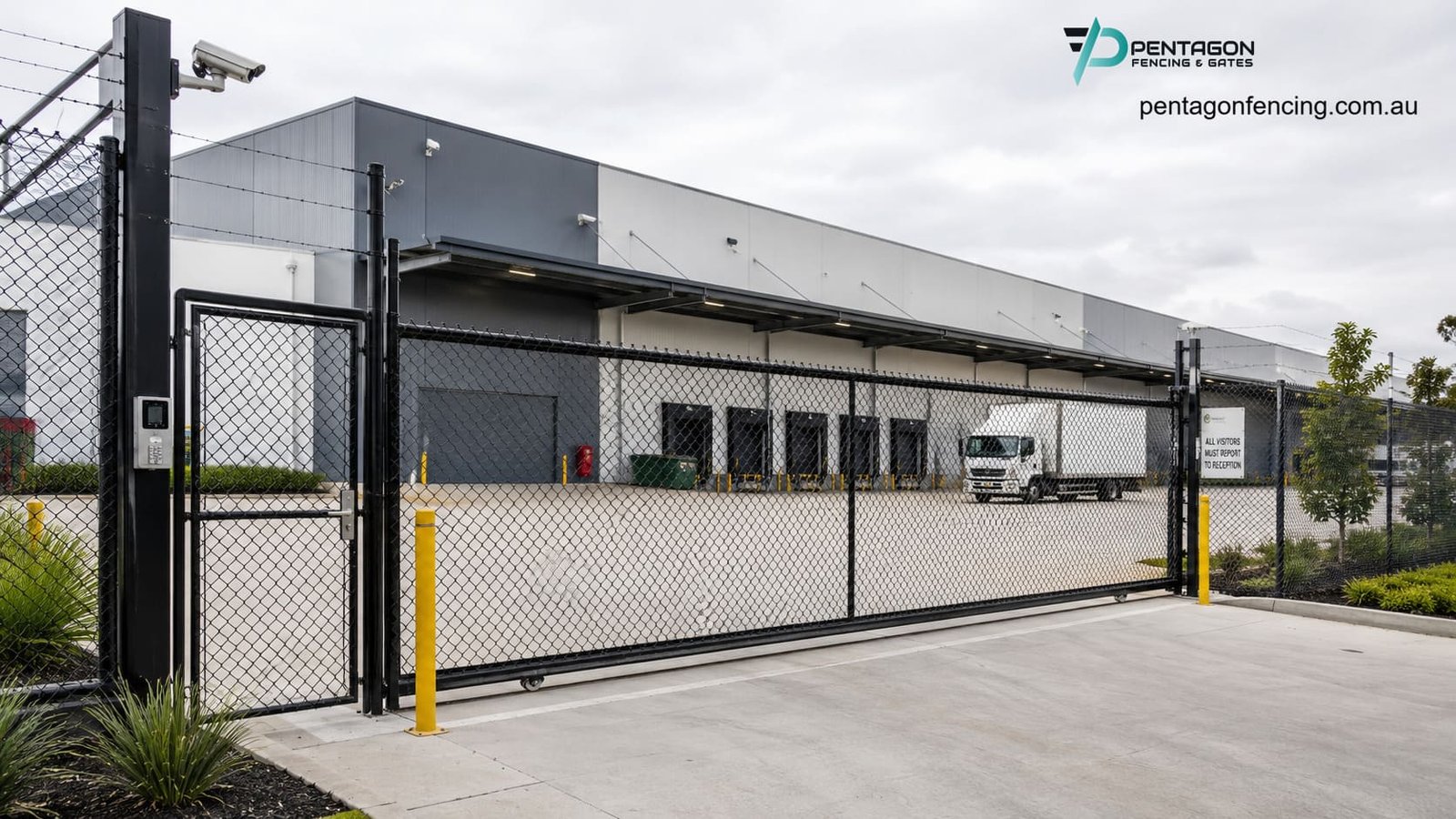
For warehouses, the perimeter normally has two competing needs: stop unauthorised access and keep authorised logistics moving. The system must allow trucks, staff, couriers, maintenance teams and visitors to enter under control without creating unsafe queues or gaps in the fence line.
- Fence line: define what the boundary must deter, delay, screen or show.
- Vehicle gate: plan opening width, run-back, swing clearance, traffic queue, motor duty, manual release and safety devices.
- Pedestrian gate: keep staff and visitors out of truck or forklift movement where practical.
- Access control: match remotes, keypad, RFID, intercom, mobile access, vehicle loops or guard release to the user groups.
- Monitoring: align CCTV, lighting, open-too-long alerts, locks and after-hours response with the risk level.
- Maintenance: assign responsibility for gate tracks, hinges, locks, readers, vegetation, damaged panels and lighting faults.
Gate and access-control options for warehouses
The gate is often the most important part of a warehouse perimeter because it is the point where people and vehicles legitimately pass through the fence. A strong fence can still fail if the gate is too slow, left open, badly located or disconnected from access control.
| Gate or access option | Warehouse fit | Operational value | Watch-out |
|---|---|---|---|
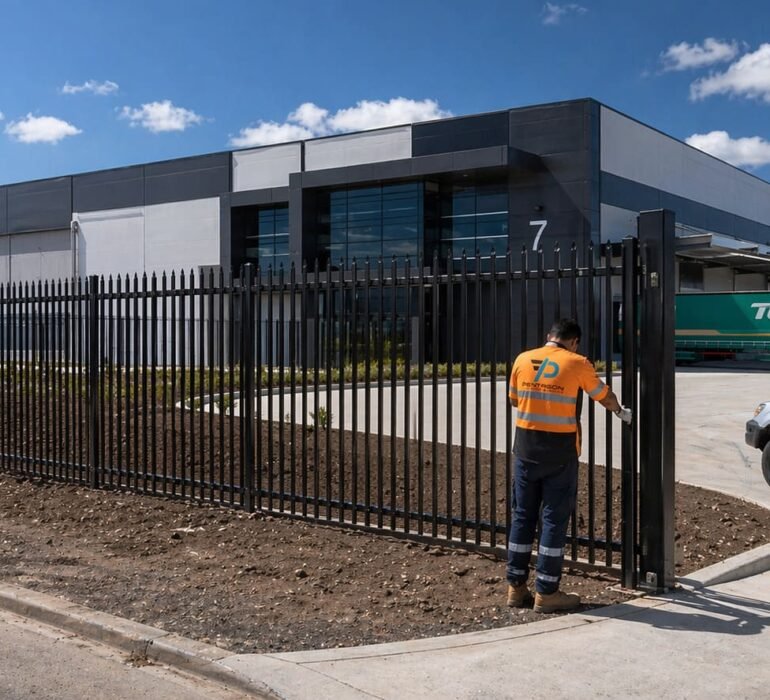
| Automated sliding gate | Main truck entries, high-use yards and boundary lines where swing arc is limited. | Keeps the gate movement parallel to the fence and can support remote controls, vehicle detection and site-security integration. | Track, run-back, end stops, sensors, motor duty and manual release must match real daily traffic. |
| Cantilever gate | Sites where a track-free opening is preferred because of gravel, mud, debris, drainage or heavy vehicle crossing. | Avoids a ground track across the driveway and can pair with weldmesh, chain wire or steel infill. | Requires side run-back and counterbalance space, suitable posts and gate-weight assessment. |
| Swing gate | Lower-traffic service yards, occasional access points and entries with enough clear inward or outward arc. | Simple hinged movement and useful where sliding run-back is unavailable. | Can block loading zones, pedestrian paths or vehicle queues if the swing arc is not protected. |
| Pedestrian or side gate | Staff entrances, visitor routes, contractor paths and restricted areas where people should not use the vehicle gate. | Improves separation of people and vehicles and keeps the main vehicle gate closed more often. | Latch, closer, reader, intercom, lighting and the path beyond the gate must be planned together. |
| Keypad, RFID, intercom or fob access | Staff car parks, logistics yards, visitor entries, after-hours access and contractor control. | Allows the business to define who can enter and how access is revoked or recorded. | Shared codes, lost fobs, poor intercom placement or weak admin can undermine the system. |
| CCTV and lighting integration | Truck gates, visitor entries, rear boundaries, high-value compounds and after-hours yards. | Supports detection, verification, deterrence and incident review. | Cameras and lights must see the gate approach, not just the fence line. |
Loading bays, forklifts and pedestrian separation
Warehouse fencing is not only about theft prevention. It can also support traffic management by separating people from powered mobile plant and directing users through safer routes. WorkSafe Victoria states that forklift traffic management should identify hazards, assess risk and include controls, and it identifies isolation of plant from people and engineering controls among risk-control options [4].
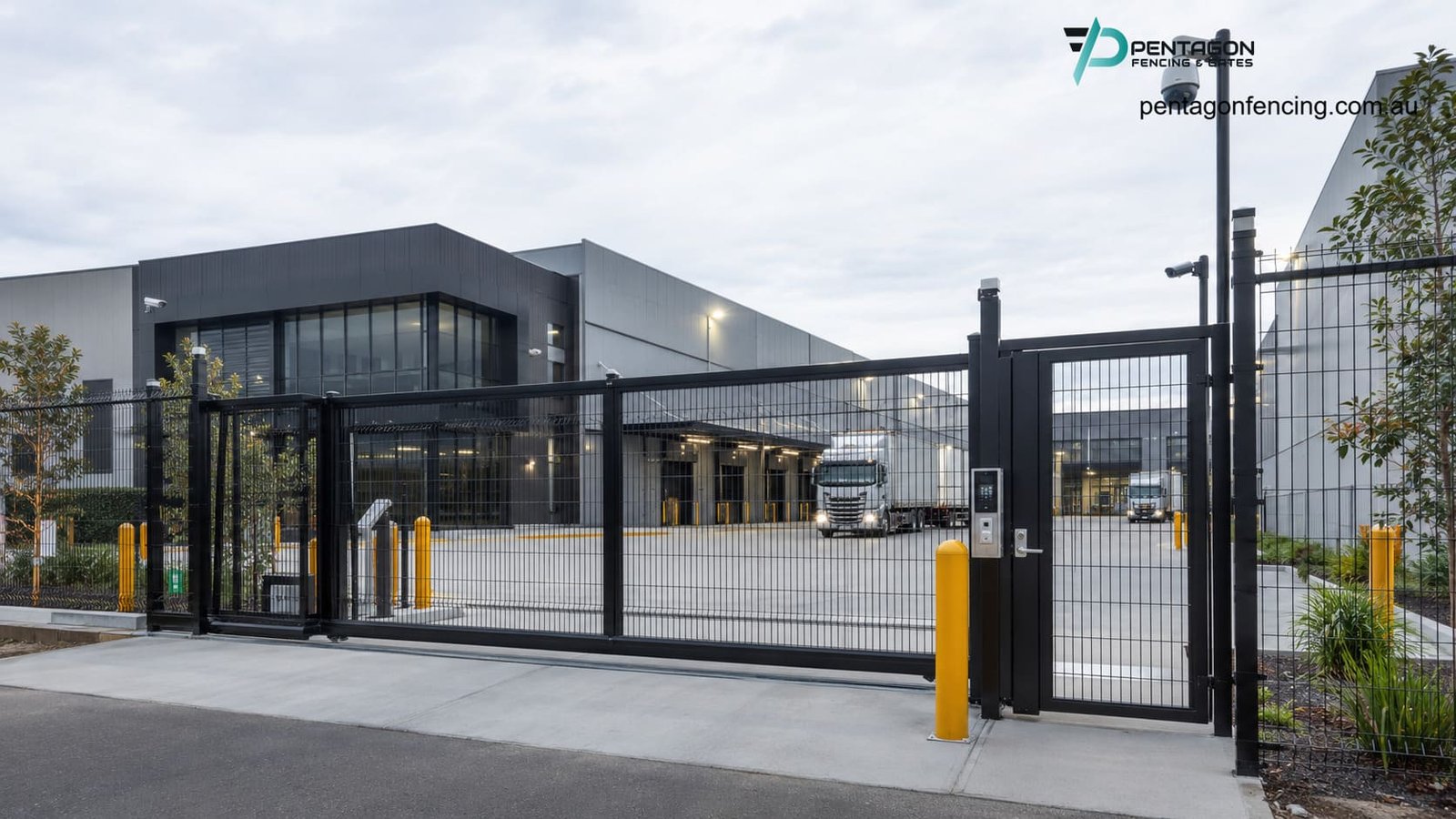
WorkSafe Victoria also lists forklifts and pedestrians sharing the same areas, inadequate traffic management plans and restricted operating spaces as common causes of collisions with powered mobile plant [9]. This affects where pedestrian gates, bollards, barriers and side fencing are placed.
- Do not place the staff pedestrian gate so users step directly into a forklift route.
- Use fencing, barriers, bollards or gates to guide pedestrians toward marked walkways and safe waiting areas.
- Keep vehicle gate controls from forcing trucks to stop across public roads, footpaths or internal pedestrian paths.
- Review the fence and access plan when racking, dispatch flow, truck schedules or loading areas change.
- Use signage and lighting to make the correct pedestrian and vehicle entry points obvious after dark.
After-hours warehouse security layers
After-hours security depends on more than fence height. Victoria Police advises businesses to install exterior lights at entry points and boundaries, keep fences and gates well-built, maintained and secured, install good-quality locks, use cameras and monitored alarms, and keep boundaries clear of potential climbing aids [10].
- Lighting: cover entry points, rear fence lines, loading areas, keypad/intercom locations and pedestrian gates.
- CCTV: capture the gate approach, vehicle plate area if required, side gate, high-value compound and rear boundary.
- Locks and readers: make sure locks, keypads, fobs, intercoms and electric releases are protected and administrated.
- Boundary housekeeping: remove pallets, bins, stacked stock, vegetation and equipment that can act as climbing aids or concealment.
- Open-gate discipline: define who may leave a gate open, for how long, and how after-hours exceptions are approved.
- Maintenance: repair damaged mesh, leaning posts, faulty lights, loose locks, sensor faults and slow gate motors before they become normalised.
Powered gate safety and maintenance
Where a warehouse uses an automated sliding, cantilever or swing gate, safety must be designed around the installed system and the people who may encounter it. HSE states that powered gate safety depends on how components are combined for the specific circumstances and how safety is maintained over time; it also says the gate must respond safely when a person interacts with it [11].
For a warehouse site, the access-control brief should therefore include safety beams or pressure edges where needed, manual release, emergency access, isolation procedure, fault response, commissioning records and routine inspection. A gate that is safe on day one can become unsafe if tracks, hinges, stoppers, sensors or motor settings deteriorate.
What affects warehouse security fencing cost?
Warehouse fencing quotes should be compared by complete system scope. A fence-only metre rate can hide the real project cost if gates, automation, access control, ground conditions and live-site staging are excluded.
| Cost driver | Effect on the quote | Caveat | Evidence to request |
|---|---|---|---|
| Fence type by zone | Palisade, weldmesh, chain wire, tubular steel and privacy screening use different materials, posts, fixings and installation methods. | A cheaper perimeter treatment may be wrong for a restricted stock or fleet compound. | Site-zone schedule, risk level, fence family, height and gate transition. |
| Height, posts and footings | Higher or heavier fence systems require more steel, stronger posts, larger footings and more handling time. | Height should follow risk, site exposure and approvals, not a generic assumption. | Finished height, post centres, footing assumptions, ground condition and wind/exposure notes. |
| Vehicle gates | Sliding, cantilever and swing gates add frames, posts, rollers or hinges, motors, safety devices and electrical scope. | The gate opening can cost and perform very differently from the same width of fixed fence. | Gate schedule, clear opening, motor duty, access-control hardware and safety-device layout. |
| Pedestrian access | Side gates, staff gates, intercoms, latches, closers, maglocks or electric strikes add hardware and coordination. | A pedestrian gate that is not connected to a safe path may need barriers, signage or layout changes. | Pedestrian route plan, hardware schedule, egress requirement and credential process. |
| Access control and security integration | Keypads, fobs, RFID, intercoms, vehicle loops, CCTV, alarms and open-too-long alerts add equipment and commissioning. | Hardware cost is only part of the project; user setup and administration must also be defined. | Access-control schedule, user groups, cable routes, power, admin owner and integration responsibility. |
| Removal, staging and live operations | Existing fence removal, disposal, temporary security, traffic control, out-of-hours work and staged handover add labour. | A live warehouse may need secure temporary access while the new perimeter is being built. | Staging plan, removal scope, temporary controls, delivery windows and operating-hour restrictions. |
Seven-step selection flow
- Map the warehouse zones. Separate truck entry, staff entry, visitor route, loading bay, rear boundary, restricted stock area and public frontage.
- Define the risk in each zone. Identify trespass, climbing, cutting, theft, after-hours entry, vehicle movement, pedestrian exposure and visibility needs.
- Choose the fence family. Route palisade, weldmesh, chain wire, tubular steel, screening, bollards or barriers according to the site role.
- Design the gates with the fence. Lock vehicle gates, pedestrian gates, gate infill, motors, safety devices and access-control points before pricing.
- Separate people and vehicles. Coordinate fencing and gates with the warehouse traffic-management plan, forklift routes and staff walkways.
- Add monitoring and after-hours controls. Plan lighting, CCTV, locks, alarm integration, open-gate rules and boundary housekeeping.
- Compare complete scopes. Require the same fence types, heights, gates, automation, access control, removals, staging, handover and maintenance from each contractor.
Warehouse fencing project checklist
- Site type: logistics hub, distribution centre, cold storage, manufacturing warehouse, retail warehouse, e-commerce fulfilment or mixed industrial site.
- Perimeter zones: front boundary, rear fence line, truck gate, staff gate, visitor entry, loading dock, service yard and internal compounds.
- Fence schedule: palisade, weldmesh, chain wire, tubular steel, privacy screening, bollards, barriers or mixed perimeter by zone.
- Vehicle gates: sliding, cantilever or swing gate, clear opening, run-back, swing clearance, motor duty and manual release.
- Pedestrian gates: staff, visitor, contractor and emergency access routes separated from truck or forklift movement where practical.
- Access control: remote, keypad, RFID, intercom, mobile access, loops, CCTV, visitor process and credential revocation.
- Safety: forklift traffic plan, pedestrian barriers, gate safety devices, lighting, signage, sightlines and emergency access.
- Operations: delivery windows, shift changes, after-hours access, security response, maintenance windows and live-site staging.
- Handover: keys, fobs, codes, manuals, gate instructions, maintenance plan, warranty, defect process and responsibility for access changes.
Common mistakes to avoid
- Using one fence type everywhere. Warehouses usually need different treatments for public frontage, rear perimeter, truck gate and internal asset compound.
- Making the vehicle gate the pedestrian route. Staff and visitors should not have to use the same opening as trucks and forklifts when a separate route is practical.
- Choosing privacy where visibility matters. Solid screening may be useful for service yards but wrong for CCTV, driver awareness or visitor entry.
- Leaving gate automation until the end. Power, conduit, loops, readers, safety devices and run-back should be planned before civil works and fabrication.
- Ignoring boundary housekeeping. Pallets, bins, vegetation and stored goods beside the fence can undermine visibility and become climbing aids.
- Comparing incomplete quotes. A quote that excludes gates, access control, lighting, removals, staging or maintenance is not equivalent to a complete warehouse-security scope.
How Pentagon Fencing can help
Pentagon Fencing & Gates can supply and install warehouse security fencing, steel fencing, sliding gates, side gates and gate automation across Melbourne, with options including palisade, weldmesh, tubular steel, chain wire, vehicle gates and access-control-ready systems [1] [5] [12].
- Map the warehouse into perimeter, truck, pedestrian, loading, visitor and restricted-stock zones before selecting fence types.
- Coordinate fixed fencing with sliding gates, cantilever gates, pedestrian gates, access control, safety devices, lighting and CCTV requirements.
- Prepare a site-specific scope covering materials, gates, ground conditions, removals, live-site staging, handover and maintenance.
FAQ
What is the best security fencing for a warehouse?
There is no single best fence for every warehouse. Palisade may suit high-deterrence zones, weldmesh may suit visible monitored boundaries, chain wire may suit large cost-controlled perimeters, and tubular steel may suit public-facing frontages. The right answer depends on the warehouse zone and risk level.
Should warehouse fencing include automated gates?
Often, yes. Truck gates and after-hours entries usually need controlled access. Automated sliding or cantilever gates can support high-use vehicle entries, but the system should include safety devices, manual release, access control and planned maintenance.
When is chain wire suitable for a warehouse perimeter?
Chain wire can be suitable for long visible boundaries, lower-to-medium-risk storage areas, rear perimeters and large sites where coverage and cost control matter. It should be upgraded to stronger mesh or palisade where repeated climbing, cutting or forced entry is likely.
How should pedestrian access be handled at a warehouse?
Pedestrian access should be separated from truck and forklift movement where practical. A side or pedestrian gate should connect to a clear internal walkway, reception point or safe waiting area rather than releasing people into a vehicle route.
What affects the cost of warehouse security fencing?
Major cost drivers include fence type, height, posts, gates, automation, access control, safety devices, lighting, CCTV integration, ground conditions, existing fence removal, temporary security, staging and maintenance requirements.
What to Keep in Mind
- Start with warehouse zones and operational flow before choosing palisade, weldmesh, chain wire, tubular steel or privacy screening.
- Plan fencing, gates, access control, lighting, CCTV and maintenance as one perimeter-security package.
- Separate pedestrian and vehicle movement wherever the gate layout could expose people to trucks, forklifts or loading activity.
- Use visibility where supervision, CCTV and driver awareness matter; use stronger deterrence where high-value stock or restricted assets justify it.
- Compare complete scopes that include gates, automation, safety devices, access-control administration, removals, staging and handover.
References
- Pentagon Fencing & Gates, “Steel Fencing Melbourne: Palisade, Weldmesh, Tubular, Rod Top and Chain Wire Options,” Pentagon Fencing & Gates. Accessed: Jun. 30, 2026. [Online]. Available: https://pentagonfencing.com.au/steel-fencing-melbourne/
- National Protective Security Authority, “Security Fences and Gates,” NPSA. Accessed: Jun. 30, 2026. [Online]. Available: https://www.npsa.gov.uk/building-protection/building-infrastructure/security-fences-and-gates
- Pentagon Fencing & Gates, “Palisade Fencing & Steel Security Fencing Melbourne,” Pentagon Fencing & Gates. Accessed: Jun. 30, 2026. [Online]. Available: https://pentagonfencing.com.au/service/steel-security-fencing-melbourne/
- WorkSafe Victoria, “Developing a Forklift Traffic Management Plan,” WorkSafe Victoria. Accessed: Jun. 30, 2026. [Online]. Available: https://www.worksafe.vic.gov.au/developing-forklift-traffic-management-plan
- Pentagon Fencing & Gates, “Sliding Gates,” Pentagon Fencing & Gates. Accessed: Jun. 30, 2026. [Online]. Available: https://pentagonfencing.com.au/service/sliding-gates/
- Department of Transport and Planning Victoria, “6.4 Barriers and Fences,” Planning Victoria. Accessed: Jun. 30, 2026. [Online]. Available: https://www.planning.vic.gov.au/guides-and-resources/guides/urban-design-guidelines-for-victoria/objects-in-the-public-realm/barriers-and-fences
- Pentagon Fencing & Gates, “Weldmesh Steel Fencing Melbourne: Anti-Climb Security Without Blocking Visibility,” Pentagon Fencing & Gates. Accessed: Jun. 30, 2026. [Online]. Available: https://pentagonfencing.com.au/weldmesh-steel-fencing-melbourne/
- Pentagon Fencing & Gates, “Chain Wire Steel Fencing Melbourne: Cost-Effective Security for Large Perimeters,” Pentagon Fencing & Gates. Accessed: Jun. 30, 2026. [Online]. Available: https://pentagonfencing.com.au/chain-wire-steel-fencing-melbourne/
- WorkSafe Victoria, “Forklift Hazards and Risk Controls,” WorkSafe Victoria. Accessed: Jun. 30, 2026. [Online]. Available: https://www.worksafe.vic.gov.au/forklift-hazards-and-risk-controls
- Victoria Police, “Business Premises Security,” Victoria Police. Accessed: Jun. 30, 2026. [Online]. Available: https://www.police.vic.gov.au/securing-business-premises
- Health and Safety Executive, “Ensuring Powered Doors and Gates Are Safe,” HSE. Accessed: Jun. 30, 2026. [Online]. Available: https://www.hse.gov.uk/work-equipment-machinery/powered-gates/safety.htm
- Pentagon Fencing & Gates, “Side Gate,” Pentagon Fencing & Gates. Accessed: Jun. 30, 2026. [Online]. Available: https://pentagonfencing.com.au/service/side-gate/