
Table of Contents
School fencing contractors should be evaluated on more than fence panels and metre rates. A school or childcare boundary has to balance security, supervision, visibility, safe pedestrian access, vehicle movement, emergency access and a public-facing appearance that does not feel hostile to students, children, families or visitors.
For school fencing contractors Melbourne projects, the practical question is not “which fence is strongest?” It is “which perimeter, gate and access-control package fits each school zone?” Pentagon Fencing & Gates provides steel fencing and gate systems across Melbourne, including palisade, spear top, rod top, weldmesh, tubular steel and chain wire options for commercial, industrial, government, infrastructure and school-related applications [1].
Why school fencing is easy to specify incorrectly
- You choose a high-deterrence fence without checking whether it feels too aggressive or unsafe around children, parents and public-facing entries.
- You use a solid privacy boundary where supervision, sightlines, visitor wayfinding or informal surveillance should remain open.
- You design the fence line before planning pedestrian gates, vehicle gates, staff access, deliveries, after-hours use and emergency egress.
- You compare school fencing solutions only by material, even though the same product can perform differently depending on height, spacing, top profile, gates, fixings and surrounding climbable objects.
- You ask for school security fencing Melbourne options without defining whether the risk is unauthorised entry, climbing, student exit, vehicle movement, vandalism, privacy, equipment protection or visitor control.
Key Takeaways
- School fencing contractors should be able to discuss security, visibility, safe access, gate hardware, pedestrian flow and maintenance as one school perimeter package.
- Victorian government school guidance says fencing and associated gates should be fit-for-purpose, strong, durable and safe; integrate with the landscape; discourage climbing; and be integrated with pedestrian and vehicle access gates [2].
- For early learning and childcare settings, fence and gate design must be treated more carefully than a standard commercial boundary. Victorian school-building guidance for early learning facilities includes enclosed outdoor spaces, minimum height requirements in specified settings, non-scalable design, self-closing and self-latching gates and avoidance of climbable objects near the fence line [3].
- Best fencing for school security is a site-specific decision. Weldmesh may support visibility and anti-climb intent, rod top or tubular steel may suit public-facing boundaries, and stronger steel systems may be reserved for higher-risk service or asset zones.
- Traffic and gate planning matters. Victorian Department of Education traffic guidance requires school traffic risks to be identified and managed, including pedestrian and vehicle interaction, deliveries, car parks and mobile equipment [4].
What should a school fencing scope include?
A school fencing scope should define more than the fence type and height. It should map the school site into zones: front entry, student arrival area, staff car park, childcare or early learning outdoor space, sports courts, maintenance yard, waste area, plant equipment, pedestrian gates, vehicle gates and public-facing boundaries.
A practical school perimeter fencing specification should identify who uses each access point, what the fence is expected to prevent, whether visibility is required, where gates should self-close or lock, how emergency access works, how vehicles and people are separated and how the boundary will be inspected over time.
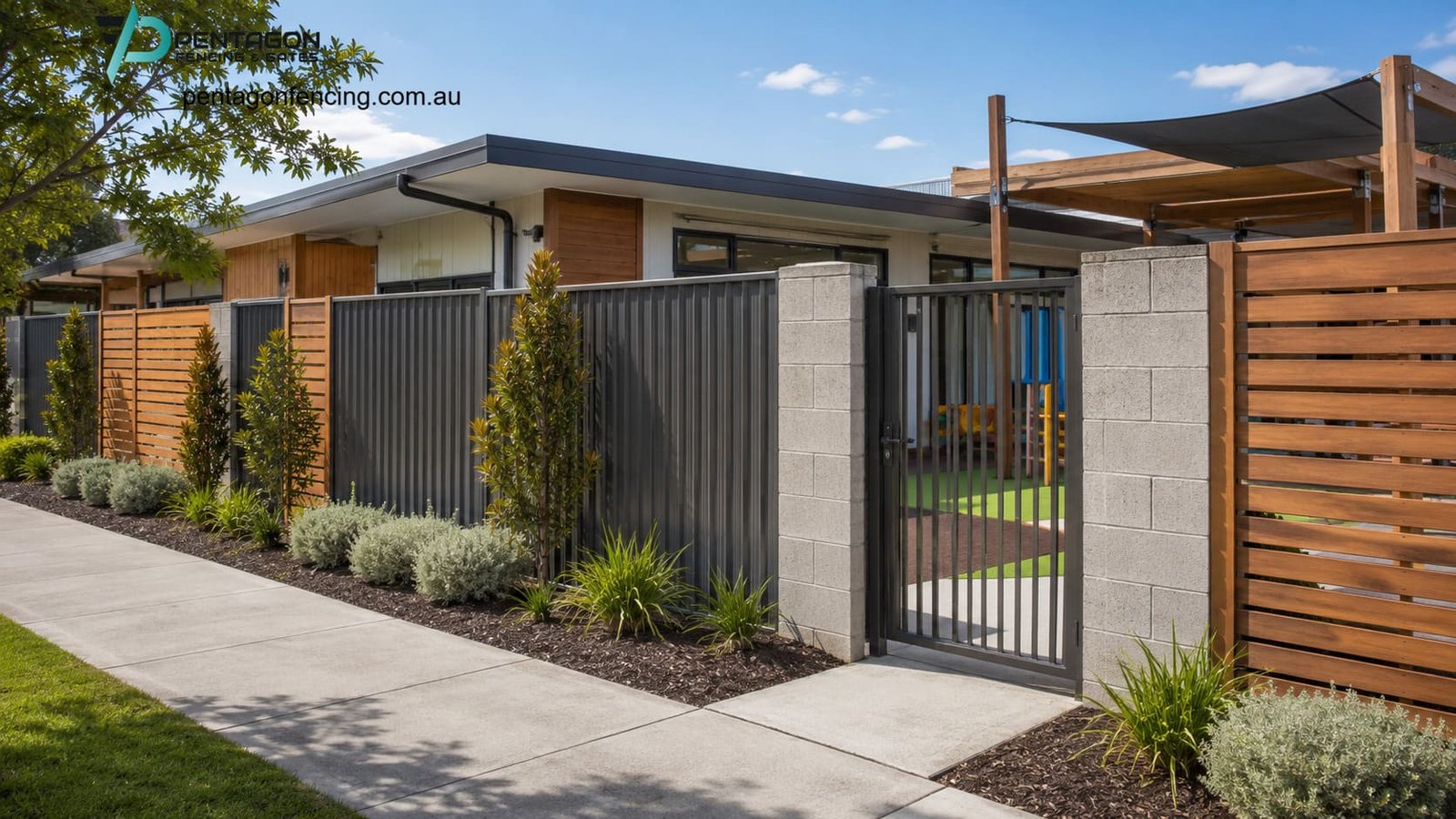
This is especially important because school fencing has competing requirements. It may need to discourage unauthorised access while still allowing teachers and staff to supervise. It may need to protect children without creating sharp top details. It may need to guide visitors toward reception without turning the street frontage into a blank wall.
School safety, visibility and security matrix
The table below provides a practical decision framework for school and childcare fencing. It should be used as an early scoping tool, not as a substitute for site-specific regulatory, design or engineering advice.
| School zone | Primary concern | Fencing direction | Gate/access direction | Contractor check |
|---|---|---|---|---|
| Main student entry | Morning and afternoon peaks, supervision, visitor direction and safe movement from the street. | Use a visible, non-hostile boundary that guides students and families without hiding the entry from staff or the public realm. | Use clear pedestrian gates, signage, latch or access control, and emergency egress planning. | Ask how the design keeps student movement separate from cars, buses, deliveries and maintenance vehicles. |
| Childcare or early learning outdoor space | Children must be contained safely while educators retain supervision and emergency access. | Use non-scalable detailing and avoid climbable rails, equipment, trees or loose objects near the fence line. | Use self-closing and self-latching gate hardware where required by the setting, with latch access controlled from the appropriate side. | Check the relevant childcare, building, school and site-specific requirements before specifying height, latch and mesh details. |
| Sports court or oval boundary | Ball control, visibility, public access, after-hours use and maintenance access. | Consider weldmesh, chain wire or tubular options depending on impact, visibility and access needs. | Provide maintenance gates and supervised access points without creating hidden or unmanaged openings. | Ask about ball impact, post spacing, gate width, trip hazards and line-of-sight supervision. |
| Staff car park and service access | Vehicles, deliveries, maintenance contractors and staff movement near school users. | Use fencing or barriers to define vehicle zones and protect pedestrian paths. | Use controlled gates, clear pedestrian routes and access rules for staff, deliveries and contractors. | Ask how the gate plan supports the school Traffic Management Plan and avoids conflict during peak periods. |
| Plant, equipment or waste compound | Unauthorised access to plant, bins, utilities, maintenance areas or restricted services. | Use stronger steel or mesh enclosures where the area is restricted, while preserving required service access and visibility. | Use locks, protected latches and credentials that are restricted to authorised staff or contractors. | Ask how locks, gates, hinges, climbing aids, lighting and maintenance clearances are handled together. |
| Street-facing or public boundary | Presentation, public safety, informal surveillance, visibility and school identity. | Use transparent or partially transparent boundary types where public-facing sightlines matter. | Make the visitor gate obvious and keep vehicle gates separate where practical. | Ask whether the top profile, height and visibility are appropriate for children, visitors and public-space interface. |
Fence types for schools and childcare sites
The right fence type depends on the role of that boundary. The same school may use weldmesh around one area, rod top fencing at a public-facing boundary, aluminium picket at a softer frontage and a stronger steel enclosure around plant or restricted equipment.
| Fence type | Strong school fit | Why it can work | Watch-out | Route deeper when |
|---|---|---|---|---|
| Weldmesh fencing | School perimeters, childcare boundaries, sports interfaces and supervised areas where clear views matter. | Weldmesh can maintain sightlines while creating a rigid physical barrier; Pentagon notes that welded-wire panels can support surveillance and controlled access [6]. | Aperture, wire size, rails, fixings, gates and bottom gaps change the practical security and climb resistance. | The school is comparing anti-climb mesh, visibility, gate infill, sports impact or 358-style security. |
| Rod top or square top steel | Public-facing school boundaries, parks, childcare frontages and areas where sharp spear tops are inappropriate. | Pentagon positions rod top or square top fencing as a non-pointed steel boundary option that can support visibility around schools and public facilities [5]. | Rod top is not automatically anti-climb or compliant; spacing, rail placement, height and gate design still need review. | The project is specifically about safer public-facing steel profiles. |
| Aluminium picket or tubular-style frontage | Primary-school, childcare, church, heritage or community frontages where a softer visual language matters. | Can define the school boundary while keeping views open and reducing the visual weight of the perimeter. | Spacing, height, top profile, latch detail and climb opportunities still need child-safety review. | The project is frontage-led and needs architectural or heritage-style presentation. |
| Chain wire or chain mesh | Sports courts, ovals, ball-control areas, maintenance zones and long visible boundaries where cost-controlled coverage is useful. | It provides practical coverage and visibility across larger areas. | It should not be treated as the highest-security anti-climb answer by default, and it may be inappropriate for some childcare containment needs. | The quote depends on mesh, wire, posts, rails, height, bracing, coatings and gates. |
| Colorbond, timber or modular wall screening | Selected privacy boundaries, plant screens, bins, neighbour interfaces or acoustic/privacy areas. | Can block views and improve privacy where visibility is not the main requirement. | Solid screening can reduce supervision and informal surveillance if used at the wrong school edge. | The main problem is privacy, noise or neighbour-interface control rather than open security visibility. |
| Palisade or spear top steel | Restricted service zones, utilities or high-risk asset boundaries where a visibly restrictive perimeter is justified. | Can provide a stronger deterrent than softer frontage styles. | Pointed profiles may be unsuitable for child-facing or public-facing locations and should be routed through a risk review. | The risk is specifically high-deterrence security rather than general school boundary control. |
Safe access planning for students, staff and visitors
School fencing and gates should guide people to the correct entry. A strong boundary can still fail operationally if students use a driveway gate, visitors cannot find reception, parents wait at the wrong access point, or deliveries cross pedestrian movement during school peaks.
The Victorian Department of Education traffic management policy says schools must identify and manage risks associated with traffic on school sites. It specifically notes pedestrian and traffic interaction as a significant risk, and traffic plans should consider pick-up and drop-off, deliveries, staff and visitor car parks, special events and mobile equipment [4].
- Students: use clear pedestrian gates and routes that avoid vehicle entries and unsupervised side openings.
- Staff: provide controlled access from car parks without routing staff through delivery or maintenance gates.
- Visitors: make the correct entry visible and connected to reception, not hidden behind a service gate.
- Deliveries and contractors: separate service access from student movement where practicable, and use access rules for after-hours work.
- Emergency responders: confirm gate widths, keys, access codes or override procedures before the fence is installed.
Childcare fencing Melbourne: early learning requirements need extra care
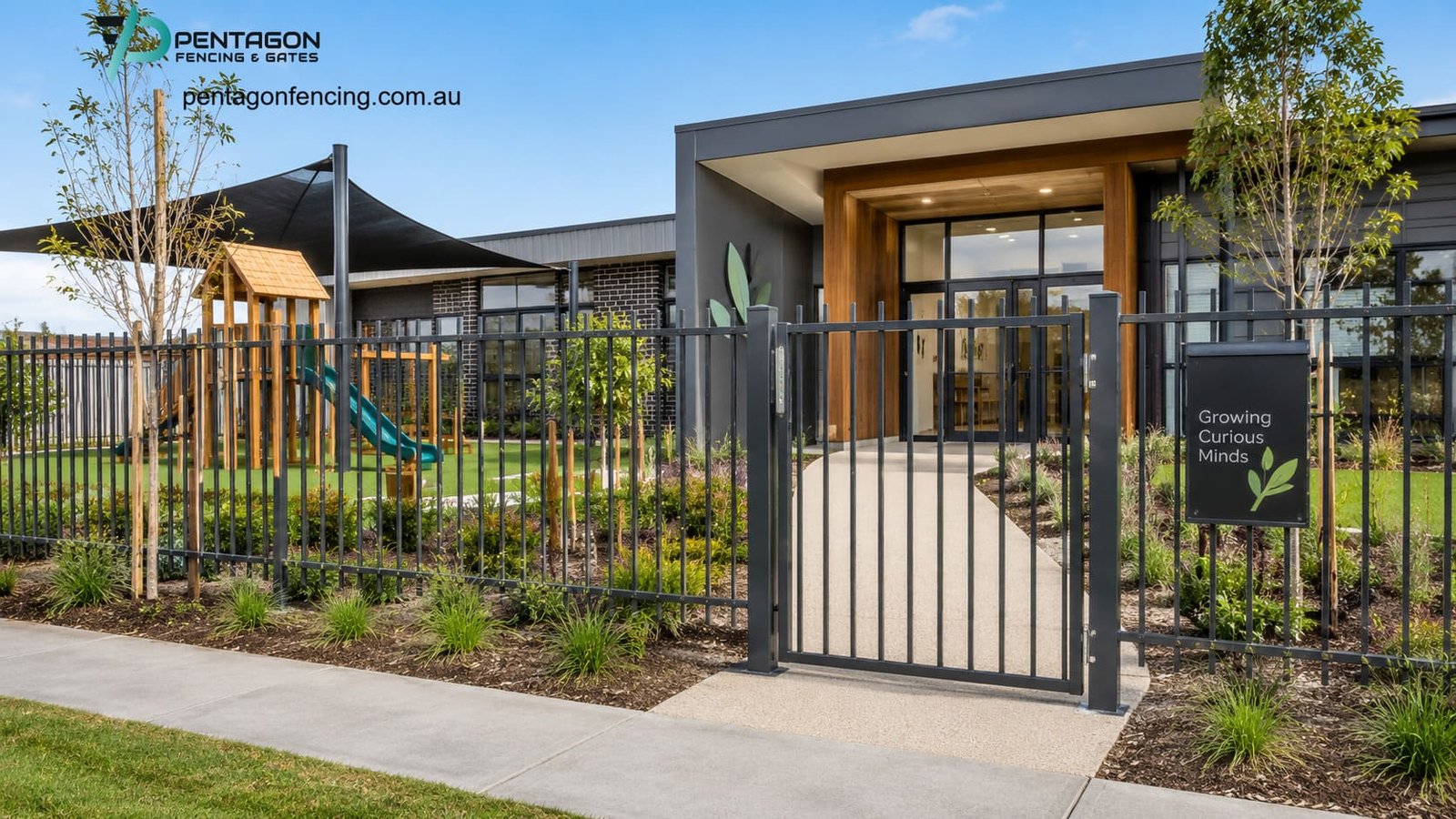
Childcare fencing Melbourne projects should not reuse a standard commercial fence scope without reviewing early learning requirements. Victorian school-building guidance states that outdoor spaces in early learning facilities must be enclosed by fencing or barriers that meet specified minimum requirements and prevent children from going through, climbing over or under, or creating entrapments. It also warns against placing objects such as equipment or landscaping elements near the fence where they could become footholds [3].
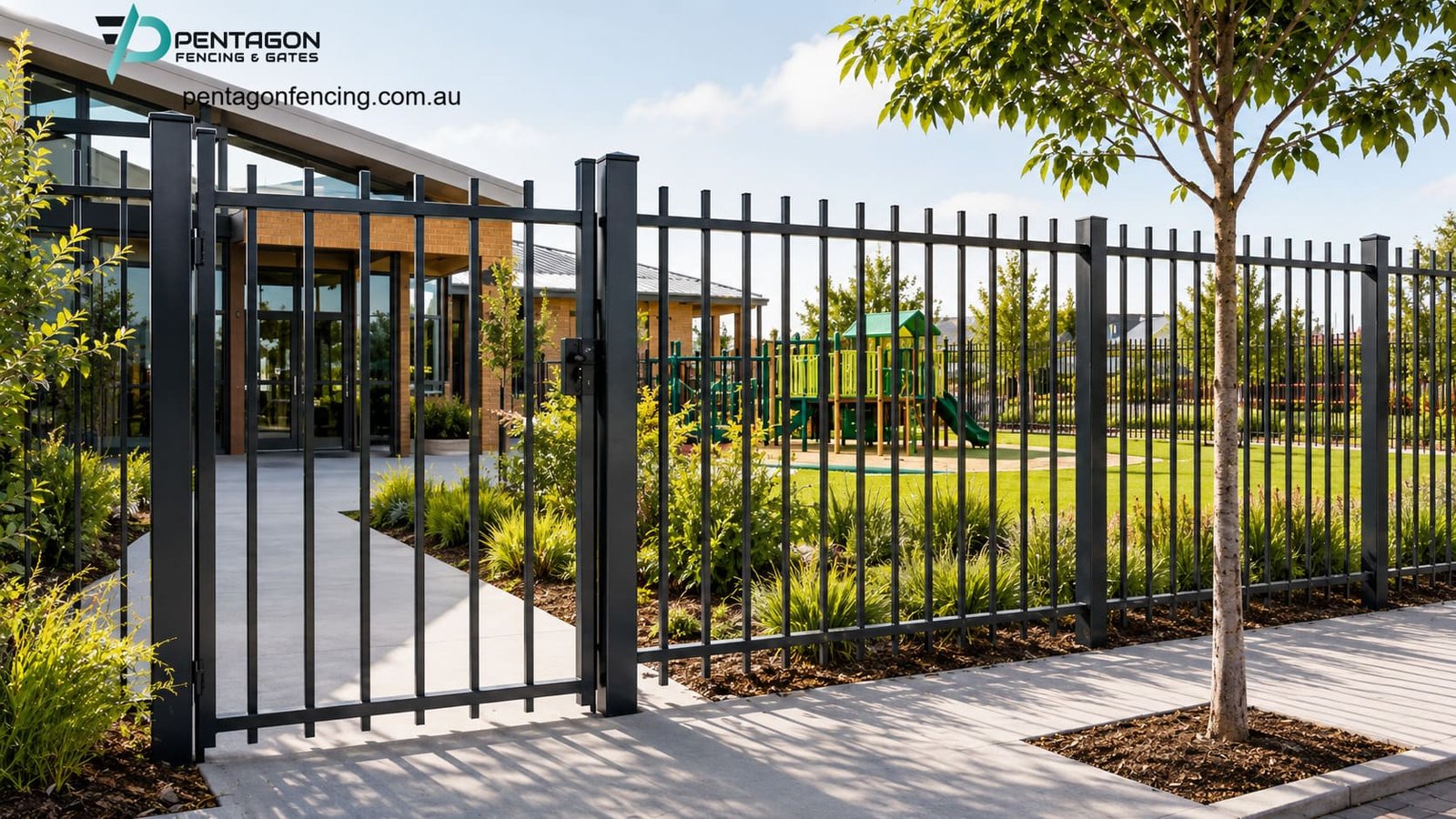
The same guidance also states that outdoor gates in early learning facilities should be self-closing and self-latching, with internal-side protection so unauthorised adults cannot reach over and open the gate; it also references high-level handles on the internal side and capture gates where exits could lead to unsafe areas [3].
For a contractor, this means the gate hardware, latch side, top profile, vertical openings, climbability, nearby equipment and maintenance access should be discussed before fabrication. A fence that looks strong can still be wrong if it creates footholds, hides children from supervision or has a gate latch that can be reached or propped open.
Pedestrian gates, access control and emergency access
Pedestrian gates are often the highest-use parts of a school boundary. They need to work for supervised arrival and departure, staff access, visitor entry, excursions, sports use, maintenance, cleaners and emergency situations.
Pentagon’s steel gate guide notes that pedestrian steel gates should provide a dedicated walk-through route where people do not need to share the vehicle opening, and that gates should match the adjoining security fence and site access flow [8]. Where gates are automated or electrically released, powered-gate safety should also be considered. HSE explains that powered-gate safety depends on how components are combined for the specific circumstances and maintained over time, and that foreseeable interaction may include children playing around or on the gate [9].
| Gate/access item | School use | Design implication | Contractor evidence to ask for |
|---|---|---|---|
| Self-closing pedestrian gate | Early learning, childcare, side entries and supervised student access points. | Closer and latch must work under real user behaviour, wind, slope and wear. | Hardware model, latch side, closer adjustment, testing method and maintenance instructions. |
| Intercom or visitor release | Visitor gate, reception-controlled entry, after-hours access or restricted campus zones. | Camera, call point and signage should make the correct entry obvious and safe to use. | Intercom location, camera view, release workflow, power, data route and fallback process. |
| Keypad, fob or swipe access | Staff, cleaners, maintenance teams and authorised contractors. | Credentials need ownership, revocation and time-based access rules. | Credential list, admin process, emergency override and documentation. |
| Vehicle gate | Staff car park, delivery access, maintenance gate, waste collection or service yard. | Should not be the main pedestrian route. Opening width, vehicle turning path and waiting area must be planned. | Gate schedule, traffic plan interface, safety devices, manual release and emergency access process. |
| Maintenance gate | Groundskeeping, sports equipment, waste, plant rooms and service contractors. | Should be locked, logged or controlled so it does not become an unsupervised shortcut. | Lock type, hinge rating, access rules, signage and inspection schedule. |
Public-facing school boundaries and visibility
Many schools and childcare centres have boundaries that sit directly beside streets, footpaths, parks or mixed-use sites. A solid or highly restrictive fence might improve privacy in one area but reduce supervision, wayfinding and public-space visibility in another.
Planning Victoria recommends that barriers and fences support amenity and safety, use highly visible materials, provide non-injurious top rail details and, on boundaries abutting a street frontage or public space, use low-height or partially transparent fence types to support informal surveillance [7].
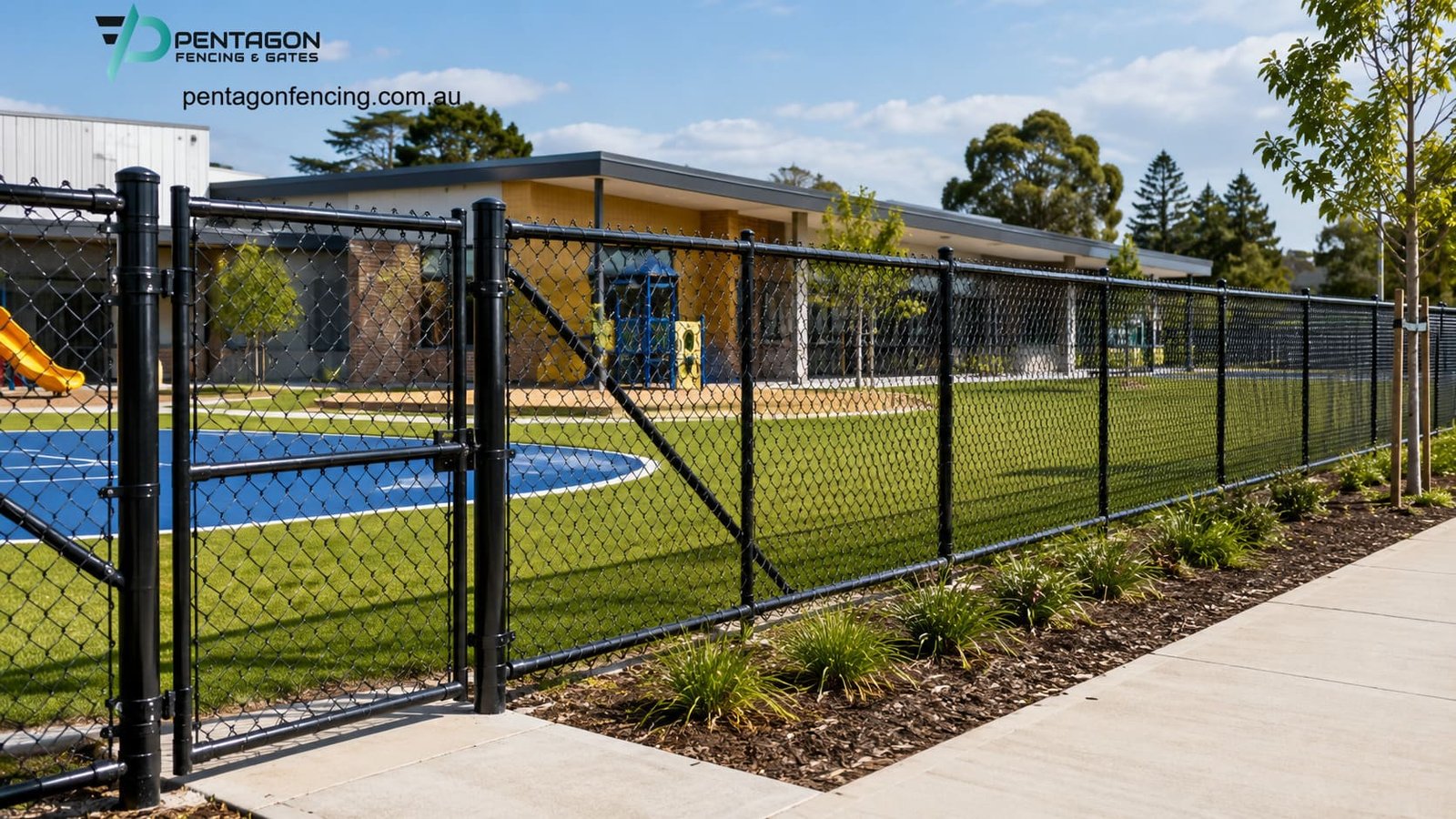
This does not mean every school fence must be low or transparent. It means the boundary should be designed by frontage. A childcare outdoor play boundary, a staff car park, a sports court and a main reception entry may need different levels of privacy, visibility, height and gate control.
Contractor selection checklist
When comparing school fencing contractors, ask for evidence that they can deliver the full package rather than only supply a fence panel. The checklist below supports contractor evaluation and quote comparison.
| Evaluation area | What to ask | Why it matters | Red flag |
|---|---|---|---|
| School-zone mapping | Can the contractor separate student entry, staff car park, childcare area, sports zone, service gate and public frontage? | Different school zones need different safety, visibility and access-control treatments. | One fence type is proposed everywhere without site-flow review. |
| Childcare and early learning awareness | Can they discuss climbability, gates, latches, supervision sightlines and nearby foothold risks? | Early learning outdoor spaces require a more cautious gate and boundary review. | They treat childcare fencing the same as a standard commercial boundary. |
| Gate and access control | Can they include pedestrian gates, vehicle gates, emergency access, locks, closers, intercoms or access-control readiness? | A safe fence can be undermined by a poorly planned gate. | Gates are added as allowances without hardware or user-flow details. |
| Visibility and top profile | Can they explain when to use weldmesh, rod top, tubular, aluminium picket, Colorbond or palisade? | School boundaries often need security without sharp, hostile or visibility-blocking design. | The recommendation relies only on appearance or price. |
| Traffic-management interface | Can the gate plan support school drop-off, deliveries, staff parking and mobile equipment routes? | Vehicle and pedestrian interaction is a significant school-site risk. | Vehicle gates and pedestrian routes are drawn without traffic review. |
| Handover and maintenance | Will they provide maintenance notes for gates, locks, hinges, panels, coatings, access hardware and inspections? | School fences are high-use assets that need ongoing checks after installation. | The quote ends at installation with no user or maintenance handover. |
Security is layered: fencing, lighting, locks and maintenance
A school fence is only one part of the boundary. Victoria Police advises businesses to install exterior lighting at entry points and boundaries, keep fences and gates well-built, maintained and secured, install good-quality locks, use cameras and alarms where relevant, and keep the boundary clear of potential climbing aids [10].
For schools and childcare centres, that translates into a layered approach:
- Use fencing to define the boundary and guide approved entry points.
- Use visibility, lighting and CCTV to support supervision where appropriate.
- Use pedestrian gates, locks and access-control hardware to manage authorised users.
- Keep play equipment, bins, planters, trees, storage and loose items from becoming footholds near the fence line.
- Inspect gate closers, hinges, locks, panels, posts, fixings and damaged finishes before small defects become normalised.
What affects school fencing cost?
Pricing should be compared by complete school-specific scope rather than by metre rate alone. A simple front fence, early learning outdoor enclosure, sports court fence and access-controlled gate package can have very different cost drivers.
| Cost driver | Effect on quote | Caveat | Evidence to request |
|---|---|---|---|
| Fence type by zone | Weldmesh, rod top, aluminium picket, chain wire, Colorbond, timber and palisade have different material and installation costs. | The lowest material price may not satisfy the school zone’s visibility, safety or access requirement. | Zone-by-zone fence schedule, height, profile, material and finish. |
| Height, posts and ground conditions | Taller or heavier systems require stronger posts, deeper footings and more installation time. | Height should follow risk, regulations, approvals and site conditions rather than being increased automatically. | Post schedule, footing assumptions, soil or pavement condition and stepped-section detail. |
| Pedestrian and vehicle gates | Self-closing gates, vehicle gates, maintenance gates, hinges, locks, closers and access control add hardware and labour. | A gate can cost and perform differently from the same width of fixed fence. | Gate schedule, latch details, access-control scope, manual release and emergency access plan. |
| Traffic and public-interface controls | Barriers, bollards, signage, lighting, line marking and pedestrian routing may be needed beyond the fence itself. | A fence-only quote can miss the access and safety controls needed for real school operation. | Traffic plan interface, pedestrian path, visibility review and signage/lighting scope. |
| Existing fence removal and staging | Removal, disposal, temporary barriers, out-of-hours work and school-term staging can change the project cost. | Live school sites may need boundaries kept secure during works. | Staging plan, temporary separation, work hours, site access and handover sequence. |
| Maintenance and handover | Inspection routines, gate adjustments, key or credential handover and coating maintenance add long-term value. | A cheaper quote can be a poor choice if it excludes documentation and maintenance guidance. | Handover pack, warranty details, maintenance intervals and defect-response process. |
Seven-step selection flow
- Map school zones. Separate student entry, childcare outdoor areas, staff car parks, sports courts, public frontages, service yards and restricted equipment areas.
- Define the risk per zone. Identify whether the issue is unauthorised access, climbing, child containment, visibility, traffic movement, privacy, vandalism or equipment protection.
- Choose fence families. Shortlist weldmesh, rod top, aluminium picket, tubular steel, chain wire, screening or stronger steel by zone.
- Plan gates early. Define pedestrian gates, vehicle gates, maintenance gates, self-closing hardware, locks, access control and emergency access before pricing.
- Review visibility and public interface. Check sightlines, frontage character, informal surveillance, non-injurious top profiles and wayfinding.
- Coordinate traffic and supervision. Align the fence with student movement, visitor entry, staff parking, deliveries and any school Traffic Management Plan.
- Compare complete scopes. Require consistent assumptions for materials, height, gates, hardware, removal, staging, approvals, maintenance and handover.
School fencing contractors Melbourne project checklist
- Site type: primary school, secondary school, childcare, early learning centre, special school, supported inclusion setting or mixed education campus.
- Boundary zones: main frontage, student gate, staff car park, visitor entry, playground, childcare outdoor space, sports zone, service yard and plant compound.
- Fence types: weldmesh, rod top, aluminium picket, tubular steel, chain wire, Colorbond, timber, modular wall, barriers or mixed fencing by zone.
- Gates: pedestrian gate, staff gate, visitor gate, maintenance gate, vehicle gate, self-closing hardware, latch side, locks and emergency access.
- Safety: climbability, non-injurious top profile, visibility, entrapment risk, child containment, nearby footholds and maintenance inspection.
- Access control: keys, fobs, intercom, keypad, electric strike, maglock, visitor release, code management and access revocation.
- Traffic interface: drop-off, pick-up, deliveries, staff parking, buses, emergency vehicles and pedestrian separation.
- Handover: product information, gate instructions, keys or credentials, warranty, maintenance schedule and defect-response process.
Common mistakes to avoid
- Choosing “maximum security” everywhere. A school also needs visibility, supervision, safe top details and a non-hostile public interface.
- Using privacy screening where supervision matters. Solid fences can be useful at selected boundaries, but they can also hide activity from staff and public view.
- Leaving pedestrian gates until the end. Gates decide how students, staff, parents, visitors and contractors actually move through the boundary.
- Ignoring childcare-specific risks. Climbable objects, reachable latches, horizontal rails, under-gate gaps and weak self-closing hardware can create serious issues.
- Comparing incomplete quotes. Fence-only pricing often excludes gates, access control, removal, staging, traffic controls, lighting, signage and handover.
- Skipping maintenance planning. A sagging gate, failed closer, damaged panel or loose lock can undermine the whole school boundary.
How Pentagon Fencing can help
Pentagon Fencing & Gates can support school and childcare fencing projects across Melbourne with steel fencing, weldmesh, rod top, tubular steel, pedestrian gates, vehicle gates and access-control-ready gate packages [1] [8].
- Map the school into safety, visibility, access and public-facing zones before selecting fence types.
- Coordinate fixed fencing with pedestrian gates, vehicle gates, self-closing hardware, locks, access control and maintenance requirements.
- Prepare a site-specific scope covering materials, gates, staging, removals, traffic interface, handover and ongoing inspection needs.
FAQ
What type of fencing is best for school security?
There is no universal best option. Weldmesh can suit visible security, rod top can suit public-facing non-pointed steel boundaries, aluminium picket can suit softer frontages, and stronger steel systems may suit restricted service zones. The right answer depends on the school zone and risk level.
Should school fencing be solid or see-through?
It depends on the boundary. See-through options can support supervision, CCTV and public-facing visibility, while solid fencing can help with privacy or screening at selected areas. The design should balance visibility, safety, privacy and site context.
What matters most for childcare fencing?
Childcare fencing should prevent young children from going through, over or under the boundary, avoid climbable features and control gate latches. Self-closing and self-latching gates, latch position and nearby objects require careful review.
Do schools need separate pedestrian and vehicle gates?
Often, yes. Separate pedestrian access can reduce interaction between students, staff, visitors, cars, buses, deliveries and maintenance vehicles. The gate plan should align with the school’s traffic-management approach.
What should school fencing contractors include in a quote?
A complete quote should include fence type, height, posts, gates, locks, closers, access-control readiness, removal work, staging, traffic interface, finishes, handover documents and maintenance requirements.
What to Keep in Mind
- Start with school zones, student movement, supervision and access needs before selecting weldmesh, rod top, aluminium picket, chain wire or screening.
- Plan pedestrian gates, vehicle gates, latches, locks, access control and emergency access with the fence, not after the perimeter is priced.
- Use visible and non-injurious boundary styles where public-facing safety, supervision and informal surveillance matter.
- Treat childcare and early learning fencing as a higher-care scope with climbability, latch position and nearby foothold risks reviewed early.
- Compare complete contractor scopes that include materials, gates, traffic interface, staging, handover and maintenance.
References
- Pentagon Fencing & Gates, “Steel Fencing Melbourne: Palisade, Weldmesh, Tubular, Rod Top and Chain Wire Options,” Pentagon Fencing & Gates. Accessed: Jun. 30, 2026. [Online]. Available: https://pentagonfencing.com.au/steel-fencing-melbourne/
- Victorian School Building Authority, “5. Technical specifications,” schoolbuildings.vic.gov.au. Accessed: Jun. 30, 2026. [Online]. Available: https://www.schoolbuildings.vic.gov.au/building-quality-standards-handbook/technical-specifications
- Victorian School Building Authority, “8. Appendix,” schoolbuildings.vic.gov.au. Accessed: Jun. 30, 2026. [Online]. Available: https://www.schoolbuildings.vic.gov.au/building-quality-standards-handbook/appendix
- Department of Education Victoria, “Traffic Management,” Policy and Advisory Library. Accessed: Jun. 30, 2026. [Online]. Available: https://www2.education.vic.gov.au/pal/traffic-management/print-all
- Pentagon Fencing & Gates, “Weldmesh Steel Fencing Melbourne: Anti-Climb Security Without Blocking Visibility,” Pentagon Fencing & Gates. Accessed: Jun. 30, 2026. [Online]. Available: https://pentagonfencing.com.au/weldmesh-steel-fencing-melbourne/
- Pentagon Fencing & Gates, “Rod Top Steel Fencing Melbourne: Safer Security for Schools, Parks and Public Facilities,” Pentagon Fencing & Gates. Accessed: Jun. 30, 2026. [Online]. Available: https://pentagonfencing.com.au/rod-top-steel-fencing-melbourne/
- Pentagon Fencing & Gates, “Steel Gates Melbourne: Matching Sliding, Swing and Pedestrian Gates to Security Fencing,” Pentagon Fencing & Gates. Accessed: Jun. 30, 2026. [Online]. Available: https://pentagonfencing.com.au/steel-gates-melbourne/
- Health and Safety Executive, “Ensuring powered doors and gates are safe,” HSE. Accessed: Jun. 30, 2026. [Online]. Available: https://www.hse.gov.uk/work-equipment-machinery/powered-gates/safety.htm
- Department of Transport and Planning Victoria, “6.4 Barriers and fences,” Planning Victoria. Accessed: Jun. 30, 2026. [Online]. Available: https://www.planning.vic.gov.au/guides-and-resources/guides/urban-design-guidelines-for-victoria/objects-in-the-public-realm/barriers-and-fences
- Victoria Police, “Business premises security,” Victoria Police. Accessed: Jun. 30, 2026. [Online]. Available: https://www.police.vic.gov.au/securing-business-premises